Browse audiobooks by Caius Marius, listen to samples and when you're ready head over to Audiobooks.com where you can get 3 FREE audiobooks on us
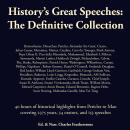
History's Great Speeches: The Definitive Collection: 40 hours of historical highlights from Pericles
"This complete edition spans 2,400 years (431 BCE–1944) in 40 hours, 155 speeches, and 52 speakers, including foundational addresses by Gandhi and Mao—voices that shaped modern Asia. Begin in 431 BCE with Demosthenes, whose structural genius remains the DNA of modern expression. Traverse Athens’ zenith via Pericles’ Funeral Oration, Alexander’s volatile proclamations, and Rome’s crisis in Cicero’s showdown with Cataline—featuring Caesar’s sole surviving senate address and Mark Antony’s incendiary eulogy. Witness rhetoric’s rebirth after a millennium: from Prophet Mohammed’s Farewell and Pope Urban II’s Crusade call, to Pico della Mirandola’s Renaissance-sparking Oration and Milton’s defiant Satan. The Reformation ignites through Luther’s 95 Theses and Calvin’s satirical Treatise on Relics, while Enlightenment firebrands Pitt, Burke, and Robespierre (whose anti-death-penalty stance mirrors Cicero) fuel revolutions. The collection illuminates seismic shifts: Luther's 95 Theses and Calvin's Treatise on Relics defining the Reformation; the Enlightenment and Revolutionary fervor articulated by Pitt, Burke, and Robespierre's chilling discourses on Terror; the birth of American liberty through Patrick Henry and Washington; and the tumultuous End of Empire featuring Napoleon's legendary addresses, Daniel O'Connell, and Frederick Douglass' searing indictments of slavery. Delve into challenges to order with anarchists Proudhon and Bakunin. Witness the forging of modern polities through Bismarck's 'Blood and Iron', Lincoln's Gettysburg Address, Susan B. Anthony's suffrage plea, and Swami Vivekananda's groundbreaking Parliament address. Chart the Rise of Socialism with William Morris, Annie Besant, and Eugene Debs' heroic workers pleas from prison. We finish with transformative modern voices: Gandhi 's South African struggle and early activism and Mao Tse-Tung's defining wartime addresses Gandhi’s early and Mao’s revolutionary manifestos."
AM Sullivan, Abraham Lincoln, Albert Apponyi, Alexander the Great, Annie Besant, Caius Memmius, Caius Marius, Catiline, Cato The Younger, Charles Phillips, Chief Joseph, Daniel O'Connell, Demosthenes, Dinarchus, Edmund Burke, Eduard Bernstein, Edward Carpenter, Elizabeth I, Emilio Castelar, Eugene Debs, Frederick Douglass, Gaetano, George Graham Vest, Girolamo Savonarola, Giuseppe Garibaldi, Huldrych Zwingli, John Calvin, Julius Caesar, Louis Kossuth, Louis Lingg, Mao Tse-Tung, Marcus Tullius Cicero, Mark Anthony, Mark Twain, Martin Luther, Maximillian Robespierre, Mikhail Bakunin, Mohandas Gandhi, Muhammad, Napoleon Bonaparte, Otto von Bismarck, Pericles, Peter Kropotkin, Phillip Melanchthon, Pico della Mirandola, Pierre-Joseph Proudhon, Pope Urban II, Red Jacket, Robert Emmet, Susan B Anthony, Swami Vivekananda, William Lloyd Garrison, William Morris, William Pitt (Author), Charles Featherstone (Narrator)
Audiobook
Civil War in the Roman Republic: A time of great civil, military and political strife that mirrors o
"While compiling and narrating these speeches, I've often been struck by how easily they could be translated into a modern day context. Frequently, a speech has reminded me of the news of the day, somewhere in the world. Nowhere has this been more evident than in these speeches. Given over two thousand years ago, every single one could be applied to situations and people today with barely any revision. The late republic (from about 133BCE) was characterized by civil discontent, with three Servile Wars, two attempted coups, a Social War between Rome and Italian allies, and endless conflict. We begin in 110-106BCE with two speeches railing against the fixed social order and corruption of the highborn, as well as the scorn poured on those of lower birth. We then jump to the Cataline Conspiracy in 63 BCE, an attempt to overthrow the Senate that was only defeated at great cost, and continued to be a symbol of Rome’s troubles. Here we see Cataline exhorting his troops, Cato arguing for harsh punishment, C icero calling Cataline every contemptible name under the sun, and the only known speech of Julius Caesar, in which he argues for a sensible and jurisprudential response to this great crime. Cicero’s leadership of Rome is then documented, covering the beliefs and actions that saw him exiled and then returned to power by the Senate. Finally, we have Mark Antony’s hagiographic oration of Julius Caesar, and then two speeches of Cicero’s railing against the perversion of Caesar’s legacy that Mark Antony was putting into practice, and the need to hold onto tradition for the right reasons, not simply to cover the misdeeds of politicians. Antony became Consul in this time, and Cicero saw in him the final downfall of the republic, which lasted for only seventeen years after this moment before becoming an Empire."
Caius Marius, Caius Memmius, Catiline, Cato The Younger, Cicero, Julius Caesar, Mark Anthony (Author), Charles Featherstone (Narrator)
Audiobook

©PTC International Ltd T/A LoveReading is registered in England. Company number: 10193437. VAT number: 270 4538 09. Registered address: 157 Shooters Hill, London, SE18 3HP.
Terms & Conditions | Privacy Policy | Disclaimer
Join our community for the latest bookish news, reading recommendations, exclusive opening extracts, author events and competitions. It\'s all free. And enter a monthly draw to win a £50 Gift Card. See past winners here
Join Our Community