Browse audiobooks narrated by Charles Featherstone, listen to samples and when you're ready head over to Audiobooks.com where you can get 3 FREE audiobooks on us
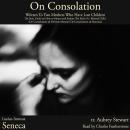
"“If you have lost a son, you have only ceased to hold him; you have not lost him. He is beyond all harm… Nature lends us children not as possessions, but as gifts that must be returned.” The two most personal letters that Seneca wrote were to his mother, after he had been exiled to Corsica, and to Marcia, who had just lost her son. In both, he consoles a mother who is overwhelmed by grief. No parent should ever lose a child, or have them taken so far away that they may never see them again. To Marcia, he gives a bracing, almost fierce call to break grief’s stranglehold. He tells her not by denying pain, but also recognise that the dead are beyond suffering, given the release nature grants all things, and that endless mourning dishonours the life she loved. To his mother Helvia, torn apart by her son’s absence and public disgrace, Seneca consoles her with the fact that exile is no great burden, and she has always been a model of virtue and strength; that his two brothers are still there, and his adopted child needs her. Written with his classic style, but a strong dose of pathos and sympathy that is often missing from his more abstract ruminations, these are letters from a son, a friend, a fellow sufferer, who is determined to heal wounds he knows firsthand. They overflow with a mix of grit and tenderness, as Seneca shows that grief, when met with reason and love, can transform into a deep, unshakeable memory, and that even the most crushing loss can become the ground on which a sturdier self is built."
Aubrey Stewart, Lucius Anneus Seneca (Author), Charles Featherstone (Narrator)
Audiobook
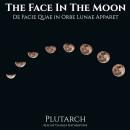
"In 100 AD, Plutarch wrote what would become the first science fiction about the civilisation on the moon, appended to a rigorous scientific analysis of current knowledge about the moon. Orbital mechanics, optics, atmospheric refraction, lunar geography, planetary and stellar composition, xenobotany, gravitation, heliocentricity, eclipse geometry and more are discussed as the state of the art is unpacked. Often startlingly modern for a work that is two millennia old, it serves as a reminder that science began long, long before norms of the modern scientific era were established. The first half reads as genuine natural philosophy. Plutarch's speakers debate the nature of the lunar surface, rejecting the notion of a perfect celestial sphere made up of fire and ether in favour of a body with mountains, valleys, and shadow-casting terrain. They examine reflected light, atmospheric optics, and the mechanics of eclipse. One speaker advances a proto-gravitational argument: that 'down' is a local condition, that objects fall toward whatever body they belong to, and that the moon holds its own just as Earth holds ours. The second half carries that physical moon into mythological territory. A soul narrative describes the lunar surface as a way-station between lives, a realm where mind and spirit undergo staged separation before returning to the cosmos or descending again to Earth. Discussing the voyages taken as the mind separates from the soul in journeys around the moon, it serves as both theological and science-fictional. Perfect for readers drawn to the history of science and the speculations that arise from it, this book is the first known moment empirical observation and speculative reasoning combined, in what would millennia later be called hard sci fi."
Plutarch (Author), Charles Featherstone (Narrator)
Audiobook
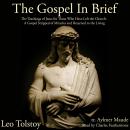
"The true teachings of Jesus, stripped of mysticism, hierarchies and rules; the philosophy of humanity's greatest teacher as 'a very strict, pure, and complete metaphysical and ethical doctrine.' From Tolstoy's preface: An examination of Christian teaching not according to interpretations [by 'the so-called Fathers of the Church'] but solely according to what has come down to us of Christ's teaching, as ascribed to him in the Gospels. If the reader belongs to the great majority of educated people brought up in the Church belief but who have abandoned its incompatibilities with common sense and conscience [and] considers all Christianity a harmful superstition—I ask him to remember that what repels him and seems to him a superstition is not the teaching of Christ; that Christ cannot be held responsible for the monstrous tradition that has been interwoven with his teaching and presented as Christianity: that to judge of Christianity, only the teaching of Christ as it has come down to us must be learned—that is, the words and actions attributed to Christ and that have an instructive meaning. Studying the teaching of Christ in that way the reader will convince himself that Christianity, far from being a mixture of the lofty and the low, or a superstition, is a very strict, pure, and complete metaphysical and ethical doctrine, higher than which the reason of man has not yet reached, and in the orbit of which (without recognizing the fact) human activity—political, learned, poetic, and philosophic—is moving. I ask [the reader] to remember that the teaching of Christ as set forth in this book is quite a different teaching [to that of the church].'"
Leo Tolstoy (Author), Charles Featherstone (Narrator)
Audiobook
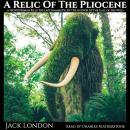
"A thousand miles beyond the nearest outpost, deep in the far north, an isolated prospector gets an unexpected visitor: a stranger named Thomas Stevens, looking for tobacco and a place by the fire. Before the night is out, Stevens has told him why he is really there, recounting how his dog and her newborn litter were trampled by a bull mammoth thirty feet long, and how he set out after the animal with nothing but a hand-axe (and taken half his store of very fine tobacco). What follows is Stevens's account of a months-long pursuit through a hidden maze of valleys, won by patience, fury, and a refusal to let the beast ever rest. He returns from the hunt with a pair of boots cut from its hide, and a story that the narrator, hedging carefully throughout, is not quite willing to either believe or deny. Jack London's 'A Relic of the Pliocene' is a tall tale told with a straight face, a piece of frontier mythmaking from the author of White Fang, The Call of the Wild, and many other foundational frontier tales."
Jack London (Author), Charles Featherstone (Narrator)
Audiobook
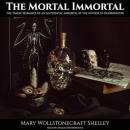
The Mortal Immortal: The Tragic Romance of an Accidental Immortal by the Author of Frankenstein
"When the alchemist Cornelius Agrippa begins work on a secret elixir, his young apprentice Winzy believes it can cure him of only one thing: his hopeless love for Bertha. In a moment of despair, he drinks it, certain he will wake indifferent to her at last. He does not. Instead, he wakes more himself than ever, and Bertha, escaping the wealthy guardian who wants her married elsewhere, finally agrees to be his wife. For years their happiness seems complete. Then Winzy notices what no one else will say aloud: while Bertha grows older, he does not change at all. Five years after that fateful night, Agrippa, dying, confesses what the elixir truly was, and the secret of Winzy's unchanging youth grows harder and harder to keep from the wife ageing beside him. Narrated by Winzy himself at the close of more than three centuries of unasked-for life, The Mortal Immortal is Mary Wollstonecraft Shelley's quiet companion piece to Frankenstein: a story less interested in monsters than in marriages, and in what happens to ordinary human love when one partner is, by accident, no longer quite human at all."
Mary Wollstonecraft Shelley (Author), Charles Featherstone (Narrator)
Audiobook
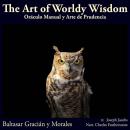
"“Absolutely unique — a book made for constant use and a companion for life' 'I have never found a book that contains such a multitude of wise rules for the conduct of life.” - Arthur Schopenhauer “Europe has never produced anything more subtle in matters of moral knowledge' 'Such a book should be every thinking person’s constant companion, read slowly, weighed ounce by ounce.” - Friedrich Nietzsche “[Gracian was] the great cartographer of the interior life” - José Ortega y Gasset In the courts of seventeenth-century Spain, a Jesuit priest distilled a lifetime of sharp observation into 300 maxims on prudence, strategy, and self‑mastery that became a sensation across Europe, with lasting influence over the centuries. Originally published in 1647 as Oráculo Manual y Arte de Prudencia, this collection of aphorisms and their commentaries was intended to offer guidance on how to live fully, advance socially, and become a better person. Drawing on careful study of statesmen and those in positions of power, Gracián crafted maxims that offer profound insight into the art of living and the practice of achieving. His secular moral reflections on reality and appearances, self-love and friendship, wit and ignorance are pragmatic, spiritual, prudent, and discreet. Together the maxims form a durable, tested companion to decision‑making and practical judgment, on how to cultivate inner substance, read others’ intentions without prejudice, and protect one’s energy from futile conflicts. Voltaire praised it for its astute observations on human nature, and Schopenhauer translated it into German, hailing it as his pocket oracle and introducing it to a new audience. It is said to have accompanied Winston Churchill on the voyage that took him to the Boer War, and André Gide was among those who admired the French edition."
Baltasar Gracián y Morales, Joseph Jacobs (Author), Charles Featherstone (Narrator)
Audiobook
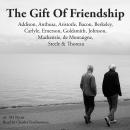
The Gift of Friendship: What the Wisest Minds Said About Our Deepest Bonds Across Two Thousand Years
"This beautifully curated anthology draws on major historical figures including Emerson, Thoreau, Carlyle, Oliver Goldsmith, Dr. Samuel Johnson, Francis Bacon, Montaigne, and Aristotle. The pieces range across themes such as the sentiment of friendship, its pleasures, and the art of choosing friends well — together forming a rich portrait of what the wisest minds across two millennia considered one of life's most essential bonds. The voices are varied in tone, era, and temperament, but united in their love and respect for friendship, the greatest of relationships. From Aristotle's philosophical precision to Emerson's idealism, Thoreau's observations and the polish of Addison and Steele., what unites them all is a shared conviction that friendship is not incidental to a good life but central to it — that to understand friendship is, in some measure, to understand what it means to be human. We find celebration of loyalty, of mutual recognition, of the rare pleasure of being truly known, alongside a frank acknowledgement of friendship's fragility, its demands, and its occasional disappointments. Together the selections build into something more than the sum of their parts: a sustained meditation on human connection that feels as pertinent today as when it was first compiled. A short but deeply rich book, it reminds us that what matters most never changes, and that a good friend is the greatest of all treasures."
Alfred H. Hyatt, Anthusa, Aristotle, Francis Bacon, George Berkeley, Henry Mackenzie, Henry David Thoreau, Joseph Addison, Michel de Montaigne, Oliver Goldsmith, Richard Steele, Samuel Johnson, Thomas Carlyle (Author), Charles Featherstone (Narrator)
Audiobook
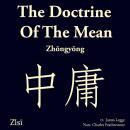
"Traditionally attributed to Confucius’s grandson Zǐsī (子思), Zhōngyōng (中庸) began as a single chapter in the Classic of Rites before being elevated to one of the Four Books (Sìshū, 四书) of classical Chinese philosophy by the Neo-Confucian scholar Zhū Xī (朱熹). It was a central text of Confucianism and, for over a milenium, anyone seeking a government position in China was expected to have mastered this short work, as well as influencing scholarship in Korea, Japan, and Vietnam. The title combines zhōng (中, meaning central, impartial, or balanced) and yōng (庸, constant or unwavering). It suggests both a balanced stance between extremes and a stable, reliable way of living. The series of 33 short meditations explores how self-cultivation and social order are fundamentally the same. It covers ideas about moderation, rectitude, sincerity, equilibrium, harmony, and lack of prejudice. The ideal person (jūnzǐ, 君子) navigates every situation without falling into excess or deficiency, holding to a golden and self-improving mean. A friend should be neither too close nor too remote; neither grief nor joy should be excessive, since unregulated happiness can be as harmful as uncontrolled sorrow. In the twentieth century, Confucianism was blamed for China’s stagnation. The May Fourth Movement attacked the Four Books as relics of a feudal past, and the Cultural Revolution sought to erase them. For decades, zhōngyōng disappeared from view. In recent years mainland China has re-engaged with its classical heritage, and the Four Books have been reintroduced into schools, public life, and popular publishing, and a new generation of readers is discovering how these ancient texts speak to timeless questions about personal ethics, social order, and the search for meaning. Short enough to read in an afternoon, difficult enough to spend a lifetime thinking about, The Doctrine of the Mean remains one of the most concise and quietly demanding works in the Confucian canon."
Zisi (Author), Charles Featherstone (Narrator)
Audiobook
Cathay: Poems by Rihaku, aka Li Po/Li Bai (李白): A Mistranslated Modernist Masterpiece
"While working in London as secretary to WB Yeats, Ezra Pound by chance began a hotly controversial and widely influential book of translations from one of China’s great poets. Pound, who did not read Chinese, worked from the unfinished notes of Ernest Fenollosa, an American scholar of Japanese art. The volume draws heavily on the work of Rihaku (the Japanese name for Li Bai, 李白), the eighth-century Tang dynasty poet known for his themes of wandering, friendship, drinking, and the natural world. From its first appearance, Cathay divided opinion. The collection influenced the direction of English-language modernist verse, but the distinguished translator Arthur Waley found Pound's versions of Li Bai's poetry so badly 'not up to par' that he retranslated several of the poems as a direct rejoinder at the School of Oriental Studies in London. Pound's defenders have argued that the poems succeed precisely because they break from the originals. Hugh Kenner says those who criticize Pound’s variations 'miss the point', as he set out to produce innovative English poems using the ancient Chinese texts as 'an inspirational springboard, not a constraining template', and Ford Madox Ford said they would make him the greatest poet of his day. Michael Alexander states that many scholars consider them the best translations of Chinese to English poetry ever made, and Wenyan Guo argues that Pound's versions achieve 'the greatest fidelity to poem translation,' through the 'intensity of the emotion and the preservation of the meeting point of poetics,' reproducing the aesthetic significance of the original and achieving 'unity with the soul of the original poem'. This book marks the transition from imagism to vorticism in Pound's work, written during dark days for both him and the world. So are they great poems, great translations, or both? We will never know, but either way they remain a rare glimpse of two of history’s greatest poets."
Ezra Pound (Author), Charles Featherstone (Narrator)
Audiobook
On Leisure: Retire The Stoic Way: Seneca’s Guide to a Purposeful Retirement (De Otio)
"When and why are you justified in withdrawing from public life? In the brief but remarkably rich essay On Leisure (De Otio), the Stoic philosopher Seneca explains his choice to withdraw from public life into contemplative retirement. Born to a wealthy and literary family, Seneca was brought to Rome as an infant and educated in rhetoric and philosophy, he pursued a senatorial career, survived exile on a charge of adultery, and was recalled to Rome to be tutor and chief advisor to the young Nero. For nearly a decade he was a co-ruler of the empire, accumulating extraordinary wealth and influence while navigating the lethal politics of the imperial court. By the time he wrote De Otio, he was in his mid-sixties, increasingly marginalised as Nero's reign darkened, his retirement was both a philosophical ideal and a matter of survival. Three years later, Nero ordered him take his own life. He did so with the composure his philosophy demanded. De Otio is Seneca's philosophical case for his own retirement. For Seneca, leisure is the active, joyful work of studying nature, nurturing the mind, and serving humanity from a place of quiet reflection. The true community served is not our city or nation, but the great commonwealth of all humans across all time. We serve that community through thought, writing, and the examined life. Although stoicism requires participation in the world, Seneca argues that withdrawal into contemplative leisure is itself be a form of service, not an abandonment of Stoic duty but a fulfilment of it at a higher level. When the political world is too corrupt or too dangerous for honest engagement, wisdom and virtue command a retreat to philosophy, study, and self-cultivation. A searching, beautifully argued meditation on where a life's real work lies, and on the courage it can take to claim the space to pursue it, this is Seneca's timeless handbook for a meaningful retirement, reminding us that a life well-spent on wisdom is no waste at all."
Aubrey Stewart, Lucius Annaeus Seneca (Author), Charles Featherstone (Narrator)
Audiobook
"Can happiness be built, or does it only arrive by chance? Seneca takes up what he calls the question everyone rushes toward without stopping to think about: what is a happy life, and how is one actually achieved? Addressed to his elder brother Gallio, this is the Stoic legend at his most ambitious and most nakedly human. De Vita Beata was composed when Seneca was in his early sixties, still formally at the centre of imperial power as Nero's chief advisor, but with the political ground already shifting beneath him. It is the work of a man surrounded by danger, reasoning out how to live well under conditions he cannot fully control. Seneca argues that happiness lies not in pleasure, wealth, acclaim, or comfort, but in a virtuous life lived in accordance with reason, in harmony with nature, and in freedom from the tyranny of desire and fear. He distinguishes true joy from the brittle satisfactions of appetite and ambition and engages with Epicurus, whose views he admired more than his fellow Stoics liked to admit. What makes De Vita Beata especially compelling is when Seneca faces his critics directly. He was one of the wealthiest men in Rome, an intimate of imperial power, and a man whose philosophical professions of detachment sat awkwardly alongside his enormous fortune. He does not flinch from this. His defence, that the wise person can possess wealth without being possessed by it, that virtue is not proved by poverty but by the correct relationship to whatever fortune provides, is argued with honesty and considerable audacity. He admits that he himself is not yet a sage, but a patient in the process of healing. A generous, practical, and deeply human meditation on what we chase and why, and on how to cultivate an inner fortress of tranquillity that fortune cannot breach."
Aubrey Stewart, Lucius Annaeus Seneca (Author), Charles Featherstone (Narrator)
Audiobook
I Ching/ Yì Jīng; The Book of Changes: 易经 The Daoist & Confucian classic of divination and cosmology
"The Classic of Changes (I Ching / Yìjīng / 易經) is one of the oldest and most enduring texts in the Chinese literary tradition, and one of the oldest books on record. The trigrams and method are classically attributed to the culture hero and legendary emperor Fu Xi (c. 2800 BCE), who also invented fishing, hunting, music, writing, laws, and the calendar. Around 1000 BCE, King Wen of Zhou combined them into the 64 hexagrams and wrote the core judgements, followed by his son the Duke of Zhou, who wrote the line texts in the following century. The appendices, or Ten Wings, are traditionally attributed to the philosopher Confucius, though Legge's commentary throws significant doubt on this attribution. Consulted for millennia as an oracle, a philosophical framework, and a guide to the patterns underlying human experience and the natural world, the Yìjīng has for millennia shaped the Confucian, Daoist, and Buddhist traditions, as well as Chinese literature, art, medicine, and statecraft. James Legge's was the first Professor of Chinese at Oxford and the principal translator of Sacred Books of the East. His translation was the first in English and remains a landmark of sinological scholarship. Included here in full are Legge's substantial introductory essays, situating the text in its historical and cultural context; his careful translation of the core text (Jīng 經) with the judgements (Tuàn 彖) and line statements; and all of the Ten Wings (Shí Yì 十翼), including the Tuànzhuàn, Xiàngzhuàn, Xìcí, Wényán, Shuōguà, Xùguà, and Záguà. A comprehensive, scholarly, and scrupulously annotated entry point into one of humanity's great classics, Legge's Yìjīng has yet to be surpassed for accessibility combined with rigor. Whether you come to the Yìjīng as a student of Chinese philosophy (Zhōngguó zhéxué 中國哲學), a practitioner of divination, or simply a curious reader seeking a window into the deepest currents of Chinese thought, this edition serves as an invaluable companion."
Fu Xi, James Legge (Author), Charles Featherstone (Narrator)
Audiobook
©PTC International Ltd T/A LoveReading is registered in England. Company number: 10193437. VAT number: 270 4538 09. Registered address: 157 Shooters Hill, London, SE18 3HP.
Terms & Conditions | Privacy Policy | Disclaimer
Join our community for the latest bookish news, reading recommendations, exclusive opening extracts, author events and competitions. It\'s all free. And enter a monthly draw to win a £50 Gift Card. See past winners here
Join Our Community