Browse audiobooks by Mikhail Bakunin, listen to samples and when you're ready head over to Audiobooks.com where you can get 3 FREE audiobooks on us
The Birth of Anarchism: 1849-1887
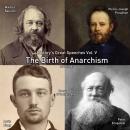
"Mankind can rule itself without the force of top-down authority, and freedom is more than just choosing how to meet the needs and demands of capital. Inequality is structural and intentional, not inevitable and necessary. It does not have to be this way. In solidarity, we are better. Think for yourself, and question authority. This is the essence of anarchism, which has a bad name and reputation because it attacks the necessity of centralised power and authority. The media archetype is Tyler Durden, filled with violence and nihilism – yet anarchism is the most positive of political philosophies, one that Jesus and Buddha both preached, stating that empathy and a rejection of authority were key to human flourishing. Neither would disagree with most early anarchists. Proudhon, whose “property is robbery” is perhaps the most well-known anarchist slogan, lays out the conceptual foundation for key anarchist ideas. He argues that usury (charging interest) is a fundamental harm to society, that there is enough for everyone if we simply take other values to be higher than capital gain, that mutualism is inevitable, and that all governments and ideologies make the same mistake, in trying to change society from the top. Positive change must arise from the great masses of humanity, not from their rulers. Bakunin's speeches are about solidarity arising from the masses, and the ground for a global reconfiguration. Louis Lingg was convicted to death with six others, for being one of the ‘Chicago Anarchists’. They were executed to make a political point, based on corrupted evidence and perjury. His statement is one of contempt for the powers that be, and his belief that mankind should be free and should fight until it is. We end with Kropotkin, who firmly believed in decentralized society. He believed that the greatest strength of mankind lies in the masses, not their rulers, and exhorts us to “Act for Yourselves”."
Louis Lingg, Mikhail Bakunin, Peter Kropotkin, Pierre-Joseph Proudhon (Author), Charles Featherstone (Narrator)
Audiobook
"'God & The State' by Mikhail Bakunin is a critical work that delves into the philosophical and political arguments against religion and the state. Bakunin, a key figure in anarchist thought, argues that both institutions are inherently oppressive and hinder human freedom and progress. He posits that religion, particularly organized religion, perpetuates a sense of dependency and submission among people, diverting them from their potential for rational thought and self-determination. The state, according to Bakunin, similarly imposes hierarchical structures that concentrate power in the hands of a few, leading to exploitation and inequality. Bakunin advocates for the abolition of both the state and religious institutions, proposing a society based on voluntary cooperation and mutual aid. He envisions a world where individuals are free to develop their capacities without coercion or domination. Bakunin's work emphasizes the importance of education and critical thinking as tools to liberate individuals from the shackles of authority and superstition. His radical vision challenges readers to reconsider the foundations of societal structures and to imagine alternative forms of organization that prioritize liberty and equality."
Mikhail Bakunin (Author), Geoffrey Giuliano, The Bell (Narrator)
Audiobook
The Birth of Anarchism: 1849-1887
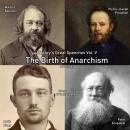
"Mankind can rule itself without the force of top-down authority, and freedom is more than just choosing how to meet the needs and demands of capital. Inequality is structural and intentional, not inevitable and necessary. It does not have to be this way. In solidarity, we are better. Think for yourself, and question authority. This is the essence of anarchism, which has a bad name and reputation because it attacks the necessity of centralised power and authority. The media archetype is Tyler Durden, filled with violence and nihilism – yet anarchism is the most positive of political philosophies, one that Jesus and Buddha both preached, stating that empathy and a rejection of authority were key to human flourishing. Neither would disagree with most early anarchists. Proudhon, whose “property is robbery” is perhaps the most well-known anarchist slogan, lays out the conceptual foundation for key anarchist ideas. He argues that usury (charging interest) is a fundamental harm to society, that there is enough for everyone if we simply take other values to be higher than capital gain, that mutualism is inevitable, and that all governments and ideologies make the same mistake, in trying to change society from the top. Positive change must arise from the great masses of humanity, not from their rulers. Bakunin's speeches are about solidarity arising from the masses, and the ground for a global reconfiguration. Louis Lingg was convicted to death with six others, for being one of the ‘Chicago Anarchists’. They were executed to make a political point, based on corrupted evidence and perjury. His statement is one of contempt for the powers that be, and his belief that mankind should be free and should fight until it is. We end with Kropotkin, who firmly believed in decentralized society. He believed that the greatest strength of mankind lies in the masses, not their rulers, and exhorts us to “Act for Yourselves”."
Louis Lingg, Mikhail Bakunin, Pierre-Joseph Proudhon, Pyotr Kropotkin (Author), Charles Featherstone (Narrator)
Audiobook

"God and the State (called by its author The Historical Sophisms of the Doctrinaire School of Communism) is an unfinished manuscript by the Russian anarchist philosopher Mikhail Bakunin, published posthumously in 1882. The work criticises Christianity and the then-burgeoning technocracy movement from a materialist, anarchist and individualist perspective. It has gone on to become Bakunin's most widely read and praised work."
Mikhail Bakunin (Author), Carl Manchester (Narrator)
Audiobook
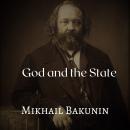
"Mikhail Bakunin (1814 -1876) was a Russian revolutionary anarchist and is considered one of the most influential figures of anarchism. Bakunin's 'God and the State', an unfinished manuscript published posthumously in 1882, is a classic and influential atheist text which sets out the anarchist critique of religion as bound up in legitimising the state. The work criticises Christianity and the technocracy movement from a materialist, anarchist and individualist perspective. God and the State is one of Bakunin's best known works which has been translated into, inter alia, Czech, German, Georgian. Dutch, Italian, Spanish, Russian, Serbo-Croatian, Polish, Greek, Romanian, Turkish and Yiddish."
Mikhail Bakunin (Author), Glen Reed (Narrator)
Audiobook
"Bakunin's most famous work, published in various lengths, this version is the most complete form of the work published hitherto. Originally titled "Dieu et l'état", Bakunin intended it to be part of the second portion to a larger work named "The Knouto-Germanic Empire and the Social Revolution" (Knouto-Germanic Empire is in reference to a treaty betwixt Russia and Germany at the time), but the work was never completed. (from book introduction)"
Mikhail Bakunin (Author), Carl Manchester (Narrator)
Audiobook
©PTC International Ltd T/A LoveReading is registered in England. Company number: 10193437. VAT number: 270 4538 09. Registered address: 157 Shooters Hill, London, SE18 3HP.
Terms & Conditions | Privacy Policy | Disclaimer
Join our community for the latest bookish news, reading recommendations, exclusive opening extracts, author events and competitions. It\'s all free. And enter a monthly draw to win a £50 Gift Card. See past winners here
Join Our Community