

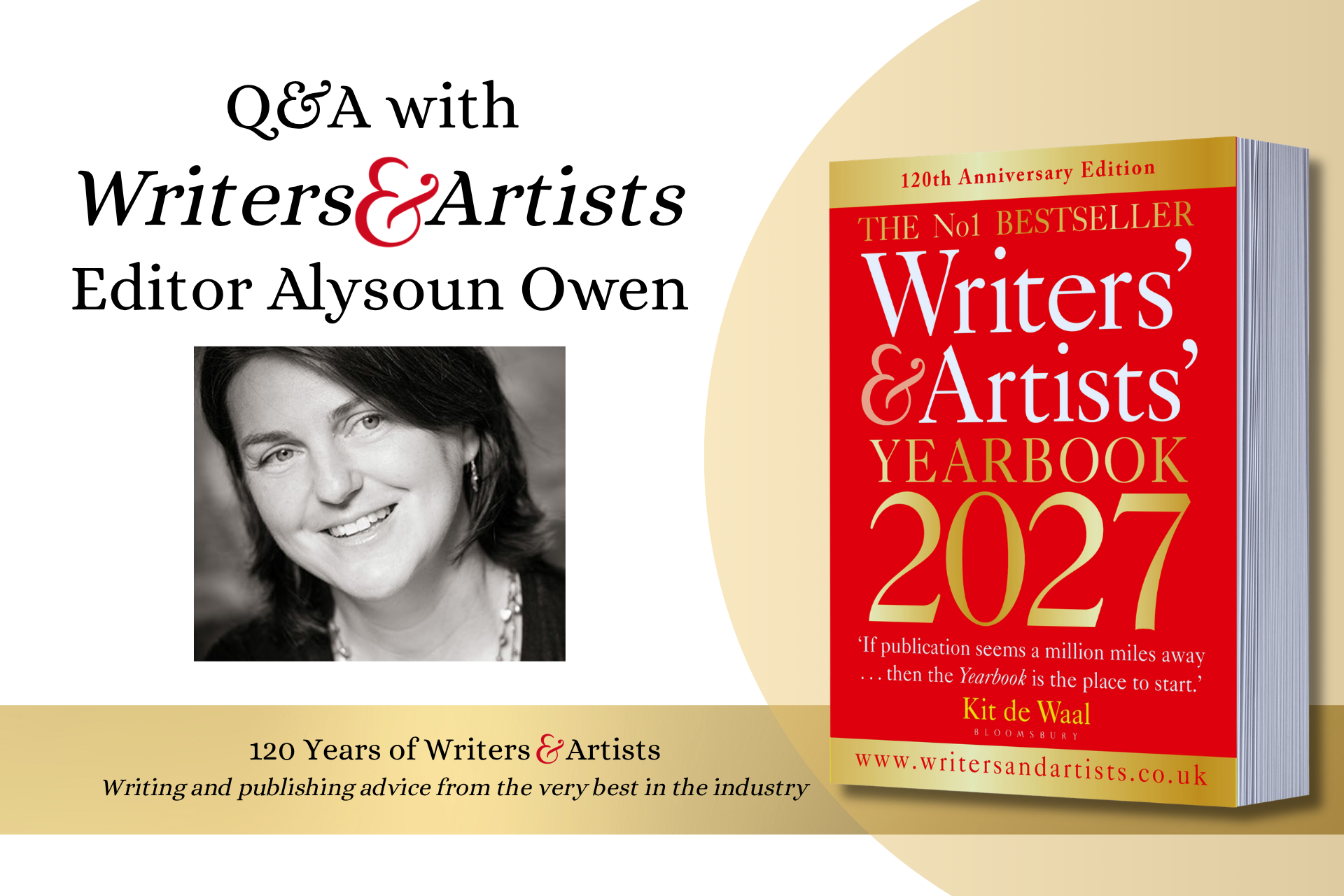
As part of our Aspiring Authors series, we’re delighted to welcome Alysoun Owen, editor of the Writers’ & Artists’ Yearbook, as it celebrates an extraordinary 120 years of supporting writers on their journey to publication. Few resources have stood the test of time in quite the same way - and fewer still remain as trusted, practical and relevant today.
We sat down with Alysoun to explore why the Yearbook continues to matter, how the industry has evolved, and what aspiring authors really need to know.
The Writers’ & Artists’ Yearbook is celebrating its 120th anniversary - what do you think has made it such a trusted companion for writers over so many decades?
The Yearbook first appeared in 1906. Published by A&C Black publishers, it was a slim, 80-page paperback pamphlet. From its inception its intention was clear: to be a ‘commercial directory for professional writers, photographers and artists, giving address, rates, time of payment’, in short somewhere to find up-to-date details of who to contact and how in one convenient publication.
We have, over these many long years, remained true to the original aims and have added topical advice articles too (these first appeared in 1917). The Yearbook is trusted in large part because of this history – it has established itself as a trustworthy, impartial and reliable brand. Readers know the information is accurate. My team of experienced editors work with the 4,500+ contacts within the book, to meticulously review and update every edition. I commission new articles each year to sit alongside some existing ones – we have 80+ each edition. We keep our noses and ears to the ground as we observe trends in publishing, know which agents move agency or set-up their own, we record when a new publisher or writing prize emerges, or when another closes. All this, and much more, we share with our readers.
Each year we add more content too. The Yearbook is really a barometer that reflects changes across the publishing and wider media industries.
The Yearbooks are trusted to help writers (and illustrators) and they have a clear track record in doing so: and that is why they continue to support writers of fiction and non-fiction (and poets, playwrights and screen writers too) across all formats, genres and age groups. Readers tell us they want a copy of the Yearbook on their shelf to remind them that they are a writer and to prompt them into action.
Authors, in reviews and interviews and in the articles they contribute to the Yearbook, attest to its need and how it helped them become a better more confident writer or to find an agent or to secure a publishing deal, usually against very high odds. It also offers up-to-date detailed information about the legal and financial aspects of being a creative.
And the publishing industry – publishers, Society of Authors, Writers’ Guild of Great Britain, literary agents – advocate for it too.
For as long as readers want this Yearbook (now a mighty 816 pages) and the advice we provide (also via our face-to-face and online events and www.writersandartists.co.uk), we will continue to provide them with the essential support they need.
In a publishing landscape that has changed so dramatically, what are the biggest shifts you’ve seen - and what has remained reassuringly the same?
Let’s start with what has remained constant. This can be categorised via two strands. One, what authors need and want, and secondly, the publishing process. As I alluded to above, authors want straightforward, impartial advice and perhaps, more than ever, when confronted by a tsunami of unfiltered information online, the Yearbook can help them navigate what can seem like daunting, unfamiliar territory.
How quickly we can publish a book and get it into the hands of readers may have changed, but the steps in doing so well and professionally haven’t really altered. Writing, submitting, editing, designing, setting, printing, marketing, selling . . . are key parts of the publishing process, as they always have been.
As to changes – dramatic and otherwise. The significant shifts have all been driven by technology, or rather the impact of technological advances on the industry and on individuals. This is an obvious and pretty seismic change. Laptops, mobiles, online bookstores, social media, BookTok together have revolutionised how we create, access, sell, buy and share content i.e. print books as well as e- and audio versions. Publishers and booksellers can now engage and communicate with readers directly and readers can be publishers and in turn in contact directly with their own readers.
It’s clear that the Age of AI has heralded new changes, not least around protection of copyright and ownership of IP (Intellectual Property) and opened a debate about what real authorship is. Anna Ganley, CEO of the Society of Authors, has written a piece all about this in the 2027 edition of the Yearbook.
There are now more routes to publication than ever before. How should aspiring authors begin to navigate these options?
The quick answer is to invest in a copy of the Yearbook!
As you say, there are more routes, which is good for the writer and good for readers too. There is the ‘traditional’ agent and publisher route, but also self-publishing in all its guises plus sponsorship and crowdfunding options too.
To decide which route to take, I suggest you ask yourself some questions. Read the advice in the Writers’ & Artists’ Yearbook so you can answer them in an informed way:
- What do I want to achieve? Do I want to publish one book or try to carve out a life as an author for the long-term? What does that entail?
- Do I have the time, resources and expertise to self-publish my own book? If so, how do I find companies and expert editors, designers etc. to help me?
- Do I know how to reach my readers directly or do I need a publisher to help me do that?
- Could I self-publish an e-book but try to get an agent and publisher to publish in print? (Publishers can get your book into libraries and high street bookshops.)
For writers seeking an agent, what are the most important things to get right when preparing a submission?
In short, I have 3 main pieces of advice:
1. Do your homework and research – look for agents in the pages of the Writers’ & Artists Yearbook that are open for submission, that represent your book’s genre and age of reader your manuscript is for and then only submit to a manageable shortlist to start with.
2. Always send agents what they want and how they want it. Typically for fiction this is a short synopsis, cover email and the first 3 chapters, but check exactly what they require by checking their websites. Some also want a writing CV. Nearly all agents expect digital submission and many want them via the online QueryManager: again, check each agency website to see what is preferred.
3. Prepare a personal email for each submission directed at each individually named agent you approach, don’t do a mail merge or write ‘Dear Sir/Madam . . .’. Be as professional as you can be. Treat submission a little like applying for a job: make sure your approach is error- and typo-free and shows you and your work in the best possible light.
Why are those all-important opening pages so critical - and what makes them stand out?
Think about how you read a new book. Unless you are very unusual, you will turn to page 1. If the opening catches your attention, you will read on and will want to know what happens next. The same is true for an agent: they are effectively your first reader. They will be looking at what grabs or entices them. Is the opening well written, does it set up an interesting scene / character / problem? Does it intrigue?
Rejection is a common part of the journey. How should writers approach and learn from it?
The poor sensitive writer who has poured themselves and their creative energies into their work, needs to develop the hide of a rhinoceros when it comes to submission. Don’t think of rejection as personal – it’s not you agents are choosing not to pursue, but your work. So, relook at that and what your submission looks like: could it be improved, how? There is some good advice about this at www.writersandartists.co.uk
Try to get writer buddies on- or off-line who you can share experiences with. A writing community is useful, so you can support each other when rejection comes and can buoy each other up – rejection is a usual part of the submission process.
With so much advice available online, why does independent, expert guidance still matter?
Absolutely. For the reasons I have articulated above. There is so much unfiltered material and advice online (some of course which is very good), that having a resource and guide that is very well-regarded and which can bring essential advice together in one place is probably more useful than ever before.
What role does the Writers’ & Artists’ Yearbook play today in helping writers cut through the noise?
I like to think we are the writer’s most trusted friend and guide.
In his Foreword to a previous edition, bestselling author Ian Rankin wrote: ‘Even established writers can feel as though they’re climbing a mountain. Think of the Writers’ & Artists’ Yearbook as your sherpa.’ That will do nicely as a succinct raison d’être for this book.
How has the way writers discover opportunities and build their careers evolved in recent years?
Tech and social media have paid a big part of course and one of the biggest influences over the last 3-4 years has been BookTok – a way for authors to reach new readers and for readers to find new authors. As a platform, it provides exciting new ways of direct engagement and agents and publishers are checking out new talent there too.
What practical steps would you recommend for someone serious about building a long-term writing career?
A few things:
- First, don’t give up your day job – just yet. Few writers get rich or earn enough to live on from writing alone.
- Write lots and lots to practise your art – try to carve out time every day if you can. Become a better writer.
- Be prepared, do your homework, make a plan, in the way you would for any other career move: think about what steps you need to take to develop your plan.
- Are there other associated activities you can earn income from as you write your novel: for example, write commercial copy?
- Once you have a published book to your name, think about other income sources: give talks in schools if you write for children etc.
For those just starting out, what’s the single most important piece of advice you would give?
Read – extensively – works of new writers, established writers, in the genre you are writing and around that genre too. The best writers are voracious readers first.
Then write. Practice. Write what you want to express, not what you think the market wants.
Looking ahead, what do you think the next decade holds for aspiring authors and the publishing industry?
I think the AI debate will ramp up and there will be more informed thinking about what its impact will be on creative professions. Some legislation will ensue and I think in some quarters there will be a backlash.
I think there will continue to be a drive to get a wide range of voices heard through the pages of a ‘book’.
I think that there will be some more interesting collaborations between creatives e.g. illustrators, podcasters, game developers, spoken word and graphic novel creators working together, so that text and image become more interactive in more original ways which we may not yet have product names for!
But, I also think human beings will continue to enjoy sitting down with a good book to lose themselves in a new world created by words. In fact, we might need that more than ever.
And finally, what does this 120-year milestone mean to you personally, and to the Yearbook’s ongoing mission?
I’m very proud of the Yearbook – of its history and that it still resonates with readers today. I’m happy to have played my part over the last 14 years in that history and to have worked with such an amazing cast of talent over that time – contributing authors and agents as well as my colleagues at Bloomsbury and the hundreds of budding authors we meet at events. They tell us how the Yearbook has helped them and in turn they help shape the content and advice we provide in our next editions.
Because each new generation produces new would-be writers and illustrators and because there are changes across the publishing industry every year, the Yearbook and our website www.writersandartists.co.uk will be around many more years to come in providing good-value, expert advice and support.


Comments (0)
Leave A Reply
You must be logged in to post a comment.