

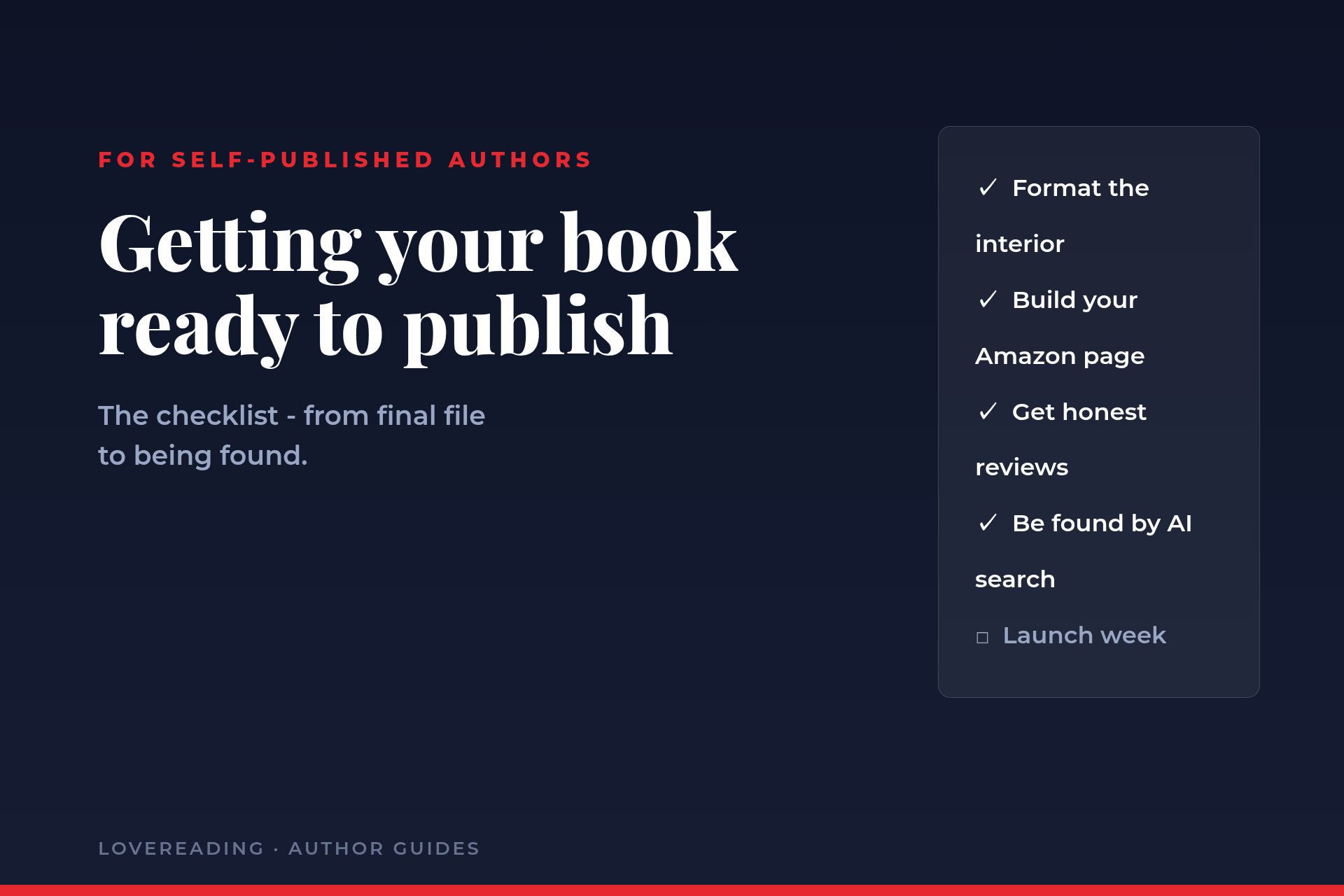
Publishing your own book means wearing every hat at once: writer, proofreader, designer, marketer. It is easy to lose track of what actually needs doing before launch day. This checklist walks through the practical steps that make the difference between a book that looks self-published and one that holds its own on the shelf, digital or otherwise.
A note on links: this guide includes links to services from publishing.co.uk, which is part of the same ownership group as LoveReading. LoveReading receives a share of fees from those services.
From manuscript to final file
Your manuscript is finished, edited and proofread - but a Word document is not a book. Print and ebook editions each have their own technical requirements: trim size, margins, gutter widths, embedded fonts, front matter order, and a table of contents that actually works on a Kindle. Amazon's KDP previewer will catch the worst errors, but it will not tell you that your paragraph spacing looks amateurish or your chapter openers are inconsistent.
You can learn the formatting rules yourself with a few evenings and a template, or hand it off - services such as publishing.co.uk's book formatting (from 69 GBP per book, with a 24-hour turnaround) will produce print-ready and Kindle-ready files for you. Either way, order a physical proof copy before you approve anything. Screens hide problems that paper reveals.
Your Amazon page is your shop window
Most readers will meet your book on its Amazon product page, so treat that page as seriously as the cover. Get the basics right first: a description written for browsers, not for you (short paragraphs, a hook in the first line); the right categories and keywords; a properly filled-in author profile via Author Central.
Then consider A+ Content - the image-rich section below the description that traditional publishers use routinely and most self-published authors ignore. It lets you show review quotes, series banners and author credentials visually. You can build it yourself in KDP's tools, or add professionally designed A+ Content design as a 39 GBP add-on if design is not your strength. It will not rescue a weak book, but it noticeably lifts how professional your page feels.
Getting honest reviews before launch
Reviews are the hardest asset for a self-published author to earn honestly. Friends and family reviews get removed; paid five-star farms can sink your account. What you want is credible, independent editorial opinion.
This is something we do here at LoveReading. Our indie author review service puts your book in front of a LoveReading ambassador, who reads it in full and provides a review plus written feedback, and your book is considered by our consumer review panel. Book Plan 1 is 120 GBP with an eight-week turnaround, Book Plan 2 is 170 GBP with a four-week turnaround, and there is a Picture Book Plan at 120 GBP. If the review is positive, your book gets a free listing on LoveReading, a chance at the Indie Books We Love badge, and a Recommended by LoveReading graphic to use in your own marketing. It is a review service, not a promotion campaign - the opinion is genuinely independent, which is exactly why a positive one carries weight.
Alongside editorial review, build a small advance reader team: readers who get the book early in exchange for an honest Amazon review in launch week. Ten genuine reviews in week one beats fifty in month six.
Being found by AI search
A growing share of book discovery now happens inside AI assistants - readers ask ChatGPT or Claude for "the best cosy crime debuts this year" rather than typing it into Google. Whether your book and author website surface in those answers depends on how clearly your online presence describes who you are and what you have written: consistent author information, structured data, pages an AI crawler can actually read.
This is a new discipline and nobody has it fully figured out yet, so be wary of anyone promising guaranteed AI rankings. A sensible first step is simply finding out where you stand: the AI Visibility Audit offers a free check of how visible you currently are to AI search, with a full report available for 29.99 GBP if you want the detail. Even the free check tells you whether this is a gap worth working on.
Launch-week basics
None of this needs a budget - just a plan written down before the day arrives:
- Set a launch date at least four weeks out and work backwards from it.
- Email your mailing list (even if it is thirty people) on launch day with a direct buy link.
- Brief your advance readers to post their reviews in the first few days.
- Prepare three or four social posts in advance so launch week is not spent writing captions.
- Tell your local bookshop and library - many actively support local authors.
- Check your product page on a phone. Most buyers will see it that way.
Above all, remember that launch week is a starting line, not a verdict. Books build slowly, and every step on this checklist keeps working for you long after the launch posts have scrolled past.
By the LoveReading editorial team
Comments (0)
Leave A Reply
You must be logged in to post a comment.