LoveReading Says
LoveReading Says
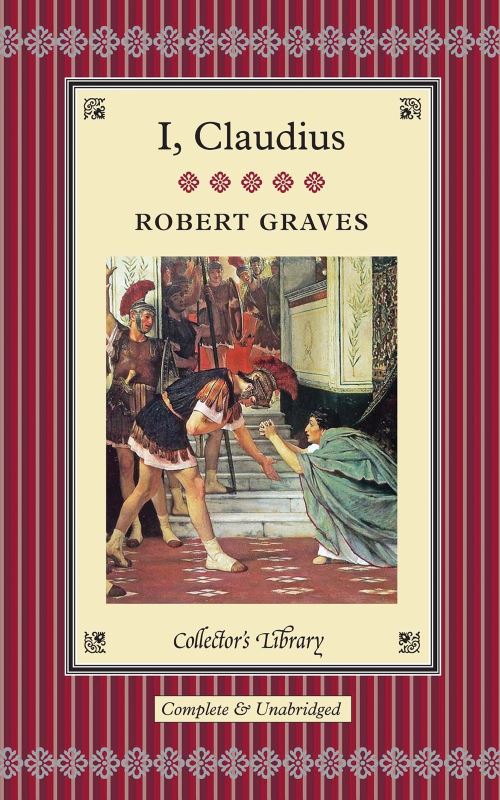
May 2014 Guest Editor Daisy Goodwin on I, Claudius...
Discovered this in my early teens and was completely hooked by the story of the rise to power of the most unlikely Roman Emperor. Graves was a classical scholar, but he never forgets that his primary role as a novelist is to tell a story. He inhabits Ancient Rome, as surely as Hilary Mantel breathes the air of the Tudor Court. Great historical novels are the ones that show us the past rather than tell us about it.
LoveReading
About I, Claudius
The Julio-Claudian family possessed all the brutality and dysfunctionality of the Sopranos, but with fewer (or no) constraints on their power to injure outsiders or each other. From this raw material Robert Graves brilliantly recreates a world of power, intrigue and cruelty, a world permeated through and through with the threat of sudden and violent death. In the process he raises striking, sometimes unanswerable questions: was Tiberius really as depraved as Suetonius suggests? Was Livia the true power behind Augustus' throne? And did she really poison all those people? Did Caligula seriously plan to make his horse a consul? Whether or not we can answer these questions, this was certainly a world in which such things could happen.
Read the full description
Find This Book In
About
I, Claudius Synopsis
The Julio-Claudian family possessed all the brutality and dysfunctionality of the Sopranos, but with fewer (or no) constraints on their power to injure outsiders or each other. From this raw material Robert Graves brilliantly recreates a world of power, intrigue and cruelty, a world permeated through and through with the threat of sudden and violent death. In the process he raises striking, sometimes unanswerable questions: was Tiberius really as depraved as Suetonius suggests? Was Livia the true power behind Augustus' throne? And did she really poison all those people? Did Caligula seriously plan to make his horse a consul? Whether or not we can answer these questions, this was certainly a world in which such things could happen.
With an Afterword by Tom Griffith.
About This Edition
| ISBN: |
9781907360800 |
| Publication date: |
1st April 2013 |
| Author: |
Robert Graves |
| Publisher: |
Macmillan Collector's Library an imprint of Macmillan |
| Format: |
Hardback |
| Pagination: |
598 pages |
| Primary Genre |
Modern and Contemporary Fiction
|
| Other Genres: |
|
| Recommendations: |
|
Press Reviews
Robert Graves Press Reviews
'I, CLAUDIUS and CLAUDIUS THE GOD are an imaginative and hugely readable account of the early decades of the Roman Empire ... racy, inventive, often comic' Daily Telegraph
'One of the really remarkable books of our day, a novel of learning and imagination, fortunately conceived and brilliantly executed' New York Times
'Still an acknowledged masterpiece and a model for historical fiction ... sympathetic and intensely involving: a great feat of imagination' -- Hilary Mantel
Author
About Robert Graves
Robert Graves was born in 1895 in Wimbledon, the son of Irish writer Perceval Graves and Amalia Von Ranke. He went from school to the First World War, where he became a captain in the Royal Welch Fusiliers. After this, apart from a year as Professor of English Literature at Cairo University in 1926, he earned his living by writing, mostly historical novels, including: I, Claudius; Claudius the God; Count Belisarius; Wife of Mr Milton; Sergeant Lamb of the Ninth; Proceed, Sergeant Lamb; The Golden Fleece; They Hanged My Saintly Billy; and The Isles of Unwisdom. He wrote his autobiography, Goodbye to All That, in 1929, and it was soon established as a modern classic. The Times Literary Supplement acclaimed it as 'one of the most candid self portraits of a poet, warts and all, ever painted', as well as being of exceptional value as a war document. Two of his most discussed non-fiction works are The White Goddess, which presents a new view of the poetic impulse, and The Nazarine Gospel Restored (with Joshua Podro), a re-examination of primitive Christianity. He also translated Apuleius, Lucan and Suetonius for the Penguin Classics, and compiled the first modern dictionary of Greek Mythology, The Greek Myths. His translation of The Rubáiyát of Omar Khayyám (with Omar Ali-Shah) is also published in Penguin. He was elected Professor of Poetry at Oxford in 1961 and made an Honorary Fellow of St John's College, Oxford, in 1971.
Robert Graves died on 7 December 1985 in Majorca, his home since 1929. On his death The Times wrote of him, 'He will be remembered for his achievements as a prose stylist, historical novelist and memorist, but above all as the great paradigm of the dedicated poet, "the greatest love poet in English since Donne".'
More About Robert Graves