Browse Ancient Civilizations audiobooks, listen to samples and when you're ready head over to Audiobooks.com where you can get 3 FREE audiobooks on us
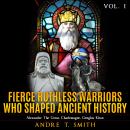
Fierce Ruthless Warriors Who Shaped Ancient History Vol. I: Alexander The Great, Charlemagne, Genghi
"Embark on a thrilling journey through ancient history with 'Fierce Ruthless Warriors Who Shaped Ancient History: Vol I,' where the lives and legacies of three legendary warrior kings - Alexander the Great, Charlemagne, and Genghis Khan - are vividly brought to life. Discover Alexander the Great, not just a conqueror but a visionary whose influence bridged diverse cultures and religions, leaving an indelible mark from Egypt to Britain. His legendary exploits, blending history and myth, reveal a figure revered across multiple cultures and religious traditions. Delve into the world of Charlemagne, the architect of modern Europe and a fervent spreader of Christianity. His ingenious military strategies, political cunning, and complex relationship with the Church, established him as a formidable Holy Roman Emperor, reshaping the West forever. Explore the epic saga of Genghis Khan, perhaps history's greatest conqueror. From an illiterate nomad to the ruler of the largest empire ever assembled, his story is one of astonishing military prowess and a complex legacy that continues to evoke awe and controversy. 'Fierce Ruthless Warriors Who Shaped Ancient History: Vol I' is a compact, engaging, and enlightening read, offering a fresh perspective on these iconic figures. Their tales, intertwining violence and heroism, politics and diplomacy, underscore their dual legacies as ruthless warriors and visionary leaders who forever altered the course of history."
Andre T. Smith (Author), Jim D. Johnston (Narrator)
Audiobook
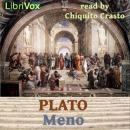
"Meno (Ancient Greek: Μένων) is a Socratic dialogue written by Plato. Written in the Socratic dialectic style, it attempts to determine the definition of virtue, or arete, meaning in this case virtue in general, rather than particular virtues, such as justice or temperance. The goal is a common definition that applies equally to all particular virtues. Socrates moves the discussion past the philosophical confusion, or aporia, created by Meno's paradox (aka the learner's paradox) with the introduction of new Platonic ideas: the theory of knowledge as recollection, anamnesis, and in the final lines a movement towards Platonic idealism.. (Introduction by Wikipedia)"
Plato (Author), Chiquito Crasto (Narrator)
Audiobook
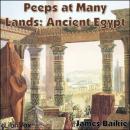
Peeps at Many Lands: Ancient Egypt
"Written primarily for children, James Baikie's 'peep' at ancient Egypt is a really well done, historical account of the ways of that fascinating land so many years ago. It has stood well the test of time, being both well researched and well written. It's a fun book for everyone, and families especially will enjoy listening together."
James Baikie (Author), Sibella Denton (Narrator)
Audiobook
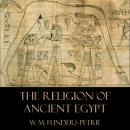
"William Matthew Flinders Petrie – the father of Egyptian Archaeology – developed and applied statistical analysis to pottery from prehistoric sites and by this established seriation as a relative dating method as a major contribution to Egyptian Archaeology. In this scientific paper he describes special varieties of the conception of the supernatural in ancient Egypt. The source text also includes a list of "principal works on Egyptian religion" and a list of works "on religions ancient and modern". (Summary by Kajo and Piotrek81)"
William Matthew Flinders Petrie (Author), LibriVox Volunteers (Narrator)
Audiobook
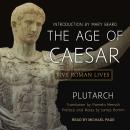
The Age of Caesar: Five Roman Lives
"Pompey, Caesar, Cicero, Brutus, Antony: the names still resonate across thousands of years. Major figures in the civil wars that brutally ended the Roman republic, their lives pose a question that haunts us still: how to safeguard a republic from the flaws of its leaders. This edition of Plutarch delivers a fresh translation of notable clarity, explanatory notes, and ample historical context."
Plutarch (Author), Michael Page (Narrator)
Audiobook
"Cyril of Alexandria was the leading voice of Nicene orthodoxy in the Christological controversies between Constantinople (381) and Chalcedon (451). Assuming the mantle of the Cappadotian fathers, he answered the auguments of Nestorius who had changed the liturgy of Constantinople by altering the prayer which referred to Mary as the Mother of God. Although he died seven years before the Council of Chalcedon, his writings and formulations heavily influenced not only Chalcedon, but the entire trajectory of orthodox christological thought. (Summary by Jonathan Lange)"
Cyril Of Alexandria (Author), LibriVox Volunteers (Narrator)
Audiobook
"The Constitution of Athens (Greek: Ἀθηναίων πολιτεία) was written by Aristotle or his student. The text was lost until discovered in the late 19th century in Egypt. Topics discussed include Solon's legislative reforms abolishing debt slavery and the rise and decline of democracy and tyranny in Athens. (Summary by Geoffrey Edwards)"
Aristotle (Author), Geoffrey Edwards (Narrator)
Audiobook
Ancient Alexandria: The History and Legacy of Egypt's Most Famous City
"Africa may have given rise to the first humans, and Egypt probably gave rise to the first great civilizations, which continue to fascinate modern societies across the globe nearly 5,000 years later. From the Library and Lighthouse of Alexandria to the Great Pyramid at Giza, the Ancient Egyptians produced several wonders of the world, revolutionized architecture and construction, created some of the world’s first systems of mathematics and medicine, and established language and art that spread across the known world. With world-famous leaders like King Tut and Cleopatra, it’s no wonder that today’s world has so many Egyptologists. The 5th century BCE Greek historian Herodotus wrote that Egypt was “the gift of the Nile” because the river made its soil so fertile and thus helped create one of the first great civilizations. Indeed, the land of Egypt so impressed the Greeks that when Alexander the Great conquered the Nile Valley in the 4th century BCE, he decided that he would build a new city on its soil and name it Alexandria. After Alexander, the city of Alexandria grew and became the most important city in the world for centuries as it watched and played a role in the rise and fall of numerous dynasties. The city also became home to one of the Seven Wonders of the Ancient World – the Lighthouse of Alexandria – and a center of culture and learning, which was exemplified by the Library of Alexandria. Truly, Alexandria was as unique as it was great; it was a Greek city built on Egyptian soil that was later ruled by the Romans and then became an important center of early Christian culture. Today, Alexandria is a teeming metropolis that, although much larger than it was in ancient times, is a shadow of its former self culturally speaking. So what made Alexandria stand apart from other ancient cities such as Rome and Babylon and how did it become the gift of the Mediterranean? The answer is complicated, but an examination of Alexandria’s history reveals that from the time the city was founded until the Arab conquest, the different dynasties who ruled there took the time and effort to foster and patronize arts, culture, and learning that made Alexandria famous. Alexandria was also an important center of trade in the ancient Mediterranean world as tons of grain, gold, and papyri sailed down the Nile River on barges to the harbors in Alexandria and then to the rest of the world, while exotic spices, silks, and other commodities were imported into Egypt via the same harbors in the ancient city. Some of the features of Alexandria changed throughout the centuries, but its most vital components remained consistent. Alexandria meant different things to different people, but for over 500 years all people saw the city as a center of culture. Ancient Alexandria: The History and Legacy of Egypt’s Most Famous City examines the history of one of the ancient world’s most important cities."
Charles River Editors (Author), Colin Fluxman (Narrator)
Audiobook
The Valley of the Kings: The History of Ancient Egypt's Most Famous Tombs and Burial Site
"Africa may have given rise to the first humans, and Egypt probably gave rise to the first great civilizations, which continue to fascinate modern societies across the globe nearly 5,000 years later. From the Library and Lighthouse of Alexandria to the Great Pyramid at Giza, the Ancient Egyptians produced several wonders of the world, revolutionized architecture and construction, created some of the world’s first systems of mathematics and medicine, and established language and art that spread across the known world. With world-famous leaders like King Tut and Cleopatra, it’s no wonder that today’s world has so many Egyptologists. Given the abundance of funerary artifacts that have been found within the sands of Egypt, it sometimes seems as though the Ancient Egyptians were more concerned with the matters of the afterlife than they were with matters of the life they experienced from day to day. One of the most abundant sources of these funerary artifacts is the Valley of the Kings, a royal necropolis located on the west bank of the Nile at Thebes. Here, pharaohs of the New Kingdom Period were buried in elaborate, treasure-filled tombs that were cut deep into the cliffs that walled the Nile Valley. In many of the royal tombs in the Valley of the Kings, intricate reliefs were painted on the walls that depicted the sun god and the dead king on their nightly journey through the underworld, which was known in Egyptian as the Duat (Wilkinson 2003, 82). These scenes, which vary slightly from tomb to tomb, are known collectively by modern scholars as The Book of Gates because they depict the sun god’s journey through 12 gates or pylons, one for each hour of the night (Wilkinson 2003, 81). As the sun god and the dead king travel through the night, they have to contend with various demons and a giant snake known as Apophis (Lesko 1991, 119). The Egyptians believed this journey was cyclical, as they viewed time itself, so it took place daily (Lesko 1991, 119). Though these tombs have been extensively plundered, they still stand as gateways to the afterlife that provide a murky window into the past of a fascinating civilization. Most importantly, the relatively untouched tomb of the young King Tutankhamun offered clear insight. Many of the objects that were discovered in Tutankhamun’s tomb were clearly made specifically for him and his burial, such as the coffins, funerary masks, canopic equipment and statues. Other objects, such as the furniture, clothing, and chariots, were obviously items that had been used during Tutankhamun’s lifetime. The motifs found upon many of his possessions depicted him in triumph over his enemies. For example, a painted wooden chest bears a fine example of such a scene; the king is shown in his chariot, followed by his troops, attacking a group of Nubians. Scenes depicting aggression and triumph over Egypt’s enemies by Egypt’s king are classical examples of Egyptian kingship."
Charles River Editors (Author), Colin Fluxman (Narrator)
Audiobook
The Parthenon: The History of Ancient Athens' Most Famous Temple
"The Acropolis, which literally means “a city on the heights,” is a citadel whose currently surviving structures were mostly built during the 5th century BCE. in honor of Athena, the patron goddess of Athens. It functioned as a sacred precinct that contained the city’s most important religious and municipal structures, many of which have remained relatively intact for over 2,000 years. The Propylaea (the gateway to the Acropolis), the Parthenon (the principal shrine to the goddess), the Erechtheion (a shrine that supposedly houses the burial grounds of mythical Athenian kings), and the Temple of Athena Nike all survive to this day, and for these reasons, the Acropolis is perhaps the definitive and most eloquent expression of classical architecture, if not of the classical form itself. Naturally, like many other works of its type and influence, the structures on the Acropolis embody certain traditions, but they also depart from some traditions and also transformed others. Indeed, just as the Acropolis is Athens’ most striking feature, it is also a perfect representative of the city’s golden age, both in terms of classical style and civilization as a whole. It’s no wonder that people continue to view the Acropolis as both a portal to antiquity but also a spot with living structures whose importance continues to reverberate to this day. The architectural complex on the Athenian Acropolis is universally acclaimed as one of the most outstanding achievements of Western Civilization, but within that group of iconic buildings there is no doubt that the Parthenon is the most famous and impressive. The Doric and Ionic forms that are the basis of classical architecture, and as applied to the Parthenon, still resonate in the modern world today, as it has done throughout the centuries since its completion. It was built to the highest possible standards at the time, and no expense was spared on either the constituent parts or its decoration. Of course, given the care and the costs, people have inevitably wondered why the Athenians put so much treasure and effort into the construction of this masterpiece, and why the temple still has such an impact on those who see it today. To fully understand this most beautiful and subtle of buildings it is necessary to contextualize its construction and its use within the Athenian religious tradition. The Parthenon has to be seen from numerous perspectives, including its historical context, its mathematical sophistication, and the myths and legends told in its sculptures and friezes. Ultimately, however, the Parthenon has to be recognised for what it was at the time, not only as a place of worship but a celebration of a momentous victory over a mighty foreign power, linked to a conscious glorification of Athens as a “cosmopolis”. There is no ambiguity; the temple was the deliberate articulation of Pericles’ vision of Athens at the height of all its glory. The Parthenon: The History of Ancient Athens’ Most Famous Temple looks at the history of the famous building, from its construction to its use."
Charles River Editors (Author), Colin Fluxman (Narrator)
Audiobook

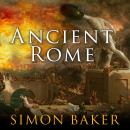
Ancient Rome: The Rise and Fall of An Empire
"This is the story of the greatest empire the world has ever known. Simon Baker charts the rise and fall of the world's first superpower, focusing on six momentous turning points that shaped Roman history. Welcome to Rome as you've never seen it before—awesome and splendid, gritty and squalid. From the conquest of the Mediterranean beginning in the third century BC to the destruction of the Roman Empire at the hands of barbarian invaders some seven centuries later, we discover the most critical episodes in Roman history: the spectacular collapse of the 'free' republic, the birth of the age of the 'Caesars,' the violent suppression of the strongest rebellion against Roman power, and the bloody civil war that launched Christianity as a world religion. At the heart of this account are the dynamic, complex, and flawed characters of some of the most powerful rulers in history: men such as Pompey the Great, Julius Caesar, Augustus, Nero, and Constantine. Putting flesh on the bones of these distant, legendary figures, Baker looks beyond the dusty, toga-clad caricatures and explores their real motivations and ambitions."
Simon Baker (Author), Chris MacDonnell (Narrator)
Audiobook
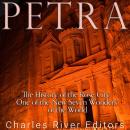
Petra: The History of the Rose City, One of the New Seven Wonders of the World
"When the European armies of the Third Crusade were defeated at the Battle of Hattin in 1187 CE, the region of what is today southern Jordan was overrun by Saladin’s armies, and over the following five centuries knowledge of Petra’s existence was lost to the people of Europe. The ancient city and center of civilization hidden in the desert became a myth, drawn largely upon Biblical accounts of the people and places in the Holy Land. However, during the Enlightenment of the early 18th century, interesting new theories emerged, and there grew a desire to rediscover the rose-red city. It was within this context that the Swiss-born explorer and orientalist Johann Ludwig Burckhardt became the known as the first European to “discover” Petra. Disguised as an Arab, he convinced a local guide to navigate him through the innumerable dangers of the Wadi Araba desert in pursuit of the rumored tomb of Aaron and a timeless city hidden in the hills. On Saturday, August 22nd, 1812, he ascended the high hills of southern Jordan and was led down a deep ravine, which twisted and turned through until a splendid sight was revealed before him: a secret valley filled with ruins and the dark holes of rock-cut tombs. Although his disguise had brought him that far, it also prevented him from being able to fully study the ruins or make copies of what he saw there. After spending only a day exploring the valley, his guide had grown suspicious, so he was forced to move on across the Sinai Peninsula, eventually arriving at Cairo on September 4th. This expedition marked the beginnings of everything that is known about this ancient and mysterious site. Further expeditions and archaeological investigations over the following two centuries have considerably broadened knowledge about Petra’s past, and the ruined Rose City is now an archaeological landscape that has been made famous as a UNESCO World Heritage site, a “new” wonder of the world, and as the repository of the Holy Grail in Indiana Jones and the Last Crusade. Yet, despite its fame, many people do not know about the religious beliefs, artistic creativity, technological innovation, commerce, and politics of the numerous peoples that resided there. Petra: The History of the Rose City, One of the New Seven Wonders of the World looks at the history of Petra from prehistoric times to the end of the Crusades, as well as the city’s “rediscovery” in the 19th century and how it has entered the world’s imagination since then."
Charles River Editors (Author), Colin Fluxman (Narrator)
Audiobook
©PTC International Ltd T/A LoveReading is registered in England. Company number: 10193437. VAT number: 270 4538 09. Registered address: 157 Shooters Hill, London, SE18 3HP.
Terms & Conditions | Privacy Policy | Disclaimer
Join our community for the latest bookish news, reading recommendations, exclusive opening extracts, author events and competitions. It\'s all free. And enter a monthly draw to win a £50 Gift Card. See past winners here
Join Our Community