

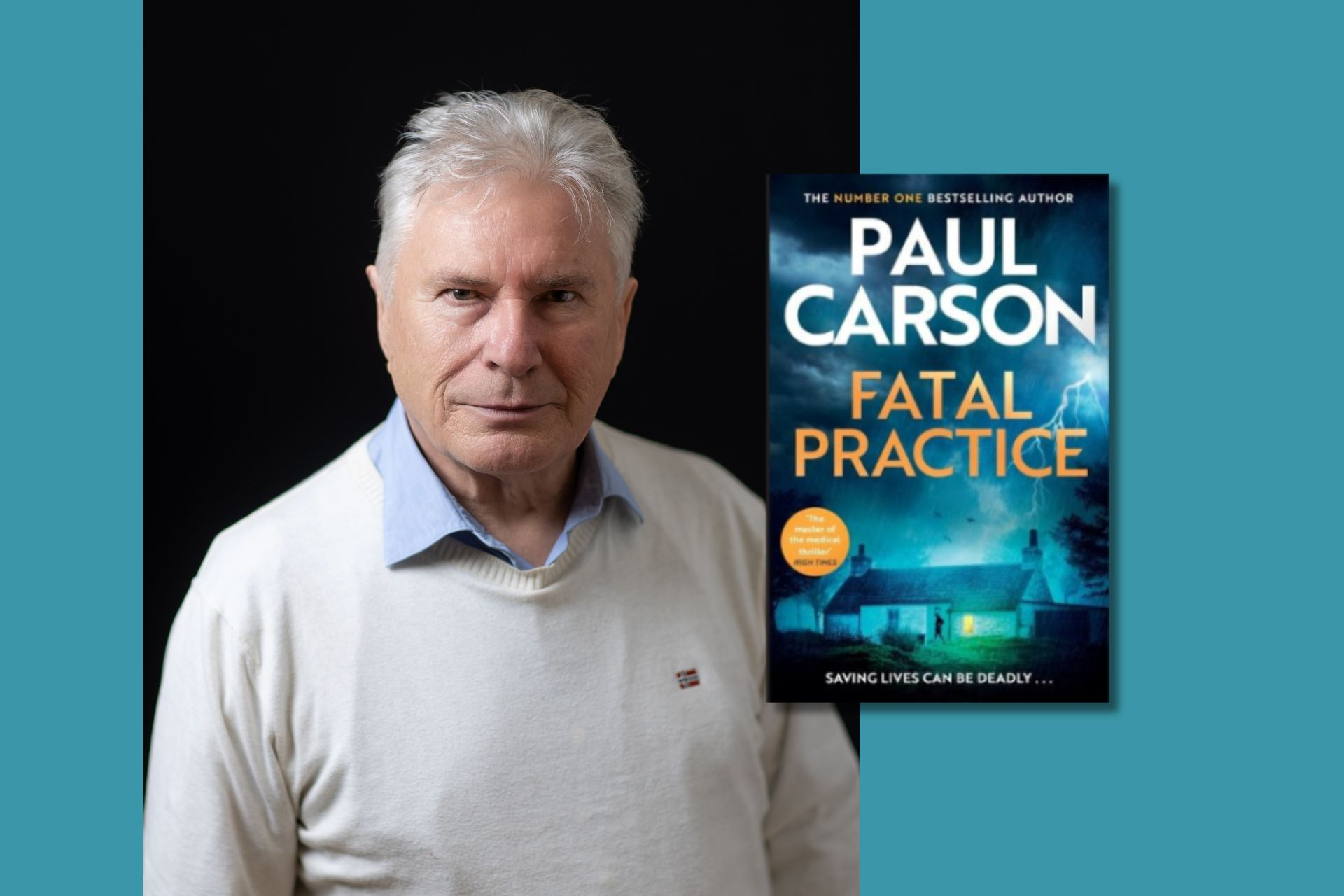
Drawing on his experience across emergency medicine, anaesthesia, paediatrics, obstetrics and general practice, Paul Carson's writing brings authenticity to the page unlike any other thriller writer. His debut, Scalpel was a #1 Irish Times bestseller for 17 consecutive weeks, and his novels have been translated into 18 languages.
Carson's latest book, Fatal Practice is the start of a new series following locum Dr Jakob Kane. Described by our Editorial Expert Liz Robinson as "Oh-so readable and intensely thought-provoking", Kane uncovers suspicious activity connected to the doctor he replaced in a novel that explores abuse of power within the medical system.
We're thrilled to get the chance to pose some questions to Paul Carson about this latest "emotionally provocative medical thriller", and discover how he's able to breathe such authenticity into his work.
Your medical knowledge adds a searing authenticity to your novels, at what point did you decide to step into the world of writing?
My writing came from necessity. After working in hospital and family medicine in Australia, the UK and Jersey (1977 – 1983), I returned to Ireland in 1984 to set up my own practice. I wrote to newspapers and magazines, offering to be a health correspondent. All I’d written to that point were prescriptions that chemists had difficulty reading! One publication wrote back: ‘We can do a weekly column if you’re any good.’ I wrote about heart disease, breathing difficulties, allergies – anything that filled a page and paid a fee.
Over the next ten years I published health books and children’s books. Driven by ‘what’s your next challenge’, I moved to fiction. My first medical thriller, Scalpel, became an Irish bestseller and opened unexpected doors into television development.
Around the same time, I was confronted by a very different challenge, leukaemia.
In 2003, I started anti-cancer therapy.
“You might live four more years.”
Enter Rituximab, newly approved for specific cancers.
And here I am, in 2026, still in remission and very well.
What areas of your career have you found connected most strongly with the type of thrillers you write?
Write about what you know: is the usual advice for writers. Doctors see drama in hospitals and family practice. We hear stories that leave us reeling. We’re sometimes exposed to extremes of human behaviour (In 1980, a dangerous psychotic patient tried to kill me by luring me into a petrol-soaked shed. It’s a long story, but obviously he didn’t succeed. As I was coaxing him out, he struck a match. Within seconds the wooden structure was engulfed in flames. He died; I didn’t.).
A GP colleague once told how he stood for an hour in the middle of a field trying to ‘talk down’ a mentally disturbed man who had a loaded shotgun pointed at his chest. And the GP’s sole protection was his doctor’s bag.
Family medicine/GP practice provides most of the material for my books. In 40+ years, I’ve dealt with a wide spectrum of human behaviour, both good and awful. Vile and saintly. Including concealed pregnancies, children put up for adoption, hidden addiction, domestic violence, financial ruin, and suicide – “an autopsy may show the cause of death, but will never reveal the thoughts coursing through a troubled mind.” I heard that at an inquest.
What is it that you think people connect to and find so fascinating about your medical thrillers?
Hospitals and surgeries are strange theatres of trust - where we surrender control. We undress. We confess. We allow strangers to examine us, sedate us, cut us open and decide whether we live or die. Trust is implicit; abuse of trust is abhorrent. That trust makes medicine fertile territory for thrillers — because betrayal in such places feels uniquely terrifying. And, possibly, that’s why readers enjoy the books. Perhaps they like being terrified, but at a distance!
They say truth is stranger than fiction, have there been times when you’ve written something and wondered how the reader will connect with it?
Many readers assume certain scenes are exaggerated or too contrived. In fact, with me, they’re based on reality. One lesson medicine taught me is that ordinary people can lead extraordinary double lives.
In a recent Substack article, I recalled the not-uncommon practice of some patients lying to the treating doctor to hide the secret underbelly of their lives. False name and address, false contact details. This leaves the doctor at a major disadvantage: how can he/she pass on test results if the patient leaves no trail? In my piece, I wrote that a well-dressed, softly spoken man signed in under a false alias. He had a serious sexually transmitted disease, and I had no way of following this up. I didn’t know who he really was. Until I spotted him in a newspaper photograph. Only then did I really know who I was dealing with.
The piece triggered a number of complaints. Most of them under (yet again) false aliases.
Tell us about how it felt to write about the abuse of power in Fatal Practice.
In Fatal Practice I wrote about what I know and it was uncomfortable because I’ve seen how power can be abused behind a respectable public face.
In the novel, a single-handed GP becomes suddenly incapacitated. A locum doctor is put in place to maintain patient care. He finds the practice strange, with unusual prescribing, missing files, worrying disclosures from patients. He’s tempted to walk away, leave the problem to someone else. “I’m a doctor, not a detective.” But his conscience won’t allow this. He has to see it through.
That was me, once upon a time.
The main character’s emotional journey in Fatal Practice is an interesting one, did he or the plot come first, how did the novel evolve?
There’s a bit (a lot?) of me in Jakob Kane. His background (son of a bible thumping pastor, dim-witted mother) isn’t mine. Belfast and Northern Ireland in the late 60s and 70s are his and my territory. There’s a scene in the book where Kane confronts a patient seeking a sick note. Kane refuses and is threatened. He doesn’t buckle. He discovers the man is a dangerous terrorist. That’s also my territory.
Rural practice in the 1980s, that’s me.
The plot was sitting in the back of my head for some time. My last book, Inquest, was on the shelves in 2013 (Random House UK). The publishers were keen to make it a series, and for a while I considered that. But it involved reading files and inspecting photographs of the dead. Including one achingly sad and disturbing suicide note. After ploughing through suicides, homicides, motor accidents, falls from heights, drowning, etcetera, I gave up. I’d already lost ten of the best years of my life to ill health. I needed a break from crime fiction.
The chance encounter with a colleague during COVID challenged my idle notions of retirement. We swapped stories: “I remember a patient with… this woman told me… it was the little boy who warned me… I thought it was all in her head.” On and on we chatted, and by the end, I knew I had another novel. I knew I had to write to keep my brain ticking over; and I knew a really good story.
Enter Dr Jakob Kane. He eyeballed me and said, “What about that encounter you told me about? Where you found out the doctor was a crook?” I was cornered. “Start writing,” he said.
I worked and reworked the storyline adding bits in, taking chunks out. The plot evolved. Some characters were strengthened, others moved into shadows. Through it all I wanted to share the life of a busy GP so readers had a sense of overwork, exhaustion and chasing the clock. One busy day drifting into another. Night calls, emergencies, deaths confirmed, deaths avoided.
At story end, readers will know only a doctor could have written Fatal Practice. And that, only a doctor could have uncovered and understood the criminality described. And that only Dr Jakob Kane knew how to end it. In his own way.
How does writing make you feel, what do you find the most difficult aspects, and what do you enjoy the most in your writing day?
Writing allows me continue my medical journey. Without the night calls, the emergencies, the asthma attacks, the heart attacks, the epileptic attacks. And so on. Now, in my 76th year, I’m using fiction to explore the dark side of medicine. It’s a challenge, which I like.
I was asked once, “Are you trying to write your way out of medicine?” I said no and that was the truth. Medicine has been my life since graduation in 1975.
It’s difficult (but not impossible) to keep the reality of a medical career out of the narrative. Names, dates, locations. If a scene is based on fact then I must disguise it so the people involved are protected. Their identities, home town, general locale must not be shared.
It’s crime fiction, not crime fact.
I enjoy putting characters in difficult situations where I have to decide if they sink or swim, are spared or doomed. What their final outcomes might be. Most time I haven’t a clue, their fictional future depends on my fertile imagination and what mood I’m in on the day! A final enjoyment is a sense of achievement at the end of a writing day. Maybe five hundred good words. Maybe a character more believable. A story readers can now relate to.
Separately, one thing I do know. Many excellent writers have to search for storylines, characters and settings. By contrast, I don’t need to look. I’ve seen it all. If only I could write proper, like a real writer.
In the nineties, publishers were said to be looking for someone to do for medicine what John Grisham had done for law. I never became that writer. But the territory remains rich, dark and largely unexplored. If you’re a doctor and reading this. Go for it.
What’s next, are you planning any more novels with Dr Jakob Kane?
I spoke with Dr Jakob Kane only last night. He was flustered and agitated and complaining.
“What do you want?” he snapped.
“There’s something I want you to check out.”
“Oh, no. I’m not going through all that again.”
“I’m sorry, Jakob,” I said. “But I can’t get it out of my head.”
“What’s it about?”
“Well,” I began. “There’s something very strange going on in….”
“I’ll pack my bags.”
We’ll be back!

Comments (0)
Leave A Reply
You must be logged in to post a comment.