

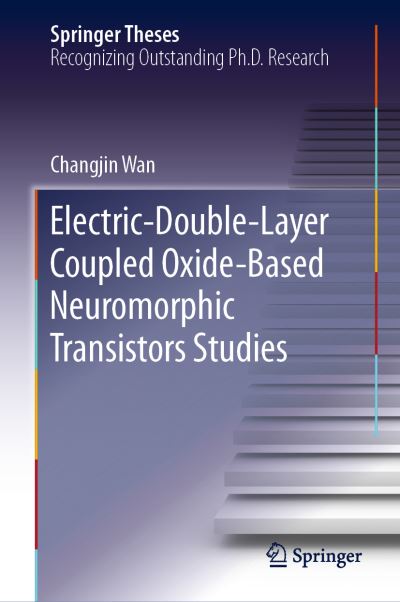
This book focuses on essential synaptic plasticity emulations and neuromorphic computing applications realized with the aid of three-terminal synaptic devices based on ion-coupled oxide-based electric-double-layer (EDL) transistors.
To replicate the robust, plastic and fault-tolerant computational power of the human brain, the emulation of essential synaptic plasticity and computation of neurons/synapse by electronic devices are generally considered to be key steps. The book shows that the formation of an EDL at the dielectric/channel interface that slightly lags behind the stimuli can be attributed to the electrostatic coupling between ions and electrons; this mechanism underlies the emulation of short-term synaptic behaviors. Furthermore, it demonstrates that electrochemical doping/dedoping processes in the semiconducting channel by penetrated ions from electrolyte can be utilized for the emulation of long-term synaptic behaviors. Lastly, it applies these synaptic transistors in an artificial visual system to demonstrate the potential for constructing neuromorphic systems. Accordingly, the book offers a unique resource on understanding the brain-machine interface, brain-like chips, artificial cognitive systems, etc.
| ISBN: | 9789811333132 |
| Publication date: | 5th February 2019 |
| Author: | Changjin Wan |
| Publisher: | Springer an imprint of Springer Nature Singapore |
| Format: | Hardback |
| Pagination: | 107 pages |
| Series: | Springer Theses |
| Genres: |
Engineering applications of electronic, magnetic, optical materials Electronics: circuits and components Condensed matter physics (liquid state and solid state physics) Neurosciences Engineering applications of bio-materials |
This book focuses on essential synaptic plasticity emulations and neuromorphic computing applications realized with the aid of three-terminal synaptic devices based on ion-coupled oxide-based electric-double-layer (EDL) transistors.
To replicate the robust, plastic and fault-tolerant computational power of the human brain, the emulation of essential synaptic plasticity and computation of neurons/synapse by electronic devices are generally considered to be key steps. The book shows that the formation of an EDL at the dielectric/channel interface that slightly lags behind the stimuli can be attributed to the electrostatic coupling between ions and electrons; this mechanism underlies the emulation of short-term synaptic behaviors. Furthermore, it demonstrates that electrochemical doping/dedoping processes in the semiconducting channel by penetrated ions from electrolyte can be utilized for the emulation of long-term synaptic behaviors. Lastly, it applies these synaptic transistors in an artificial visual system to demonstrate the potential for constructing neuromorphic systems. Accordingly, the book offers a unique resource on understanding the brain-machine interface, brain-like chips, artificial cognitive systems, etc.
Electric-Double-Layer Coupled Oxide-Based Neuromorphic Transistors Studies features in the following genres: Engineering applications of electronic, magnetic, optical materials, Electronics: circuits and components, Condensed matter physics (liquid state and solid state physics), Neurosciences, Engineering applications of bio-materials
Electric-Double-Layer Coupled Oxide-Based Neuromorphic Transistors Studies is available in Hardback
Electric-Double-Layer Coupled Oxide-Based Neuromorphic Transistors Studies was written by Changjin Wan and published by Springer an imprint of Springer Nature Singapore
Electric-Double-Layer Coupled Oxide-Based Neuromorphic Transistors Studies has 107 pages
Yes it is part of Springer Theses series