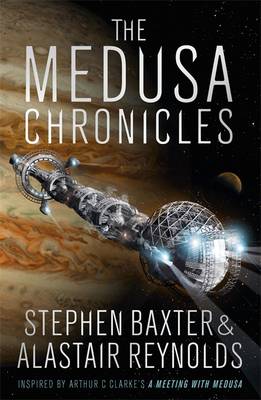
The much-lamented Arthur C. Clarke wrote the classic A Meeting with Medusa, award-winning short story in 1971 in which an alien creature is found on Jupiter. Years later, two of the best British SF writers of today have combined their talents for a worthy sequel. Following the life of Howard Falcon who discovered Medusa and is now as a result more than human, having been transformed into something of a cyborg, and is seemingly immortal as he witnesses the passing of the centuries and mankind's evolution and assists in its transition while himself evolving into a new consciousness with benevolent effect. Humanist, meditative, this is old-fashioned science fiction as evidenced by its sense of wonder and a positive attitude to scientific progress but, alongside, manages to keep the thrills on overdrive and the cosmic and planetary problems ticking along. A good read. ~ Maxim Jakubowski
Simon Spanton's view...
This is an ambitious and impressive novel sequel to Arthur C. Clarke’s short story A Meeting With Medusa. Given that, you might expect a traditional SF novel and there are many of traditional SF’s virtues here; grand scope, challenging ideas, high adventure and awe-inspiring encounters with otherness. But award-winning and bestselling authors Baxter and Reynolds are not at the forefront of modern SF without good reason this novel is also built around the very latest ecological concerns and our nervous experiments with machine intelligence. It’s a heady brew.
The story spans nearly a thousand years; much of the third millennium and follows extraordinary developments as mankind leaves earth, leaves its traditional humanity and heads out into the far solar system. It would be easy for this to feel a little remote but we are guided through these events by post human cyborg Howard Falcon. Nearly killed in an accident Falcon is now essentially a near immortal human mind in a robot body and it is with him that we both meet with the alien intelligences within Jupiter and the machine intelligences we create. Falcon is an endearingly bolshy and opinionated companion and he gives this book real heart. You’ll remember him. But you’ll also remember the extraordinary descriptions of Jupiter, of the vast sweep of centuries and the amazing transformations Baxter and Reynolds predict for us. This is a vast and dangerous future but it is also one of incredible opportunities. Fans of Kim Stanley Robinson and Peter F. Hamilton will find a similar sense of wonder here. ~ Simon Spanton
| Primary Genre | Science Fiction |
| Recommendations: |
Inspired by Sir Arthur C. Clarke's short story A Meeting with Medusa, this novel, with permission from the Clarke Estate, continues the story of Commander Howard Falcon over centuries of space-exploration, interaction with AI, first contact and beyond. All brought to life by two of our greatest SF authors, Stephen Baxter and Alastair Reynolds. Howard Falcon almost lost his life in an accident ...and a combination of human ingenuity and technical expertise brought him back. Not as himself, but as an augmented human: part man, part machine, and exceptionally capable. The Medusa Chronicles charts his journey through time, the changing interaction between humanity and our universe, and combined moments of incredible action with unparalleled exploration of and expansion into space. A compelling read from the beginning, this is classic SF which has appeal for readers who like Gravity and The Martian.
The Medusa Chronicles features in the following genres: Science Fiction, eBooks of the Month, Fiction, Recommendations
The Medusa Chronicles is available in Paperback, Hardback
The Medusa Chronicles was written by Alastair Reynolds, Stephen Baxter and published by Gollancz an imprint of Orion Publishing Co
The Medusa Chronicles has 326 pages
£9.89
-130x200.jpg)