Browse audiobooks by Hesiod, listen to samples and when you're ready head over to Audiobooks.com where you can get 3 FREE audiobooks on us
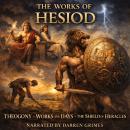
"Step into the earliest foundations of Greek myth and moral thought with The Works of Hesiod, presented here in a clear, resonant audiobook narration by Adultbrain. Written in the 8th–7th century BCE, Hesiod’s poems stand beside Homer as cornerstones of Western literature, blending myth, cosmology, ethics, and heroic tradition. Theogony An epic account of the origins of the universe and the genealogy of the gods. From Chaos to Gaia, from the Titans to the Olympians, Theogony traces the rise of Zeus and the divine order, offering a powerful vision of cosmic structure, authority, and mythic conflict. Works and Days Part moral instruction, part farming calendar, part mythological reflection, Works and Days is a deeply human poem. Addressed to Hesiod’s brother, it explores justice, labor, seasonal rhythms, and the hardships of mortal life, while recounting enduring myths such as Pandora and the Ages of Man. Shield of Heracles A vivid heroic poem centered on Heracles and his battle with the monster Cycnus. Best known for its rich and detailed description of Heracles’ shield, this work showcases early Greek epic artistry and the transition from mythic genealogy to heroic narrative. This audiobook is ideal for listeners who enjoy: Greek mythology and ancient epic poetry Foundational texts of Western philosophy and literature Thoughtful, atmospheric narration suited for study or immersive listening Whether you are discovering Hesiod for the first time or revisiting these timeless works, this audiobook brings ancient myth and wisdom to life for the modern listener."
Hesiod (Author), Darren Grimes (Narrator)
Audiobook
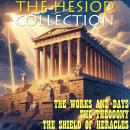
The Hesiod Collection: The Works and Days, The Theogony, The Shield of Heracles
"The Hesiod Collection presents an essential anthology of ancient Greek literature, showcasing the profound impact of Hesiod's works on the literary and philosophical traditions of the Western world. This collection features three of his most significant texts: 'The Works and Days,' 'The Theogony,' and 'The Shield of Heracles.' In 'The Works and Days,' Hesiod offers a unique blend of practical advice and moral instruction, addressing the challenges of rural life and the importance of hard work, justice, and piety. Through the lens of agrarian wisdom, he explores themes of human suffering and divine retribution, providing insights into the ethical framework of ancient Greek society. 'The Theogony' is a seminal text that details the origins and genealogies of the Greek gods, presenting a rich tapestry of mythology. Hesiod's narrative establishes a cosmic order and hierarchy among deities, influencing subsequent mythological thought and serving as a critical source for understanding ancient Greek religion. 'The Shield of Heracles' although attributed to Hesiod, is a later work that celebrates the heroism of Heracles. It vividly describes the shield crafted by Hephaestus, adorned with intricate imagery that symbolizes the struggles and triumphs of the hero, reflecting the values of bravery and honor in Greek culture. Together, these works form a foundational pillar of Western literature, offering readers a glimpse into the moral, social, and mythological landscape of ancient Greece, while highlighting Hesiod's enduring legacy as a poet and thinker. Contents: Works and days The Theogeny The Shield of Heracles"
Hesiod (Author), Peter Coates (Narrator)
Audiobook
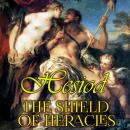
"The Shield of Heracles is an archaic Greek epic poem that was attributed to Hesiod during antiquity. The subject of the poem is the expedition of Heracles and Iolaus against Cycnus, the son of Ares, who challenged Heracles to combat as Heracles was passing through Thessaly. It has been suggested that this epic may reflect anti-Thessalian feeling after the First Sacred War (595–585 BCE): in the epic, a Thessalian hero interfering with the Phocian sanctuary is killed by a Boeotian hero (Heracles), whose mortal father Amphitryon had for allies Locrians and Phocians. This was a pastiche made to be sung at a Boeotian festival at midsummer at the hottest time of the dogstar Sirios. To serve as an introduction, fifty-six lines have been taken from the Hesiodic Catalogue of Women. The late 3rd- and early 2nd-century BCE critic Aristophanes of Byzantium, who considered the Catalogue to be the work of Hesiod, noted the borrowing, which led him to suspect that the Shield was spurious."
Hesiod (Author), Peter Coates (Narrator)
Audiobook
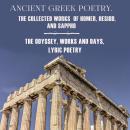
"The ancient Greeks revered Homer and Hesiod and often cited their names together in theological and theological works. While the two could have been contemporaries, some estimate that Hesiod lived up to 100 years after Homer. Sappho was an ancient Greek poetess and musician. She pioneered song lyrics and the ancient Greeks included her in the canon of nine lyric poets. Plato even numbered her among the Parnassian goddesses, referring to her as the tenth muse. The longevity of Greek ideas, images, and systems of thought bears witness to the incomparable originality of ancient Greek scientific and artistic achievements and the genius of Hellenist society. It is on the foundation of Hellenist achievements that many of our modern advancements have developed. Greek culture also significantly impacted the development of literature and education, beginning with the Romans and expanding to Europe and the West. Contents: Homer. The Odyssey. Translated by William Cowper Hesiod. Works and Days. Translated by Hugh G. Evelyn-White Sappho. The Complete Poems. Translated by John Myers O'Hara "
Hesiod, Homer, Sappho (Author), Kelli Winkler, Peter Coates (Narrator)
Audiobook
"We live in an era rife with cultural conflict. The 21st century is by no means free of wars, terrorism, riots, famine, nor epidemics. We may attempt to solve the challenges of our times by uniting the humanistic disciplines of philosophy, science, and technology. Our modern reality requires a fundamental understanding of the problems beleaguering our existence. Science and literature are key tools for gaining this insight. The wisdom accumulated throughout the centuries by scientists, philosophers, and writers is a solid foundation on which modern man can build the future. Our ability to learn from those who have come before is precisely what led Protagoras to declare that 'Man is the measure of all things.' Poetics by Aristotle The Athenian Constitution by Aristotle On Life and Death by Aristotle Agamemnon by Aeschylus The Eumenides by Aeschylus The Choephori by Aeschylus Meditations by Marcus Aurelius Medea by Euripides The Works and Days by Hesiod The Theogony by Hesiod The Shield of Heracles by Hesiod The Odyssey by Homer The Apology of Socrates by Plato Charmides by Plato Crito by Plato Euthyphro by Plato Ion by Plato Laches by Plato Lysis by Plato Menexenus by Plato The Republic by Plato The Allegory of the Cave by Plato Symposium by Plato Meno by Plato Phaedo by Plato Critias by Plato The Complete Poems by Sappho Antigone by Sophocles "
Aeschylus, Aristotle, Euripides, Hesiod, Homer, Marcus Aurelius, Plato, Sappho, Sophocles (Author), Emma Gibson, Kelli Winkler, Mark Bowen, Peter Coates, Stacey M. Patterson (Narrator)
Audiobook
"The Theogony 'the genealogy or birth of the gods' is a poem by Hesiod (8th – 7th century BC) describing the origins and genealogies of the Greek gods, composed c. 730–700 BC. It is written in the Epic dialect of Ancient Greek and contains 1022 lines. Hesiod's Theogony is a large-scale synthesis of a vast variety of local Greek traditions concerning the gods, organized as a narrative that tells how they came to be and how they established permanent control over the cosmos. It is the first known Greek mythical cosmogony. The initial state of the universe is chaos, a dark indefinite void considered a divine primordial condition from which everything else appeared. Theogonies are a part of Greek mythology which embodies the desire to articulate reality as a whole; this universalizing impulse was fundamental for the first later projects of speculative theorizing. Hesiod appropriates to himself the authority usually reserved to sacred kingship. The poet declares that it is he, where we might have expected some king instead, upon whom the Muses have bestowed the two gifts of a scepter and an authoritative voice (Hesiod, Theogony 30–3), which are the visible signs of kingship. It is not that this gesture is meant to make Hesiod a king. Rather, the point is that the authority of kingship now belongs to the poetic voice, the voice that is declaiming the Theogony."
Hesiod (Author), Peter Coates (Narrator)
Audiobook
"The earliest surviving works of ancient Greek literature, dating back to the early Archaic period, are the two epic poems the Iliad and the Odyssey. These two epics, along with the Homeric Hymns and the two poems of Hesiod, Theogony and Works and Days, comprised the major foundations of the Greek literary tradition that would continue into the Classical, Hellenistic, and Roman periods. This carefully selected collection contains: The Odyssey The Works and Days Theogony The Complete Poems of Sappho Medea Antigone Agamemnon The Choephori Eumenides The Odes of Anacreon"
Aeschylus, Anacreon, Euripides, Hesiod, Homer, Sappho, Sophocles (Author), Kelli Winkler, Mark Bowen, Peter Coates (Narrator)
Audiobook
"Beautiful Pandora is sent to earth by Zeus along with a box. Zeus gave Pandora one simple instruction—never, never open the box. After a while curiosity got the best of Pandora and she opened the box releasing sickness, sadness, and other afflictions into the world. She immediately shuts the box and there is only one thing left inside—hope. Pandora finally opens the box again and hope is spread throughout the world."
Donald Kasen, Hesiod (Author), The Peter Pan Players (Narrator)
Audiobook
"The Works and Days is a didactic poem written by the ancient Greek poet Hesiod around 700 BC. It is in dactylic hexameter and contains 828 lines. At its center, the Works and Days is a farmer's almanac in which Hesiod instructs his brother Perses in the agricultural arts. Scholars have seen this work against a background of agrarian crisis in mainland Greece, which inspired a wave of colonial expeditions in search of new land. In the poem Hesiod also offers his brother extensive moralizing advice on how he should live his life. The Works and Days is perhaps best known for its two mythological aetiologies for the toil and pain that define the human condition: the story of Prometheus and Pandora, and the so-called Myth of Five Ages."
Hesiod (Author), Peter Coates (Narrator)
Audiobook
"‘The Works and Days’ is a didactic poem of some 800 lines composed by the ancient Greek poet Hesiod. The poem deals with daily life and work, interwoven with allegory, fable and personal history. It also serves as a farmer's almanac, through which Hesiod instructs his brother Perses in the agricultural arts, and as a compendium of advice for life as a farmer. As such it opens a window on archaic Greek society, ethics, and superstition. ‘The Works and Days’ contains two mythological etiologies for the pain and trouble of the human condition, the earliest versions of the tale of Prometheus and Pandora, and of the Ages of Man."
Hesiod (Author), Victor Craig (Narrator)
Audiobook
"Hesiod was an ancient Greek poet, thought by scholars to have been active between 750 and 650 BC. Hesiod’s ‘Theogony’ is a poem describing the origins and genealogies of the Greek gods. It was sourced from various local traditions about the gods, synthesized and organized as a narrative that reveals their origin and the history of their rule over the cosmos. Hesiod declares – in the 'Kings and Singers' passage – that it is upon him, the poet, that the Muses have bestowed the visible signs of kingship, a sceptre and an authoritative voice. This means that the authority of kingship now belongs to the poet, the voice declaiming the Theogony. Instead of being a definitive source of Greek mythology, the Theogony is a snapshot of a dynamic tradition frozen in time."
Hesiod (Author), Victor Craig (Narrator)
Audiobook
"The Theogony ("Birth of the Gods") is a poem by Hesiod which describes the origin, position and relationships of the gods of the Greek pantheon. Hesiod created a synthesis of the diverse Greek traditions concerning the gods, in the form of a hymn invoking Zeus and the Muses. The Theogony is the first known Greek mythical cosmogony. However, it should not be considered as the authoritative source of Greek mythology, but rather as a portrait of a dynamic tradition that was recorded around 700 BCE. Hesiod's narrative recounts the universe's primordial state as a dark void, the emergence of the gods and how they established control over the cosmos. Life began with the spontaneous generation of four beings: Chaos (Chasm), Gaia (Earth), Tartarus (the underworld), and Eros (Desire)."
Hesiod (Author), Philip Ray (Narrator)
Audiobook
©PTC International Ltd T/A LoveReading is registered in England. Company number: 10193437. VAT number: 270 4538 09. Registered address: 157 Shooters Hill, London, SE18 3HP.
Terms & Conditions | Privacy Policy | Disclaimer
Join our community for the latest bookish news, reading recommendations, exclusive opening extracts, author events and competitions. It\'s all free. And enter a monthly draw to win a £50 Gift Card. See past winners here
Join Our Community