

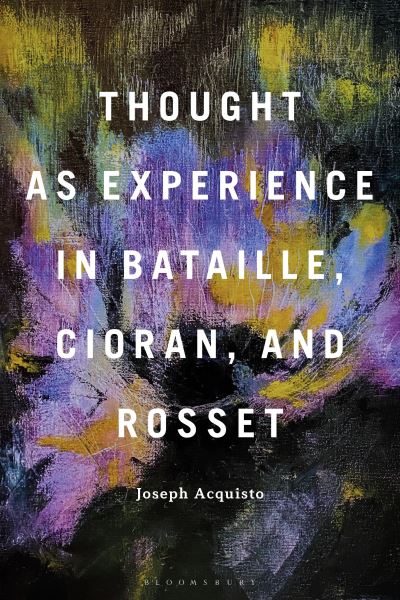
Examines how postwar French writers constitute the thinking subject and reshape its relation to the external social world. Joseph Acquisto analyzes the writings of three thinkers during and shortly after the Second World War who address the question of what it means to think, and what it means to constitute oneself as a thinking subject - at a time that seems to come "after everything"; with the ruins of attacked cities echoing the remains of a philosophical tradition that was confident in its establishment of human beings as rational, of reason leading to progress, and of both the self and the world as knowable. What Georges Bataille calls "inner experience" and Emil Cioran labels "thinking against oneself" is something akin to a drama; not a mere representation of the self in relation to the world, but a process of remapping the relation of subject to object of thought dialectically. Acquisto argues that both writers adopt an anti-systematic approach to thinking that implicates fragmentary writing as a way of turning answers about subject-object relations into questions. Acquisto contends that this stands in contrast to the approach of Clément Rosset, whose affirmation of the inaccessibility of the real leads to an anti-intellectual, grace-filled affirmation of life as it is given, under the guise of what he calls the "tragic." Bringing together thinkers that have seldom been discussed in a comparative light, Thought as Experience in Bataille, Cioran, and Rosset examines the affective dimensions of thought as experience and considers the political stakes of postwar thought as "out of order" with the world from which it springs.
| ISBN: | 9798765111239 |
| Publication date: | 11th July 2024 |
| Author: | Joseph Acquisto |
| Publisher: | Bloomsbury Academic an imprint of Bloomsbury Publishing (UK) |
| Format: | Hardback |
| Genres: |
Literary theory Phenomenology and Existentialism Western philosophy from c 1800 Comparative literature |
Examines how postwar French writers constitute the thinking subject and reshape its relation to the external social world. Joseph Acquisto analyzes the writings of three thinkers during and shortly after the Second World War who address the question of what it means to think, and what it means to constitute oneself as a thinking subject - at a time that seems to come "after everything"; with the ruins of attacked cities echoing the remains of a philosophical tradition that was confident in its establishment of human beings as rational, of reason leading to progress, and of both the self and the world as knowable. What Georges Bataille calls "inner experience" and Emil Cioran labels "thinking against oneself" is something akin to a drama; not a mere representation of the self in relation to the world, but a process of remapping the relation of subject to object of thought dialectically. Acquisto argues that both writers adopt an anti-systematic approach to thinking that implicates fragmentary writing as a way of turning answers about subject-object relations into questions. Acquisto contends that this stands in contrast to the approach of Clément Rosset, whose affirmation of the inaccessibility of the real leads to an anti-intellectual, grace-filled affirmation of life as it is given, under the guise of what he calls the "tragic." Bringing together thinkers that have seldom been discussed in a comparative light, Thought as Experience in Bataille, Cioran, and Rosset examines the affective dimensions of thought as experience and considers the political stakes of postwar thought as "out of order" with the world from which it springs.
Thought as Experience in Bataille, Cioran, and Rosset features in the following genres: Literary theory, Phenomenology and Existentialism, Western philosophy from c 1800, Comparative literature
Thought as Experience in Bataille, Cioran, and Rosset is available in Hardback
Thought as Experience in Bataille, Cioran, and Rosset was written by Joseph Acquisto and published by Bloomsbury Academic an imprint of Bloomsbury Publishing (UK)