

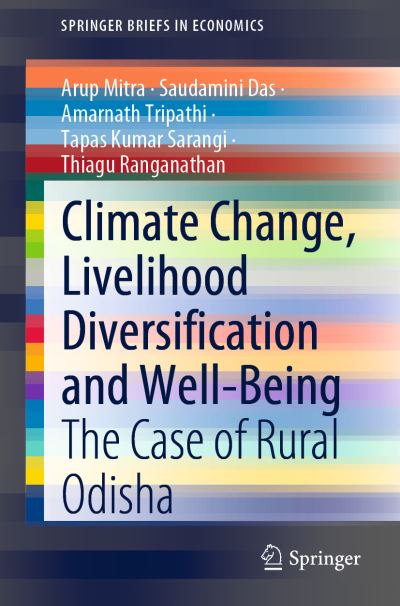
This book assesses the capacity of the rural populace in terms of their ability to perceive a change in climatic variables and, if so, how they react to these changes in order to minimize the adverse effect of climate change. It evaluates the role of education and exposure to change in physiological variables like temperature, precipitation, etc., in forming the right perception of climate change. While analysing livelihood diversification as a strategy to cope with climate change concerns across geography (districts), caste, education and the primary occupation of the households, the book also considers factors affecting diversification. One important aspect of well-being is consumption; thus, by focusing on consumption changes over time and relating it to livelihood diversification, the book makes an in-depth analysis of the coping mechanisms. Diversification adopted in the face of compulsion and in a situation of stagnancy may result in a range of low productivity activities, whereas diversification as an attempt to explore newer pathways in a vibrant context to reduce income risks and smooth consumption can be highly beneficial. The book, thus, focuses on job profile and occupational diversification of the sample households, the extent of instability in occupations and the distribution of households in terms of consumption pattern, the inter-temporal changes in it and the determinants. The book is useful for researchers, students in environmental studies, policy-makers, NGOs and also the common reader who wants to understand climate change, its effects on livelihoods and ways to overcome the shocks. It reflects on effective policies which can create awareness and empower people to explore opportunities for livelihood creation so that the overall is sustained if not improved.
| ISBN: | 9789811670480 |
| Publication date: | 25th November 2021 |
| Author: | Arup Mitra, Saudamini Das, Amarnath Tripathi, Tapas Kumar Sarangi, Thiagu Ranganathan |
| Publisher: | Springer an imprint of Springer Nature Singapore |
| Format: | Paperback |
| Pagination: | 106 pages |
| Series: | SpringerBriefs in Economics |
| Genres: |
Labour / income economics Environmental economics Ecological science, the Biosphere Climate change Sociology |
This book assesses the capacity of the rural populace in terms of their ability to perceive a change in climatic variables and, if so, how they react to these changes in order to minimize the adverse effect of climate change. It evaluates the role of education and exposure to change in physiological variables like temperature, precipitation, etc., in forming the right perception of climate change. While analysing livelihood diversification as a strategy to cope with climate change concerns across geography (districts), caste, education and the primary occupation of the households, the book also considers factors affecting diversification. One important aspect of well-being is consumption; thus, by focusing on consumption changes over time and relating it to livelihood diversification, the book makes an in-depth analysis of the coping mechanisms. Diversification adopted in the face of compulsion and in a situation of stagnancy may result in a range of low productivity activities, whereas diversification as an attempt to explore newer pathways in a vibrant context to reduce income risks and smooth consumption can be highly beneficial. The book, thus, focuses on job profile and occupational diversification of the sample households, the extent of instability in occupations and the distribution of households in terms of consumption pattern, the inter-temporal changes in it and the determinants. The book is useful for researchers, students in environmental studies, policy-makers, NGOs and also the common reader who wants to understand climate change, its effects on livelihoods and ways to overcome the shocks. It reflects on effective policies which can create awareness and empower people to explore opportunities for livelihood creation so that the overall is sustained if not improved.
Climate Change, Livelihood Diversification and Well-Being features in the following genres: Labour / income economics, Environmental economics, Ecological science, the Biosphere, Climate change, Sociology
Climate Change, Livelihood Diversification and Well-Being is available in Paperback
Climate Change, Livelihood Diversification and Well-Being was written by Arup Mitra, Saudamini Das, Amarnath Tripathi, Tapas Kumar Sarangi, Thiagu Ranganathan and published by Springer an imprint of Springer Nature Singapore
Climate Change, Livelihood Diversification and Well-Being has 106 pages
Yes it is part of SpringerBriefs in Economics series
£49.49