

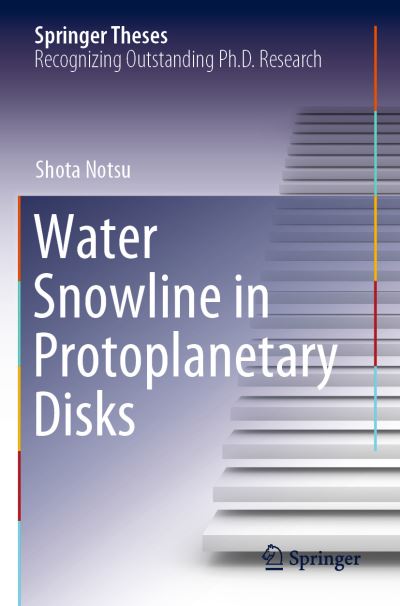
This book presents pioneering work on a critical observational test of the planet formation theory based on the theoretical study of the water snowline, beyond which water takes the form of ice, in the protoplanetary disks - the place where planets are formed. Since the water snowline is thought to divide the regions of rocky and gas-giant planet formation, the location of the snowline is essential for the planet formation process.
The book proposes a novel method to locate the snowlines using high-dispersion spectroscopic observations of water vapor lines, which is based on in sophisticated chemical modeling and line radiative transfer calculations. The author obtained the water vapor distribution in the disks using the chemical reaction network, which includes photoreactions and gas-grain interactions. The simulated transition lines of water vapor in the disks demonstrate that relatively weak transition lines with moderate excitation energies are the best tracers of water snowline.
Furthermore, the author observed submillimeter lines of water vapor in a disk using ALMA (Atacama Large Millimeter/submillimeter Array) to obtain the upper limit of the line fluxes with the highest sensitivity to date. These unprecedented findings are important in locating the snowlines in the disks, and the method goes a long way toward achieving a comprehensive understanding of the planet formation processes as well as of the origin of water on rocky planets, including our Earth, based on future observations using ALMA and SPICA (Space Infrared Telescope for Cosmology and Astrophysics).
| ISBN: | 9789811574412 |
| Publication date: | 2nd September 2021 |
| Author: | Shota Notsu |
| Publisher: | Springer an imprint of Springer Nature Singapore |
| Format: | Paperback |
| Pagination: | 134 pages |
| Series: | Springer Theses |
| Genres: |
Astronomical observation: observatories, equipment and methods Solar system: the Sun and planets |
This book presents pioneering work on a critical observational test of the planet formation theory based on the theoretical study of the water snowline, beyond which water takes the form of ice, in the protoplanetary disks - the place where planets are formed. Since the water snowline is thought to divide the regions of rocky and gas-giant planet formation, the location of the snowline is essential for the planet formation process.
The book proposes a novel method to locate the snowlines using high-dispersion spectroscopic observations of water vapor lines, which is based on in sophisticated chemical modeling and line radiative transfer calculations. The author obtained the water vapor distribution in the disks using the chemical reaction network, which includes photoreactions and gas-grain interactions. The simulated transition lines of water vapor in the disks demonstrate that relatively weak transition lines with moderate excitation energies are the best tracers of water snowline.
Furthermore, the author observed submillimeter lines of water vapor in a disk using ALMA (Atacama Large Millimeter/submillimeter Array) to obtain the upper limit of the line fluxes with the highest sensitivity to date. These unprecedented findings are important in locating the snowlines in the disks, and the method goes a long way toward achieving a comprehensive understanding of the planet formation processes as well as of the origin of water on rocky planets, including our Earth, based on future observations using ALMA and SPICA (Space Infrared Telescope for Cosmology and Astrophysics).
Water Snowline in Protoplanetary Disks features in the following genres: Astronomical observation: observatories, equipment and methods, Solar system: the Sun and planets
Water Snowline in Protoplanetary Disks is available in Paperback
Water Snowline in Protoplanetary Disks was written by Shota Notsu and published by Springer an imprint of Springer Nature Singapore
Water Snowline in Protoplanetary Disks has 134 pages
Yes it is part of Springer Theses series
£80.99