

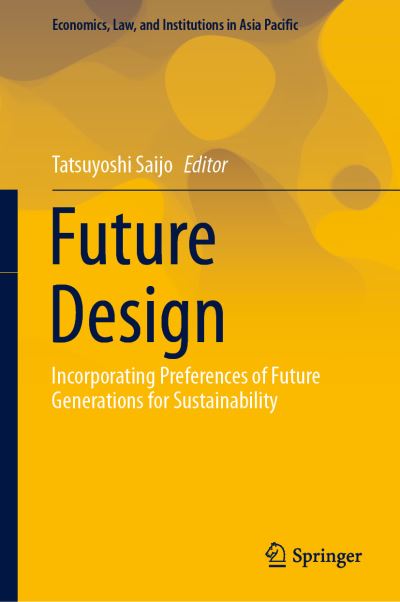
This book discusses imaginary future generations and how current decision-making will influence those future generations. Markets and democracies focus on the present and therefore tend to make us forget that we are living in the present, with ancestors preceding and descendants succeeding us. Markets are excellent devices to equate supply and demand in the short term, but not for allocating resources between current and future generations, since future generations do not exist yet. Democracy is also not "applicable" for future generations, since citizens vote for candidates who will serve members of their, i.e., the current, generation. In order to overcome these shortcomings, the authors discusses imaginary future generations and future ministries in the context of current decision-making in fields such as the environment, urban management, forestry, water management, and finance. The idea of imaginary future generations comes from the Native American Iroquois, who had strong norms that compelled them to incorporate the interests of people seven generations ahead when making decisions.
| ISBN: | 9789811554063 |
| Publication date: | 26th July 2020 |
| Author: | Tatsuyoshi Saijo |
| Publisher: | Springer an imprint of Springer Nature Singapore |
| Format: | Hardback |
| Pagination: | 227 pages |
| Series: | Economics, Law, and Institutions in Asia Pacific |
| Genres: |
Social welfare and social services Game theory Sustainability Regional, state and other local government Energy industries and utilities |
This book discusses imaginary future generations and how current decision-making will influence those future generations. Markets and democracies focus on the present and therefore tend to make us forget that we are living in the present, with ancestors preceding and descendants succeeding us.
Future Design features in the following genres: Social welfare and social services, Game theory, Sustainability, Regional, state and other local government, Energy industries and utilities
Hardback. £98.99, down from the £109.99 cover price. Not Available.
Future Design was written by Tatsuyoshi Saijo and published by Springer an imprint of Springer Nature Singapore
Future Design has 227 pages
Yes it is part of Economics, Law, and Institutions in Asia Pacific series
£98.99, reduced from £109.99. Not Available.