

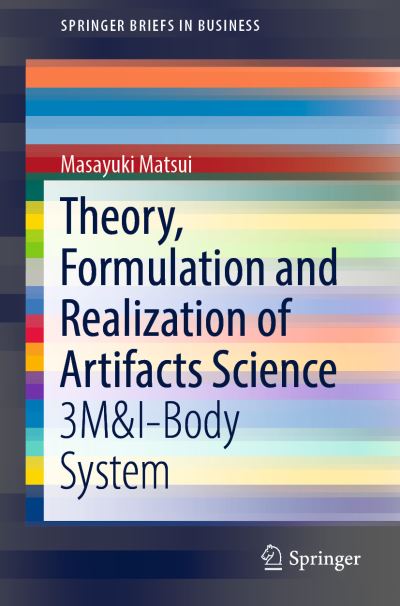
This book considers and builds on the main propositions regarding body similarity and the principles of nature versus artifacts in science. It also explores the design (matrix) power of the human, Material/Machine, Money & Information (3M&I) body with respect to productivity/gross domestic product (GDP). The book begins in 2009 with Weiner's cybernetics and describes Matsui's theory and dynamism concerning the basic equation of W = ZL and artifact formulation using matrix methods, such as Matsui's matrix equation (Matsui's ME).
In his book Fundamentals and Principles of Artifacts Science: 3M&I-Body System, published by Springer in 2016, the author championed the white-box approach for 3M&I artifacts in contrast to Simon's artificial approach from 1969. Two principles, the Sandwich (waist) and Balancing theories, and their fundamental problems, were identified. This book now proposes a third principle: the fractal/harmonic-like structure of the cosmos and life types in space and time.
The book further elaborates on the complexity of the 3M&I system and management in terms of enterprises, economics, nature, and other applications. Also, the domain of nature versus artifacts is highlighted, demonstrating the possibility of a white-box cybernetics-type robot. This fosters the realization of humanized and harmonic worlds that combine increased happiness and social productivity in an age increasingly dominated by technology.
| ISBN: | 9789811334948 |
| Publication date: | 18th April 2019 |
| Author: | Masayuki Matsui |
| Publisher: | Springer an imprint of Springer Nature Singapore |
| Format: | Paperback |
| Pagination: | 123 pages |
| Series: | SpringerBriefs in Business |
| Genres: |
Operational research Management decision making Game theory Life sciences: general issues Engineering: general Business mathematics and systems Mathematics |
This book considers and builds on the main propositions regarding body similarity and the principles of nature versus artifacts in science. It also explores the design (matrix) power of the human, Material/Machine, Money & Information (3M&I) body with respect to productivity/gross domestic product (GDP). The book begins in 2009 with Weiner's cybernetics and describes Matsui's theory and dynamism concerning the basic equation of W = ZL and artifact formulation using matrix methods, such as Matsui's matrix equation (Matsui's ME).
In his book Fundamentals and Principles of Artifacts Science: 3M&I-Body System, published by Springer in 2016, the author championed the white-box approach for 3M&I artifacts in contrast to Simon's artificial approach from 1969. Two principles, the Sandwich (waist) and Balancing theories, and their fundamental problems, were identified. This book now proposes a third principle: the fractal/harmonic-like structure of the cosmos and life types in space and time.
The book further elaborates on the complexity of the 3M&I system and management in terms of enterprises, economics, nature, and other applications. Also, the domain of nature versus artifacts is highlighted, demonstrating the possibility of a white-box cybernetics-type robot. This fosters the realization of humanized and harmonic worlds that combine increased happiness and social productivity in an age increasingly dominated by technology.
Theory, Formulation and Realization of Artifacts Science features in the following genres: Operational research, Management decision making, Game theory, Life sciences: general issues, Engineering: general, Business mathematics and systems, Mathematics
Theory, Formulation and Realization of Artifacts Science is available in Paperback
Theory, Formulation and Realization of Artifacts Science was written by Masayuki Matsui and published by Springer an imprint of Springer Nature Singapore
Theory, Formulation and Realization of Artifacts Science has 123 pages
Yes it is part of SpringerBriefs in Business series