

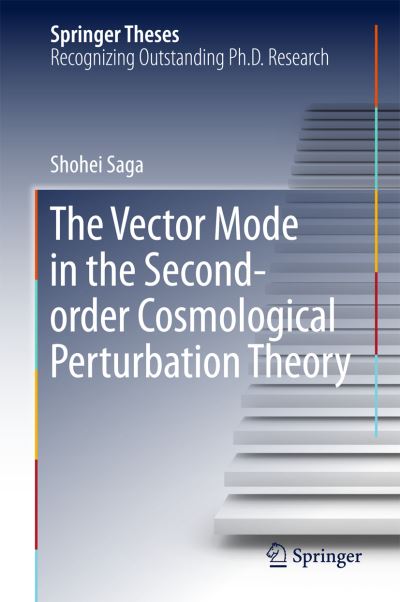
This thesis sheds valuable new light on the second-order cosmological perturbation theory, extensively discussing it in the context of cosmic microwave background (CMB) fluctuations. It explores the observational consequences of the second-order vector mode, and addresses magnetic field generation and the weak lensing signatures, which are key phenomena of the vector mode.
The author demonstrates that the second-order vector mode, which never appears at the linear-order level, naturally arises from the non-linear coupling of the first-order scalar modes. This leads to the remarkable statement that the vector-order mode clearly contributes to the generation of cosmological magnetic fields. Moreover, the weak lensing observations are shown to be accessible to the vector mode. On the basis of ongoing and forthcoming observations, the thesis concludes that the second-order vector mode is detectable.
| ISBN: | 9789811080067 |
| Publication date: | 22nd January 2018 |
| Author: | Shohei Saga |
| Publisher: | Springer an imprint of Springer Nature Singapore |
| Format: | Hardback |
| Pagination: | 136 pages |
| Series: | Springer Theses |
| Genres: |
Cosmology and the universe Gravity Astrophysics |
This thesis sheds valuable new light on the second-order cosmological perturbation theory, extensively discussing it in the context of cosmic microwave background (CMB) fluctuations. It explores the observational consequences of the second-order vector mode, and addresses magnetic field generation and the weak lensing signatures, which are key phenomena of the vector mode.
The author demonstrates that the second-order vector mode, which never appears at the linear-order level, naturally arises from the non-linear coupling of the first-order scalar modes. This leads to the remarkable statement that the vector-order mode clearly contributes to the generation of cosmological magnetic fields. Moreover, the weak lensing observations are shown to be accessible to the vector mode. On the basis of ongoing and forthcoming observations, the thesis concludes that the second-order vector mode is detectable.
The Vector Mode in the Second-Order Cosmological Perturbation Theory features in the following genres: Cosmology and the universe, Gravity, Astrophysics
The Vector Mode in the Second-Order Cosmological Perturbation Theory is available in Hardback
The Vector Mode in the Second-Order Cosmological Perturbation Theory was written by Shohei Saga and published by Springer an imprint of Springer Nature Singapore
The Vector Mode in the Second-Order Cosmological Perturbation Theory has 136 pages
Yes it is part of Springer Theses series