

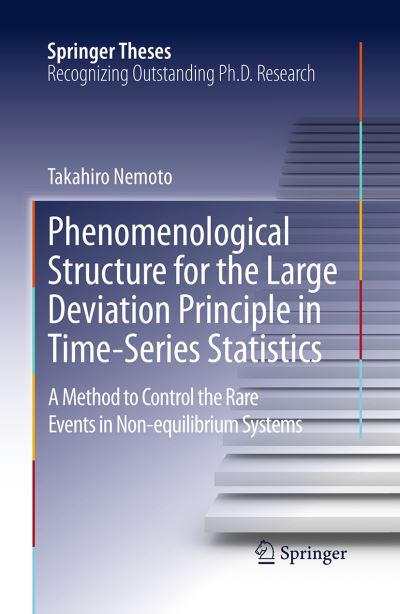
This thesis describes a method to control rare events in non-equilibrium systems by applying physical forces to those systems but without relying on numerical simulation techniques, such as copying rare events. In order to study this method, the book draws on the mathematical structure of equilibrium statistical mechanics, which connects large deviation functions with experimentally measureable thermodynamic functions. Referring to this specific structure as the "phenomenological structure for the large deviation principle", the author subsequently extends it to time-series statistics that can be used to describe non-equilibrium physics.
The book features pedagogical explanations and also shows many open problems to which the proposed method can be applied only to a limited extent. Beyond highlighting these challenging problems as a point of departure, it especially offers an effective means of description for rare events, which could become the next paradigm of non-equilibrium statistical mechanics.
| ISBN: | 9789811013188 |
| Publication date: | 23rd August 2016 |
| Author: | Takahiro Nemoto |
| Publisher: | Springer an imprint of Springer Nature Singapore |
| Format: | Paperback |
| Pagination: | 127 pages |
| Series: | Springer Theses |
| Genres: |
Cybernetics and systems theory Thermodynamics and heat Mathematical physics |
This thesis describes a method to control rare events in non-equilibrium systems by applying physical forces to those systems but without relying on numerical simulation techniques, such as copying rare events. In order to study this method, the book draws on the mathematical structure of equilibrium statistical mechanics, which connects large deviation functions with experimentally measureable thermodynamic functions. Referring to this specific structure as the "phenomenological structure for the large deviation principle", the author subsequently extends it to time-series statistics that can be used to describe non-equilibrium physics.
The book features pedagogical explanations and also shows many open problems to which the proposed method can be applied only to a limited extent. Beyond highlighting these challenging problems as a point of departure, it especially offers an effective means of description for rare events, which could become the next paradigm of non-equilibrium statistical mechanics.
Phenomenological Structure for the Large Deviation Principle in Time-Series Statistics features in the following genres: Cybernetics and systems theory, Thermodynamics and heat, Mathematical physics
Phenomenological Structure for the Large Deviation Principle in Time-Series Statistics is available in Paperback
Phenomenological Structure for the Large Deviation Principle in Time-Series Statistics was written by Takahiro Nemoto and published by Springer an imprint of Springer Nature Singapore
Phenomenological Structure for the Large Deviation Principle in Time-Series Statistics has 127 pages
Yes it is part of Springer Theses series