

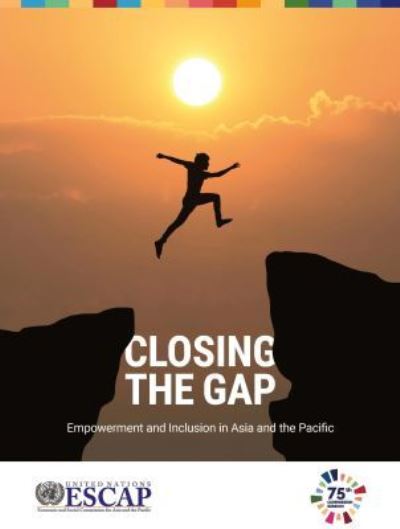
The average achievements the Asia-Pacific region has seen in education, employment and income reflect the role economic growth can play in helping people realize their potential. However, these achievements represent only that: an average. With an increasing gap between rich and poor and between those who have and those who do not have access to opportunities, Asia and the Pacific is also a region that is growing apart. This report adopts a rigorous approach to measuring and quantifying progress in the level of inclusion and empowerment of marginalised groups across countries in the region. It focuses on three main areas of direct link to the 2030 Agenda for Sustainable Development and the SDGs, namely education, employment and income (SDG 4, SDG 8 and SDG 10). The purpose of the analysis is to assess to what extent disadvantaged groups have been included and empowered in these three areas. While there are various disadvantaged groups, the report focuses on women, rural residents, persons with disabilities, youth, older persons and migrants, as well as the furthest behind groups, which are shaped by various layers of circumstances. The aim of this report is to use analytical evidence to encourage policymakers to adopt policies that underpin inclusion and empowerment in their countries.
| ISBN: | 9789211207880 |
| Publication date: | 30th October 2019 |
| Author: | United Nations |
| Publisher: | United Nations Publications |
| Format: | Paperback |
| Pagination: | 72 pages |
| Genres: |
Social discrimination and social justice Ethnic groups and multicultural studies Social research and statistics Educational strategies and policy: inclusion Development economics and emerging economies |
The average achievements the Asia-Pacific region has seen in education, employment and income reflect the role economic growth can play in helping people realize their potential. However, these achievements represent only that: an average. With an increasing gap between rich and poor and between those who have and those who do not have access to opportunities, Asia and the Pacific is also a region that is growing apart. This report adopts a rigorous approach to measuring and quantifying progress in the level of inclusion and empowerment of marginalised groups across countries in the region. It focuses on three main areas of direct link to the 2030 Agenda for Sustainable Development and the SDGs, namely education, employment and income (SDG 4, SDG 8 and SDG 10). The purpose of the analysis is to assess to what extent disadvantaged groups have been included and empowered in these three areas. While there are various disadvantaged groups, the report focuses on women, rural residents, persons with disabilities, youth, older persons and migrants, as well as the furthest behind groups, which are shaped by various layers of circumstances. The aim of this report is to use analytical evidence to encourage policymakers to adopt policies that underpin inclusion and empowerment in their countries.
Closing the Gap features in the following genres: Social discrimination and social justice, Ethnic groups and multicultural studies, Social research and statistics, Educational strategies and policy: inclusion, Development economics and emerging economies
Closing the Gap is available in Paperback
Closing the Gap was written by United Nations and published by United Nations Publications
Closing the Gap has 72 pages