

This book grew out of a graduate student paper [261] in which I set down some criticisms of J. R. Lucas' attempt to refute mechanism by means of G6del's theorem. I had made several such abortive attempts myself and had become familiar with their pitfalls, and especially with the double- edged nature of incompleteness arguments. My original idea was to model the refutation of mechanism on the almost universally accepted G6delian refutation of Hilbert's formalism, but I kept getting stuck on questions of mathematical philosophy which I found myself having to beg. A thorough study of the foundational works of Hilbert and Bernays finally convinced me that I had all too naively and uncritically bought this refutation of formalism. I did indeed discover points of surprisingly close contact between formalism and mechanism, but also that it was possible to under- mine certain strong arguments against these positions precisely by invok- ing G6del's and related work. I also began to realize that the Church- Turing thesis itself is the principal bastion protecting mechanism, and that G6del's work was perhaps the best thing that ever happened to both mechanism and formalism. I pushed these lines of argument in my dis- sertation with the patient help of my readers, Raymond Nelson and Howard Stein. I would especially like to thank the latter for many valuable criticisms of my dissertation as well as some helpful suggestions for reor- ganizing it in the direction of the present book.
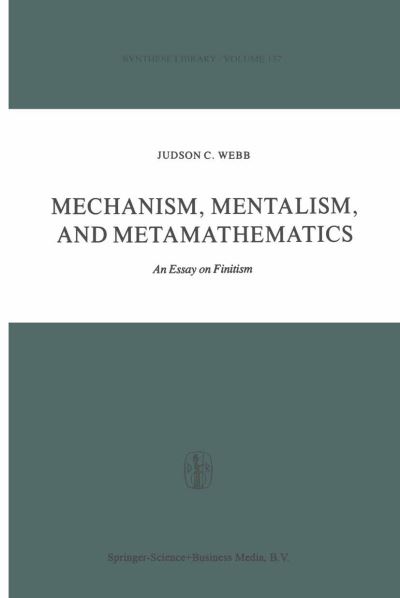
| ISBN: | 9789027710468 |
| Publication date: | 31st October 1980 |
| Author: | Judson Chambers Webb |
| Publisher: | Springer an imprint of Springer Netherlands |
| Format: | Hardback |
| Pagination: | 277 pages |
| Series: | Synthese Library |
| Genres: |
Philosophy of mind Philosophy of science |
This book grew out of a graduate student paper [261] in which I set down some criticisms of J. R. Lucas' attempt to refute mechanism by means of G6del's theorem. I had made several such abortive attempts myself and had become familiar with their pitfalls, and especially with the double- edged nature of incompleteness arguments. My original idea was to model the refutation of mechanism on the almost universally accepted G6delian refutation of Hilbert's formalism, but I kept getting stuck on questions of mathematical philosophy which I found myself having to beg. A thorough study of the foundational works of Hilbert and Bernays finally convinced me that I had all too naively and uncritically bought this refutation of formalism. I did indeed discover points of surprisingly close contact between formalism and mechanism, but also that it was possible to under- mine certain strong arguments against these positions precisely by invok- ing G6del's and related work. I also began to realize that the Church- Turing thesis itself is the principal bastion protecting mechanism, and that G6del's work was perhaps the best thing that ever happened to both mechanism and formalism. I pushed these lines of argument in my dis- sertation with the patient help of my readers, Raymond Nelson and Howard Stein. I would especially like to thank the latter for many valuable criticisms of my dissertation as well as some helpful suggestions for reor- ganizing it in the direction of the present book.
Mechanism, Mentalism, and Metamathematics features in the following genres: Philosophy of mind, Philosophy of science
Mechanism, Mentalism, and Metamathematics is available in Hardback
Mechanism, Mentalism, and Metamathematics was written by Judson Chambers Webb and published by Springer an imprint of Springer Netherlands
Mechanism, Mentalism, and Metamathematics has 277 pages
Yes it is part of Synthese Library series