

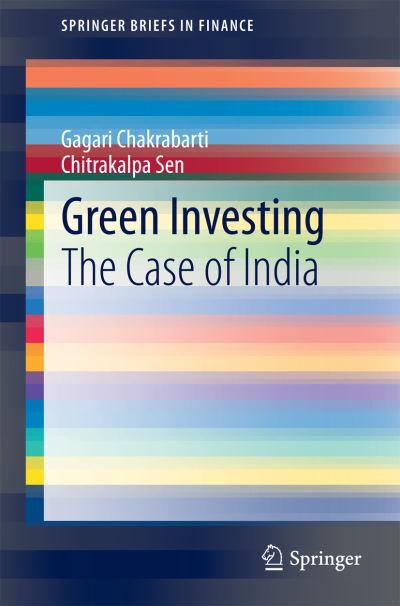
This book seeks to answer the essential question of the investment-worthiness of green instruments. It is evident that investing in green and energy-efficient firms will be the most profitable choice for wise investors in the years to come. The reconciliation of the social choice for green technology and investors' choice for gray technology will be automatically achieved once green firms become more profitable than gray ones, in the Indian context. As there has been very little research done in this area, especially in the Indian context, this book addresses that gap.
In order to do so, it follows the development of five different portfolios consisting of 100% green, 75% green-25% gray, 50% green-50% gray, 25% green-75% gray and 100% gray stocks, and attempts to answer questions such as: Do green portfolios entail less relative own-risk as compared to their gray counterparts? How effectively do green portfolios avoid market risk? Are green portfolios inherently more stable? Do green portfolios have a higher probability of surviving a financial crisis? Is the performance of green portfolios backed by their fundamentals? Is there any particular technical trading strategy that can ensure a consistently above-average return from these portfolios?| ISBN: | 9788132220251 |
| Publication date: | 9th September 2014 |
| Author: | Gagari Chakrabarti, Chitrakalpa Sen |
| Publisher: | Springer an imprint of Springer India |
| Format: | Paperback |
| Pagination: | 102 pages |
| Series: | SpringerBriefs in Finance |
| Genres: |
Finance and the finance industry Macroeconomics Sustainability The environment |
This book seeks to answer the essential question of the investment-worthiness of green instruments. It is evident that investing in green and energy-efficient firms will be the most profitable choice for wise investors in the years to come. The reconciliation of the social choice for green technology and investors' choice for gray technology will be automatically achieved once green firms become more profitable than gray ones, in the Indian context. As there has been very little research done in this area, especially in the Indian context, this book addresses that gap.
In order to do so, it follows the development of five different portfolios consisting of 100% green, 75% green-25% gray, 50% green-50% gray, 25% green-75% gray and 100% gray stocks, and attempts to answer questions such as: Do green portfolios entail less relative own-risk as compared to their gray counterparts? How effectively do green portfolios avoid market risk? Are green portfolios inherently more stable? Do green portfolios have a higher probability of surviving a financial crisis? Is the performance of green portfolios backed by their fundamentals? Is there any particular technical trading strategy that can ensure a consistently above-average return from these portfolios?Green Investing features in the following genres: Finance and the finance industry, Macroeconomics, Sustainability, The environment
Green Investing is available in Paperback
Green Investing was written by Gagari Chakrabarti, Chitrakalpa Sen and published by Springer an imprint of Springer India
Green Investing has 102 pages
Yes it is part of SpringerBriefs in Finance series