

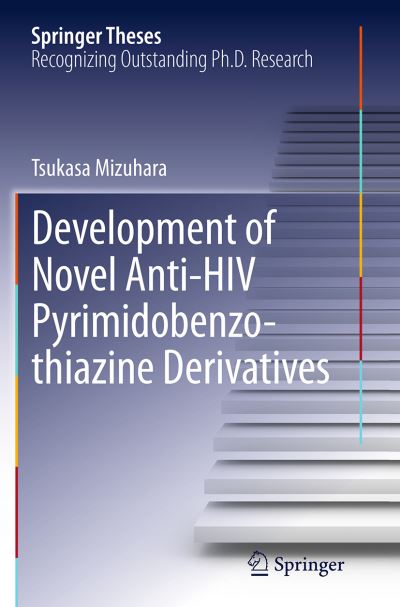
The author successfully developed novel anti-HIV PD 404182 derivatives that exhibited submicromolar inhibitory activity against both HIV-1 and HIV-2. His thesis is in three parts. The first part expounds efficient methods for the synthesis of tricyclic heterocycles related to PD 404182 based on the sp2-carbon?heteroatom bond formations. Starting from arene or haloarene, C-O, C-N, or C-S bonds were formed by simply changing the reactants. These synthetic methods provide powerful approaches for the divergent preparation of pyrimido-benzoxazine, -quinazoline, or -benzothiazine derivatives. The second part explains SAR studies of PD 404182 for the development of anti-HIV agents. Through optimization studies of the central 1,3-thiazin-2-imine core, the benzene and cyclic amidine ring parts, 3-fold more potent inhibitors were obtained compared with the lead compound. The author also reveals by a time-of-drug-addition experiment that PD 404182 derivatives impaired HIV replication at the binding or fusion stage. The third part of the thesis elucidates the development of photoaffinity probes for the target identification of PD 404182. By the photolabeling experiment of HIV-1-infected H9 cells using these probes, the author detected proteins specifically bound to PD 404182. These new anti-HIV agents may be promising agents for anti-HIV therapy because their mechanisms of action differ from those of the currently approved anti-HIV agents.
| ISBN: | 9784431561651 |
| Publication date: | 23rd August 2016 |
| Author: | Tsukasa Mizuhara |
| Publisher: | Springer an imprint of Springer Japan |
| Format: | Paperback |
| Pagination: | 151 pages |
| Series: | Springer Theses |
| Genres: |
Organic chemistry Microbiology (non-medical) Medicinal chemistry |
The author successfully developed novel anti-HIV PD 404182 derivatives that exhibited submicromolar inhibitory activity against both HIV-1 and HIV-2. His thesis is in three parts. The first part expounds efficient methods for the synthesis of tricyclic heterocycles related to PD 404182 based on the sp2-carbon?heteroatom bond formations. Starting from arene or haloarene, C-O, C-N, or C-S bonds were formed by simply changing the reactants. These synthetic methods provide powerful approaches for the divergent preparation of pyrimido-benzoxazine, -quinazoline, or -benzothiazine derivatives. The second part explains SAR studies of PD 404182 for the development of anti-HIV agents. Through optimization studies of the central 1,3-thiazin-2-imine core, the benzene and cyclic amidine ring parts, 3-fold more potent inhibitors were obtained compared with the lead compound. The author also reveals by a time-of-drug-addition experiment that PD 404182 derivatives impaired HIV replication at the binding or fusion stage. The third part of the thesis elucidates the development of photoaffinity probes for the target identification of PD 404182. By the photolabeling experiment of HIV-1-infected H9 cells using these probes, the author detected proteins specifically bound to PD 404182. These new anti-HIV agents may be promising agents for anti-HIV therapy because their mechanisms of action differ from those of the currently approved anti-HIV agents.
Development of Novel Anti-HIV Pyrimidobenzothiazine Derivatives features in the following genres: Organic chemistry, Microbiology (non-medical), Medicinal chemistry
Development of Novel Anti-HIV Pyrimidobenzothiazine Derivatives is available in Paperback, Hardback
Development of Novel Anti-HIV Pyrimidobenzothiazine Derivatives was written by Tsukasa Mizuhara and published by Springer an imprint of Springer Japan
Development of Novel Anti-HIV Pyrimidobenzothiazine Derivatives has 151 pages
Yes it is part of Springer Theses series