

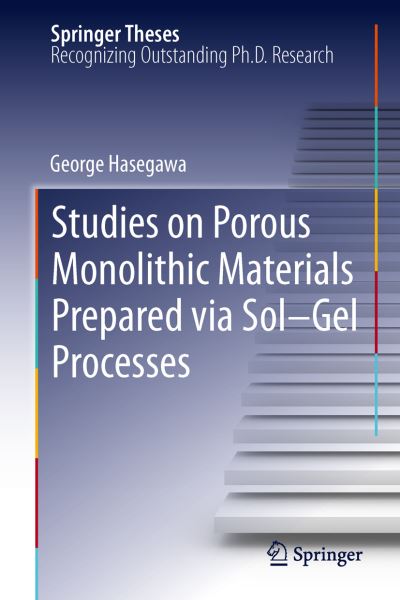
This thesis focuses on porous monolithic materials that are not in the forms of particles, fibers, or films. In particular, the synthetic strategy of porous monolithic materials via the sol-gel method accompanied by phase separation, which is characterized as the non-templating method for tailoring well-defined macropores, is described from the basics to actual synthesis. Porous materials are attracting more and more attention in various fields such as electronics, energy storage, catalysis, sensing, adsorbents, biomedical science, and separation science. To date, many efforts have been made to synthesize porous materials in various chemical compositions-organics, inorganics including metals, glasses and ceramics, and organic-inorganic hybrids. Also demonstrated in this thesis are the potential applications of synthesized porous monolithic materials to separation media as well as to electrodes for electric double-layer capacitors (EDLCs) and Li-ion batteries (LIBs). This work is ideal for graduate students in materials science and is also useful to engineers or scientists seeking basic knowledge of porous monolithic materials.
| ISBN: | 9784431546740 |
| Publication date: | 9th November 2014 |
| Author: | George Hasegawa |
| Publisher: | Springer an imprint of Springer Japan |
| Format: | Paperback |
| Pagination: | 208 pages |
| Series: | Springer Theses |
| Genres: |
Materials science Engineering applications of polymers and composites Catalysis Electrochemistry and magnetochemistry Ceramic and glass technology Energy, power generation, distribution and storage Inorganic chemistry |
This thesis focuses on porous monolithic materials that are not in the forms of particles, fibers, or films. In particular, the synthetic strategy of porous monolithic materials via the sol-gel method accompanied by phase separation, which is characterized as the non-templating method for tailoring well-defined macropores, is described from the basics to actual synthesis. Porous materials are attracting more and more attention in various fields such as electronics, energy storage, catalysis, sensing, adsorbents, biomedical science, and separation science. To date, many efforts have been made to synthesize porous materials in various chemical compositions-organics, inorganics including metals, glasses and ceramics, and organic-inorganic hybrids. Also demonstrated in this thesis are the potential applications of synthesized porous monolithic materials to separation media as well as to electrodes for electric double-layer capacitors (EDLCs) and Li-ion batteries (LIBs). This work is ideal for graduate students in materials science and is also useful to engineers or scientists seeking basic knowledge of porous monolithic materials.
Studies on Porous Monolithic Materials Prepared Via Sol-Gel Processes features in the following genres: Materials science, Engineering applications of polymers and composites, Catalysis, Electrochemistry and magnetochemistry, Ceramic and glass technology, Energy, power generation, distribution and storage, Inorganic chemistry
Studies on Porous Monolithic Materials Prepared Via Sol-Gel Processes is available in Paperback, Hardback
Studies on Porous Monolithic Materials Prepared Via Sol-Gel Processes was written by George Hasegawa and published by Springer an imprint of Springer Japan
Studies on Porous Monolithic Materials Prepared Via Sol-Gel Processes has 208 pages
Yes it is part of Springer Theses series