

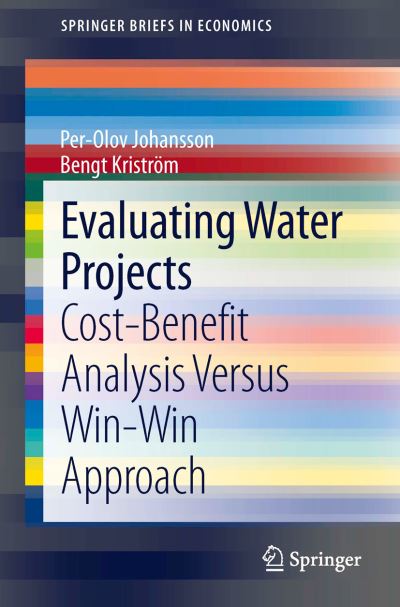
Should more water be diverted to or from electricity generation? This timely question is addressed in this short volume. Two different approaches are introduced and compared:
The first is a cost-benefit analysis, examining the case of re-regulating a Swedish hydropower plant in which water is diverted from electricity generation to the downstream dryway. The proposed scenario generates environmental and other benefits, but comes at a cost in terms of lost electricity.
The second study introduces an approach very different from the one used in conventional cost-benefit analysis, and provides a set of measures designed so that most, if not all, affected parties will be better off. Thus, in contrast to a conventional cost-benefit analysis, which draws on hypothetical compensation measures, the new approach envisages actual compensation.
Comparing two different theoretical frameworks on the basis of a real-world case, this study can be seen as a manual that can be used to evaluate reasonably small re-regulation of rivers.
| ISBN: | 9783642367892 |
| Publication date: | 18th April 2013 |
| Author: | PerOlov Johansson, Bengt Kriström |
| Publisher: | Springer an imprint of Springer Berlin Heidelberg |
| Format: | Paperback |
| Pagination: | 67 pages |
| Series: | SpringerBriefs in Economics |
| Genres: |
Environmental economics Pollution and threats to the environment |
Should more water be diverted to or from electricity generation? This timely question is addressed in this short volume. Two different approaches are introduced and compared:
The first is a cost-benefit analysis, examining the case of re-regulating a Swedish hydropower plant in which water is diverted from electricity generation to the downstream dryway. The proposed scenario generates environmental and other benefits, but comes at a cost in terms of lost electricity.
The second study introduces an approach very different from the one used in conventional cost-benefit analysis, and provides a set of measures designed so that most, if not all, affected parties will be better off. Thus, in contrast to a conventional cost-benefit analysis, which draws on hypothetical compensation measures, the new approach envisages actual compensation.
Comparing two different theoretical frameworks on the basis of a real-world case, this study can be seen as a manual that can be used to evaluate reasonably small re-regulation of rivers.
Evaluating Water Projects features in the following genres: Environmental economics, Pollution and threats to the environment
Evaluating Water Projects is available in Paperback
Evaluating Water Projects was written by PerOlov Johansson, Bengt Kriström and published by Springer an imprint of Springer Berlin Heidelberg
Evaluating Water Projects has 67 pages
Yes it is part of SpringerBriefs in Economics series