

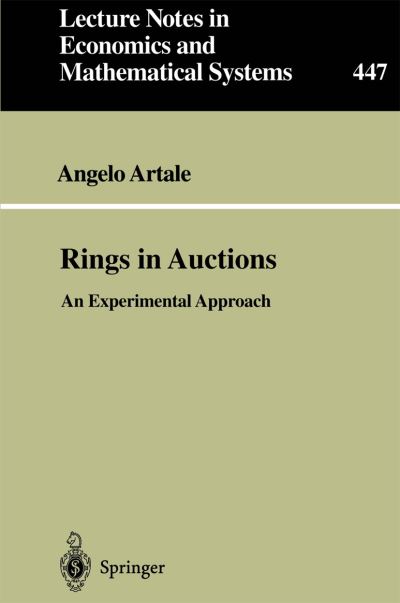
In auctions, bidders compete with one another in their attempt to 1 purchase the goods that are up for sale But buyer competition may be reduced or disappear when a ring of colluding bidders is present. The purpose of the participants to a ring is to eliminate buyer competition and to realize a gain over vendors. When all participants are members of the ring, this is done by purchasing the item at the reserve price and splitting the spoils (the difference between the item market value and the reserve price) among the participants. "The term ring apparently derives from the fact that in a settlement sale following the auction, members of the collusive arrangement form a circle or ring to facilitate observation of their trading behavior by the ring leader" (Cassady jr. (1967)). If the coalition members knew other players' values, the problem faced by the ring might be easily solved: the player with the highest value should submit a serious bid and the other members, on the contrary, only phony bids. However, ring participants do not usually know the values of other members. Therefore, ring members have to find out some mechanism which selects the player who has to bid seriously and, eventually, esta- blish side payments paid to each of the losers2.
| ISBN: | 9783540619307 |
| Publication date: | 28th January 1997 |
| Author: | Angelo Artale |
| Publisher: | Springer an imprint of Springer Berlin Heidelberg |
| Format: | Paperback |
| Pagination: | 174 pages |
| Series: | Lecture Notes in Economics and Mathematical Systems |
| Genres: |
Economic theory and philosophy |
In auctions, bidders compete with one another in their attempt to 1 purchase the goods that are up for sale But buyer competition may be reduced or disappear when a ring of colluding bidders is present. The purpose of the participants to a ring is to eliminate buyer competition and to realize a gain over vendors. When all participants are members of the ring, this is done by purchasing the item at the reserve price and splitting the spoils (the difference between the item market value and the reserve price) among the participants. "The term ring apparently derives from the fact that in a settlement sale following the auction, members of the collusive arrangement form a circle or ring to facilitate observation of their trading behavior by the ring leader" (Cassady jr. (1967)). If the coalition members knew other players' values, the problem faced by the ring might be easily solved: the player with the highest value should submit a serious bid and the other members, on the contrary, only phony bids. However, ring participants do not usually know the values of other members. Therefore, ring members have to find out some mechanism which selects the player who has to bid seriously and, eventually, esta- blish side payments paid to each of the losers2.
Rings in Auctions features in the following genres: Economic theory and philosophy
Rings in Auctions is available in Paperback
Rings in Auctions was written by Angelo Artale and published by Springer an imprint of Springer Berlin Heidelberg
Rings in Auctions has 174 pages
Yes it is part of Lecture Notes in Economics and Mathematical Systems series