

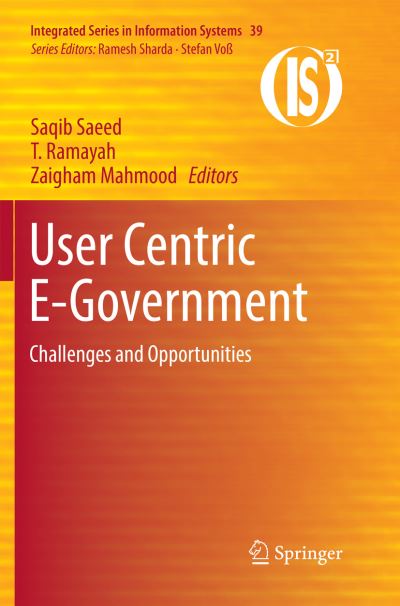
This book provides user studies and theories related to user-centered technology design processes for e-government projects. The book mainly discusses inherent issues of technology design implications, user experiences, and guidelines for technology appropriation. Ethnographic studies focusing on real life examples will enable readers to understand the problems in an effective way. Furthermore, the theories and results will help researchers and practitioners to handle these challenges in an efficient way.
E-Government is about harnessing the information revolution to improve the efficiency of government processes and the lives of citizens. It aims at a citizen centered approach to governance through effective use of the Internet and Information and Communication Technologies (ICTs). E-Government promotes transparency and effectiveness of a government's processes as well as citizens' participation (e-participation) in the affairs of the government. Whereas E-government projectsare huge undertakings for government departments, a user-centric approach requires citizens' participation in the design and delivery of e government services. In both these respects, there are huge challenges and governments require long term commitment as well as correct planning and availability of financial resources to address them.
System design for e-governmental applications is inherently a complex process. In successful e-government projects, appropriately designed technology infrastructure plays a pivotal rule. The technology appropriation process requires that e-government technologies should be in line with the work practices of end users, so that successful usage of these technologies can be realized. E-governmental systems which fail to take into account such human factors result in failure and wasting huge amounts of public money as well as a loss of confidence of the public in such technological infrastructures. It is highly important that citizens are enabled to have access to the appropriate information technology, have knowledge and skills to use the available technology, and have the positive commitment to affect the governments' strategies. So, enabling citizens to effectively participate is much more difficult. This book addresses these inherent challenges and available opportunities with respect to user-centric e-government.
| ISBN: | 9783319866253 |
| Publication date: | 10th August 2018 |
| Author: | Saqib Saeed, T Ramayah, Zaigham Mahmood |
| Publisher: | Springer an imprint of Springer International Publishing |
| Format: | Paperback |
| Pagination: | 256 pages |
| Series: | Integrated Series in Information Systems |
| Genres: |
Business mathematics and systems Communication studies Political structure and processes |
This book provides user studies and theories related to user-centered technology design processes for e-government projects. The book mainly discusses inherent issues of technology design implications, user experiences, and guidelines for technology appropriation. Ethnographic studies focusing on real life examples will enable readers to understand the problems in an effective way. Furthermore, the theories and results will help researchers and practitioners to handle these challenges in an efficient way.
E-Government is about harnessing the information revolution to improve the efficiency of government processes and the lives of citizens. It aims at a citizen centered approach to governance through effective use of the Internet and Information and Communication Technologies (ICTs). E-Government promotes transparency and effectiveness of a government's processes as well as citizens' participation (e-participation) in the affairs of the government. Whereas E-government projectsare huge undertakings for government departments, a user-centric approach requires citizens' participation in the design and delivery of e government services. In both these respects, there are huge challenges and governments require long term commitment as well as correct planning and availability of financial resources to address them.
System design for e-governmental applications is inherently a complex process. In successful e-government projects, appropriately designed technology infrastructure plays a pivotal rule. The technology appropriation process requires that e-government technologies should be in line with the work practices of end users, so that successful usage of these technologies can be realized. E-governmental systems which fail to take into account such human factors result in failure and wasting huge amounts of public money as well as a loss of confidence of the public in such technological infrastructures. It is highly important that citizens are enabled to have access to the appropriate information technology, have knowledge and skills to use the available technology, and have the positive commitment to affect the governments' strategies. So, enabling citizens to effectively participate is much more difficult. This book addresses these inherent challenges and available opportunities with respect to user-centric e-government.
User Centric E-Government features in the following genres: Business mathematics and systems, Communication studies, Political structure and processes
User Centric E-Government is available in Paperback, Hardback
User Centric E-Government was written by Saqib Saeed, T Ramayah, Zaigham Mahmood and published by Springer an imprint of Springer International Publishing
User Centric E-Government has 256 pages
Yes it is part of Integrated Series in Information Systems series
£80.99