

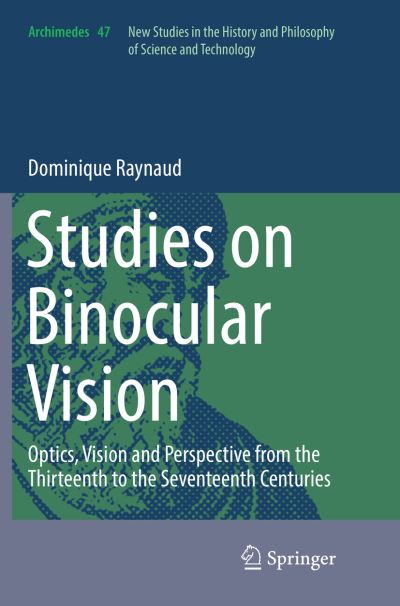
This book clarifies the interrelationship between optics, vision and perspective before the Classical Age, examining binocularity in particular. The author shows how binocular vision was one of the key juncture points between the three concepts and readers will see how important it is to understand the approach that scholars once took. In the Middle Ages and the Renaissance, the concept of Perspectiva - the Latin word for optics - encompassed many areas of enquiry that had been viewed since antiquity as interconnected, but which afterwards were separated: optics was incorporated into the field of physics (i.e., physical and geometrical optics), vision came to be regarded as the sum of various psycho-physiological mechanisms involved in the way the eye operates (i.e., physiological optics and psychology of vision) and the word 'perspective' was reserved for the mathematical representation of the external world (i.e., linear perspective).
The author shows how this division, whichemerged as a result of the spread of the sciences in classical Europe, turns out to be an anachronism if we confront certain facts from the immediately preceding periods. It is essential to take into account the way medieval scholars posed the problem - which included all facets of the Latin word perspectiva - when exploring the events of this period. This book will appeal to a broad readership, from philosophers and historians of science, to those working in geometry, optics, ophthalmology and architecture.| ISBN: | 9783319826455 |
| Publication date: | 14th June 2018 |
| Author: | Dominique Raynaud |
| Publisher: | Springer an imprint of Springer International Publishing |
| Format: | Paperback |
| Pagination: | 297 pages |
| Series: | Archimedes |
| Genres: |
History of science Electricity, electromagnetism and magnetism Theory of architecture History of architecture Ophthalmology Geometry Philosophy of science |
This book clarifies the interrelationship between optics, vision and perspective before the Classical Age, examining binocularity in particular. The author shows how binocular vision was one of the key juncture points between the three concepts and readers will see how important it is to understand the approach that scholars once took. In the Middle Ages and the Renaissance, the concept of Perspectiva - the Latin word for optics - encompassed many areas of enquiry that had been viewed since antiquity as interconnected, but which afterwards were separated: optics was incorporated into the field of physics (i.e., physical and geometrical optics), vision came to be regarded as the sum of various psycho-physiological mechanisms involved in the way the eye operates (i.e., physiological optics and psychology of vision) and the word 'perspective' was reserved for the mathematical representation of the external world (i.e., linear perspective).
The author shows how this division, whichemerged as a result of the spread of the sciences in classical Europe, turns out to be an anachronism if we confront certain facts from the immediately preceding periods. It is essential to take into account the way medieval scholars posed the problem - which included all facets of the Latin word perspectiva - when exploring the events of this period. This book will appeal to a broad readership, from philosophers and historians of science, to those working in geometry, optics, ophthalmology and architecture.Studies on Binocular Vision features in the following genres: History of science, Electricity, electromagnetism and magnetism, Theory of architecture, History of architecture, Ophthalmology, Geometry, Philosophy of science
Studies on Binocular Vision is available in Paperback, Hardback
Studies on Binocular Vision was written by Dominique Raynaud and published by Springer an imprint of Springer International Publishing
Studies on Binocular Vision has 297 pages
Yes it is part of Archimedes series
£71.99