

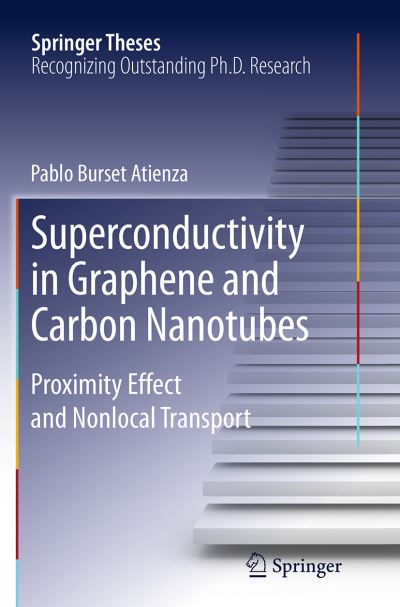
The unique electronic band structure of graphene gives rise to remarkable properties when in contact with a superconducting electrode. In this thesis two main aspects of these junctions are analyzed: the induced superconducting proximity effect and the non-local transport properties in multi-terminal devices. For this purpose specific models are developed and studied using Green function techniques, which allow us to take into account the detailed microscopic structure of the graphene-superconductor interface. It is shown that these junctions are characterized by the appearance of bound states at subgap energies which are localized at the interface region. Furthermore it is shown that graphene-supercondutor-graphene junctions can be used to favor the splitting of Cooper pairs for the generation of non-locally entangled electron pairs. Finally, using similar techniques the thesis analyzes the transport properties of carbon nanotube devices coupled with superconducting electrodes and in graphene superlattices.
| ISBN: | 9783319346137 |
| Publication date: | 23rd August 2016 |
| Author: | Pablo Burset Atienza |
| Publisher: | Springer an imprint of Springer International Publishing |
| Format: | Paperback |
| Pagination: | 157 pages |
| Series: | Springer Theses |
| Genres: |
Condensed matter physics (liquid state and solid state physics) Mathematical physics Materials science Nanosciences |
The unique electronic band structure of graphene gives rise to remarkable properties when in contact with a superconducting electrode. In this thesis two main aspects of these junctions are analyzed: the induced superconducting proximity effect and the non-local transport properties in multi-terminal devices. For this purpose specific models are developed and studied using Green function techniques, which allow us to take into account the detailed microscopic structure of the graphene-superconductor interface. It is shown that these junctions are characterized by the appearance of bound states at subgap energies which are localized at the interface region. Furthermore it is shown that graphene-supercondutor-graphene junctions can be used to favor the splitting of Cooper pairs for the generation of non-locally entangled electron pairs. Finally, using similar techniques the thesis analyzes the transport properties of carbon nanotube devices coupled with superconducting electrodes and in graphene superlattices.
Superconductivity in Graphene and Carbon Nanotubes features in the following genres: Condensed matter physics (liquid state and solid state physics), Mathematical physics, Materials science, Nanosciences
Superconductivity in Graphene and Carbon Nanotubes is available in Paperback, Hardback
Superconductivity in Graphene and Carbon Nanotubes was written by Pablo Burset Atienza and published by Springer an imprint of Springer International Publishing
Superconductivity in Graphene and Carbon Nanotubes has 157 pages
Yes it is part of Springer Theses series