

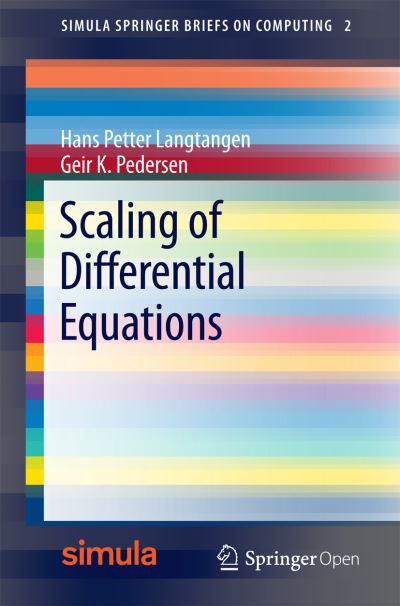
The book serves both as a reference for various scaled models with corresponding dimensionless numbers, and as a resource for learning the art of scaling. A special feature of the book is the emphasis on how to create software for scaled models, based on existing software for unscaled models.
Scaling (or non-dimensionalization) is a
mathematical technique that greatly simplifies the setting of input parameters in
numerical simulations. Moreover, scaling enhances the understanding of how
different physical processes interact in a differential equation model.
Compared to the existing literature, where the topic of scaling is frequently
encountered, but very often in only a brief and shallow setting, the present
book gives much more thorough explanations of how to reason about finding the
right scales. This process is highly problem dependent, and therefore the book
features a lot of worked examples, from very simple ODEs to systems of PDEs,
especially from fluid mechanics.
The text is easily accessible and example-driven. The first part on ODEs fits even a lower undergraduate level, while the most advanced multiphysics fluid mechanics examples target the graduate level. The scientific literature is full of scaled models, but in most of the cases, the scales are just stated without thorough mathematical reasoning. This book explains how the scales are found mathematically.
This book will be a valuable read for anyone doing numerical simulations based on ordinary or partial differential equations.
| ISBN: | 9783319327259 |
| Publication date: | 24th June 2016 |
| Author: | Hans Petter Langtangen, Geir K Pedersen |
| Publisher: | Springer an imprint of Springer International Publishing |
| Format: | Paperback |
| Pagination: | 138 pages |
| Series: | Simula SpringerBriefs on Computing |
| Genres: |
Differential calculus and equations Numerical analysis Mathematical modelling Maths for engineers Computer modelling and simulation |
The book serves both as a reference for various scaled models with corresponding dimensionless numbers, and as a resource for learning the art of scaling. A special feature of the book is the emphasis on how to create software for scaled models, based on existing software for unscaled models.
Scaling (or non-dimensionalization) is a
mathematical technique that greatly simplifies the setting of input parameters in
numerical simulations. Moreover, scaling enhances the understanding of how
different physical processes interact in a differential equation model.
Compared to the existing literature, where the topic of scaling is frequently
encountered, but very often in only a brief and shallow setting, the present
book gives much more thorough explanations of how to reason about finding the
right scales. This process is highly problem dependent, and therefore the book
features a lot of worked examples, from very simple ODEs to systems of PDEs,
especially from fluid mechanics.
The text is easily accessible and example-driven. The first part on ODEs fits even a lower undergraduate level, while the most advanced multiphysics fluid mechanics examples target the graduate level. The scientific literature is full of scaled models, but in most of the cases, the scales are just stated without thorough mathematical reasoning. This book explains how the scales are found mathematically.
This book will be a valuable read for anyone doing numerical simulations based on ordinary or partial differential equations.
Scaling of Differential Equations features in the following genres: Differential calculus and equations, Numerical analysis, Mathematical modelling, Maths for engineers, Computer modelling and simulation
Scaling of Differential Equations is available in Paperback
Scaling of Differential Equations was written by Hans Petter Langtangen, Geir K Pedersen and published by Springer an imprint of Springer International Publishing
Scaling of Differential Equations has 138 pages
Yes it is part of Simula SpringerBriefs on Computing series