

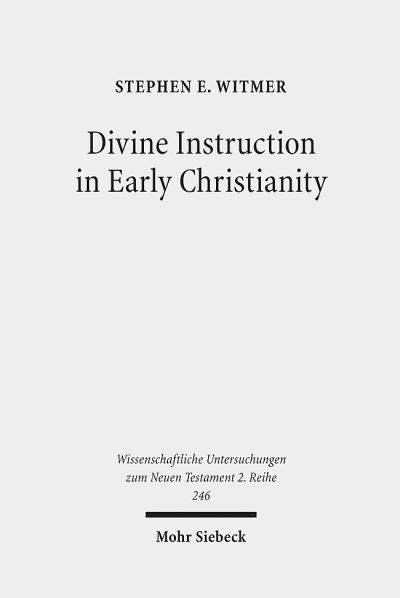
Stephen E. Witmer investigates one aspect of early Christian self-understanding: the conviction of some early followers of Jesus that they had been, and were being, taught by God, in fulfillment of OT prophetic promises (especially Isa 54:13 and Jer 31:33-34). In this study, he contextualizes the Christian understanding of divine instruction through analysis of divine instruction in the Old Testament and early Jewish literature. Of particular interest is the development of the idea of an eschatological teaching of God in some prophetic literature and early Jewish literature. With this context in place, the author focuses on the idea of divine instruction in the Johannine corpus. He argues that the Fourth Gospel re-interprets the prophetic promise of divine instruction in light of the teaching of Jesus and the Spirit, and that the concept functions in the Fourth Gospel polemically and as a means of self-legitimation. The consequences for human teaching are addressed through an examination of the Johannine letters, focusing particularly on 1 John 2.20, 27. The final chapters then extend the study beyond the Johannine corpus by investigating the key Pauline references to divine instruction and by providing a close reading of Matt 23.8-10.
| ISBN: | 9783161496080 |
| Publication date: | 23rd September 2008 |
| Author: | Stephen E Witmer |
| Publisher: | Mohr Siebeck |
| Format: | Paperback |
| Pagination: | 237 pages |
| Series: | Wissenschaftliche Untersuchungen Zum Neuen Testament 2.Reihe |
| Genres: |
History of religion Criticism and exegesis of sacred texts Christianity |
Stephen E. Witmer investigates one aspect of early Christian self-understanding: the conviction of some early followers of Jesus that they had been, and were being, taught by God, in fulfillment of OT prophetic promises (especially Isa 54:13 and Jer 31:33-34). In this study, he contextualizes the Christian understanding of divine instruction through analysis of divine instruction in the Old Testament and early Jewish literature. Of particular interest is the development of the idea of an eschatological teaching of God in some prophetic literature and early Jewish literature. With this context in place, the author focuses on the idea of divine instruction in the Johannine corpus. He argues that the Fourth Gospel re-interprets the prophetic promise of divine instruction in light of the teaching of Jesus and the Spirit, and that the concept functions in the Fourth Gospel polemically and as a means of self-legitimation. The consequences for human teaching are addressed through an examination of the Johannine letters, focusing particularly on 1 John 2.20, 27. The final chapters then extend the study beyond the Johannine corpus by investigating the key Pauline references to divine instruction and by providing a close reading of Matt 23.8-10.
Divine Instruction in Early Christianity features in the following genres: History of religion, Criticism and exegesis of sacred texts, Christianity
Divine Instruction in Early Christianity is available in Paperback
Divine Instruction in Early Christianity was written by Stephen E Witmer and published by Mohr Siebeck
Divine Instruction in Early Christianity has 237 pages
Yes it is part of Wissenschaftliche Untersuchungen Zum Neuen Testament 2.Reihe series
£63.36