

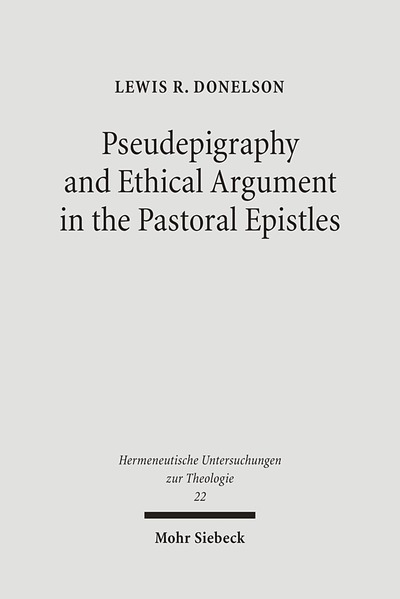
By employing analyses of the literary structure of ancient pseudepigraphical letters and of the logical structure of ethical argument, Lewis R. Donelson discovers in the Pastoral Epistles a consistent theological ethic which has cosmological and cultic grounding. First, an investigation of Greco-Roman religious pseudepigraphical letters identifies those literary patterns which determine the form of argumentation in the Pastoral Epistles. Second, an investigation of the structure of ethical argument produces categories for organizing and analyzing the apparently disorganized arguments in these letters. Finally, this study concludes that the author of the Pastoral Epistles builds a coherent theological ethic by falsifying Pauline history and by grounding his ethical warrants in church officers.
Donelson has made important contributions to unraveling the mystery of these three small epistles, which bear the name of Paul ...
Robert J. Karries in Journal of Biblical Literature, Dec. 1988, 558ff.
Dr. L.R. Donelson has written an interesting and potentially fruitful study of the Pastoral Epistles ...
Anthony Hanson in The Expository Times 12 (1986)
Insgesamt ist die vorgestellte Arbeit uneingeschrankt zu begrussen. Sie ermoglicht einen gut fundierten hermeneutischen Ansatz fur das Verstandnis der Past und lasst diesen drei Briefen zugleich eine gerechte sachliche Beurteilung zukommen.
Eckart Reinmuth in TLZ 7 (1990), S. 508
| ISBN: | 9783161490828 |
| Publication date: | 23rd October 2006 |
| Author: | Lewis R Donelson |
| Publisher: | Mohr Siebeck |
| Format: | Paperback |
| Pagination: | 221 pages |
| Series: | Hermeneutische Untersuchungen Zur Theologie |
| Genres: |
Criticism and exegesis of sacred texts Christianity |
By employing analyses of the literary structure of ancient pseudepigraphical letters and of the logical structure of ethical argument, Lewis R. Donelson discovers in the Pastoral Epistles a consistent theological ethic which has cosmological and cultic grounding. First, an investigation of Greco-Roman religious pseudepigraphical letters identifies those literary patterns which determine the form of argumentation in the Pastoral Epistles. Second, an investigation of the structure of ethical argument produces categories for organizing and analyzing the apparently disorganized arguments in these letters. Finally, this study concludes that the author of the Pastoral Epistles builds a coherent theological ethic by falsifying Pauline history and by grounding his ethical warrants in church officers.
Donelson has made important contributions to unraveling the mystery of these three small epistles, which bear the name of Paul ...
Robert J. Karries in Journal of Biblical Literature, Dec. 1988, 558ff.
Dr. L.R. Donelson has written an interesting and potentially fruitful study of the Pastoral Epistles ...
Anthony Hanson in The Expository Times 12 (1986)
Insgesamt ist die vorgestellte Arbeit uneingeschrankt zu begrussen. Sie ermoglicht einen gut fundierten hermeneutischen Ansatz fur das Verstandnis der Past und lasst diesen drei Briefen zugleich eine gerechte sachliche Beurteilung zukommen.
Eckart Reinmuth in TLZ 7 (1990), S. 508
Pseudepigraphy and Ethical Argument in the Pastoral Epistles features in the following genres: Criticism and exegesis of sacred texts, Christianity
Pseudepigraphy and Ethical Argument in the Pastoral Epistles is available in Paperback
Pseudepigraphy and Ethical Argument in the Pastoral Epistles was written by Lewis R Donelson and published by Mohr Siebeck
Pseudepigraphy and Ethical Argument in the Pastoral Epistles has 221 pages
Yes it is part of Hermeneutische Untersuchungen Zur Theologie series