

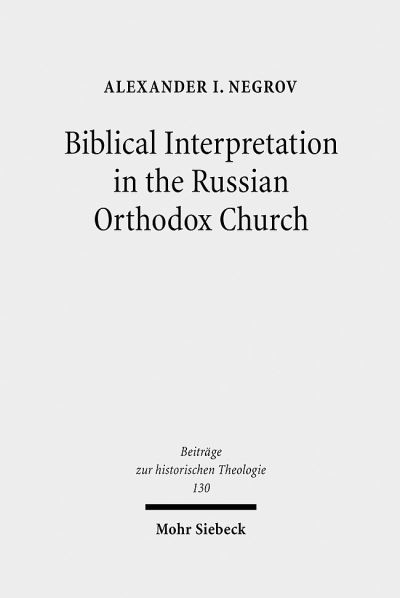
In the majority of western pre-modern and modern handbooks and surveys of the history of biblical scholarship, Eastern Orthodoxy is mostly and habitually dismissed. A clear orientation towards the western branch of the Christian church is maintained throughout. However, as the Russian Orthodox church is an organic part of the universal church this book attempts to assist in the Orthodox-Protestant interactions and serves as an introduction to Russian Orthodox hermeneutics. Alexander Negrov surveys the development of biblical interpretation within the history of the Russian Orthodox church from the Kiev period of its history (tenth to thirteenth centuries) until the Synodal period (1721-1917). The purpose of his study is to present a coherent analysis of the essential elements of Orthodox biblical hermeneutics as it developed over a period of several centuries which were critical to the defining of the Orthodox church and to present a case study of hermeneutical approach to the New Testament of D. I. Bogdashevskii (1861-1933).
The main hermeneutical features of the Russian Orthodox church show that the church and tradition are the indispensable guides to the understanding of Scripture. Christ is considered as the beginning, centre, and end of biblical interpretation and exegesis is based upon cooperation between the Holy Spirit and the human interpreter. The church demands reading of the Scriptures guided by church dogmatics as well as a multi-discipline approach to the text.
| ISBN: | 9783161483714 |
| Publication date: | 9th April 2008 |
| Author: | Alexander Negrov |
| Publisher: | Mohr Siebeck |
| Format: | Hardback |
| Pagination: | 348 pages |
| Series: | Beitrage Zur Historischen Theologie |
| Genres: |
History of religion Criticism and exegesis of sacred texts Christianity |
In the majority of western pre-modern and modern handbooks and surveys of the history of biblical scholarship, Eastern Orthodoxy is mostly and habitually dismissed. A clear orientation towards the western branch of the Christian church is maintained throughout. However, as the Russian Orthodox church is an organic part of the universal church this book attempts to assist in the Orthodox-Protestant interactions and serves as an introduction to Russian Orthodox hermeneutics. Alexander Negrov surveys the development of biblical interpretation within the history of the Russian Orthodox church from the Kiev period of its history (tenth to thirteenth centuries) until the Synodal period (1721-1917). The purpose of his study is to present a coherent analysis of the essential elements of Orthodox biblical hermeneutics as it developed over a period of several centuries which were critical to the defining of the Orthodox church and to present a case study of hermeneutical approach to the New Testament of D. I. Bogdashevskii (1861-1933).
The main hermeneutical features of the Russian Orthodox church show that the church and tradition are the indispensable guides to the understanding of Scripture. Christ is considered as the beginning, centre, and end of biblical interpretation and exegesis is based upon cooperation between the Holy Spirit and the human interpreter. The church demands reading of the Scriptures guided by church dogmatics as well as a multi-discipline approach to the text.
Biblical Interpretation in the Russian Orthodox Church features in the following genres: History of religion, Criticism and exegesis of sacred texts, Christianity
Biblical Interpretation in the Russian Orthodox Church is available in Hardback
Biblical Interpretation in the Russian Orthodox Church was written by Alexander Negrov and published by Mohr Siebeck
Biblical Interpretation in the Russian Orthodox Church has 348 pages
Yes it is part of Beitrage Zur Historischen Theologie series