

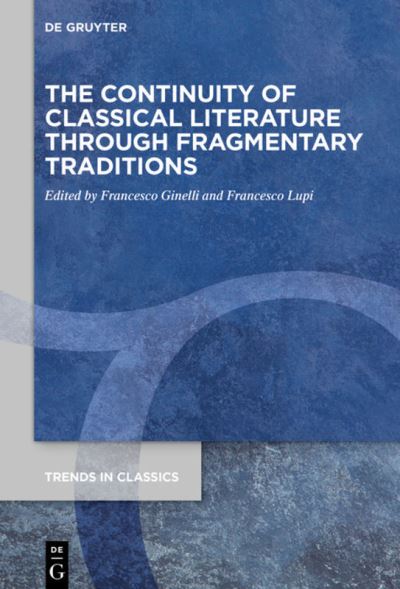
Fragmentary texts play a central role in Classics. Their study poses a stimulating challenge to scholars and readers, while its methods and principles, far from being rigidly immutable, invite constant reflection on its methods, approaches, and goals. By focusing on some of the most relevant issues that fragmentologists have to face, this book contributes to the ongoing and lively debate on the study of fragmentary texts.
This volume contains an extensive theoretical introduction on the study of textual fragments, followed by eight essays on a wide variety of topics relevant to the study of fragmentary texts across literary genres. The chapters range from archaic Greek epics (the Hesiodic corpus) to late-antique grammarian Nonius Marcellus as a source of fragments of Republican literature. All contributions share a nuanced, critical attention to the main methodological implications of the study of fragmentary texts and mutually contribute to highlighting the field's common specificities and limitations, both in theory and in editorial practice.
The book offers a representative spectrum of fragmentological issues, providing all readers with an interest in Classics with an up-to-date, methodologically aware approach to the field.
| ISBN: | 9783110700374 |
| Publication date: | 8th February 2021 |
| Author: | Francesco Ginelli, Francesco Lupi |
| Publisher: | De Gruyter |
| Format: | Hardback |
| Pagination: | 228 pages |
| Series: | Trends in Classics. Supplementary Volumes |
| Genres: |
Ancient history |
Fragmentary texts play a central role in Classics. Their study poses a stimulating challenge to scholars and readers, while its methods and principles, far from being rigidly immutable, invite constant reflection on its methods, approaches, and goals. By focusing on some of the most relevant issues that fragmentologists have to face, this book contributes to the ongoing and lively debate on the study of fragmentary texts.
This volume contains an extensive theoretical introduction on the study of textual fragments, followed by eight essays on a wide variety of topics relevant to the study of fragmentary texts across literary genres. The chapters range from archaic Greek epics (the Hesiodic corpus) to late-antique grammarian Nonius Marcellus as a source of fragments of Republican literature. All contributions share a nuanced, critical attention to the main methodological implications of the study of fragmentary texts and mutually contribute to highlighting the field's common specificities and limitations, both in theory and in editorial practice.
The book offers a representative spectrum of fragmentological issues, providing all readers with an interest in Classics with an up-to-date, methodologically aware approach to the field.
The Continuity of Classical Literature Through Fragmentary Traditions features in the following genres: Literary studies: ancient, classical and medieval, Ancient history
The Continuity of Classical Literature Through Fragmentary Traditions is available in Hardback
The Continuity of Classical Literature Through Fragmentary Traditions was written by Francesco Ginelli, Francesco Lupi and published by De Gruyter
The Continuity of Classical Literature Through Fragmentary Traditions has 228 pages
Yes it is part of Trends in Classics. Supplementary Volumes series
£92.70