

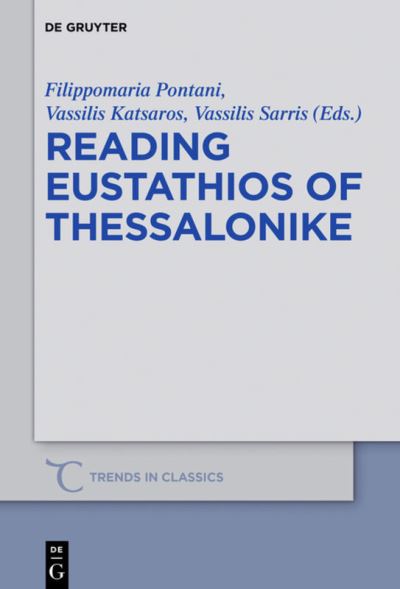
Despite the relevance of Eustathios to both Classical and Byzantine studies, no monograph and no collective volume in English has yet been devoted to his figure. This book attempts to fill in this gap by addressing the various facets of his output - above all his commentaries on Homer, Dionysius the Periegete, Pindar, and the Iambic Canon on the Pentecost; but also his historiographical work, his speeches and his theological production receive due attention. The book also tackles several aspects of Eustathios' style (proverbs, allusions, etc.), and the meaning of his work in the context of his historical moment. Addressed at specialists but also at graduate students with an interest in the reception of Classical antiquity and in Byzantine civilisation, the volume gathers papers by leading scholars from various countries, and it opens up new paths of research in several areas of philology and history, above all by interweaving and juxtaposing Eustathios' dimension as an Homerist and an immensely learned classical scholar with his capacities as an orator, a highly praised teacher, a rhetorically refined writer of Greek prose, an historian of his own turbulent times, and an archbishop who had to fulfil his everyday duties.
| ISBN: | 9783110522211 |
| Publication date: | 20th February 2017 |
| Author: | Filippomaria Pontani, Vasileios Katsaros, Vasileios Sarris |
| Publisher: | De Gruyter |
| Format: | Hardback |
| Pagination: | 379 pages |
| Series: | Trends in Classics - Supplementary Volumes |
| Genres: |
Literary studies: ancient, classical and medieval Ancient history History and Archaeology |
Despite the relevance of Eustathios to both Classical and Byzantine studies, no monograph and no collective volume in English has yet been devoted to his figure. This book attempts to fill in this gap by addressing the various facets of his output - above all his commentaries on Homer, Dionysius the Periegete, Pindar, and the Iambic Canon on the Pentecost; but also his historiographical work, his speeches and his theological production receive due attention. The book also tackles several aspects of Eustathios' style (proverbs, allusions, etc.), and the meaning of his work in the context of his historical moment. Addressed at specialists but also at graduate students with an interest in the reception of Classical antiquity and in Byzantine civilisation, the volume gathers papers by leading scholars from various countries, and it opens up new paths of research in several areas of philology and history, above all by interweaving and juxtaposing Eustathios' dimension as an Homerist and an immensely learned classical scholar with his capacities as an orator, a highly praised teacher, a rhetorically refined writer of Greek prose, an historian of his own turbulent times, and an archbishop who had to fulfil his everyday duties.
Reading Eustathios of Thessalonike features in the following genres: Literary studies: ancient, classical and medieval, Ancient history, History and Archaeology
Reading Eustathios of Thessalonike is available in Hardback
Reading Eustathios of Thessalonike was written by Filippomaria Pontani, Vasileios Katsaros, Vasileios Sarris and published by De Gruyter
Reading Eustathios of Thessalonike has 379 pages
Yes it is part of Trends in Classics - Supplementary Volumes series