

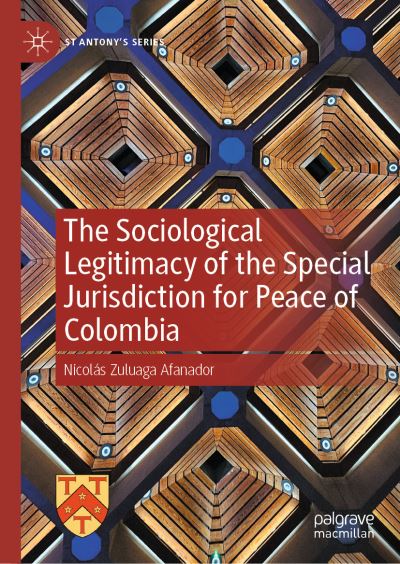
This book investigates the sociological legitimacy of Colombia's Special Jurisdiction for Peace (JEP), a key institution in the 2016 Peace Agreement with the FARC-EP. While legally established, the JEP's legitimacy has been contested by political actors, victims, and former supporters. The author argues that legitimacy should be understood sociologically-as the public's belief in the institution's right to make judicial decisions. Drawing on literature about high courts, the book identifies five key factors affecting legitimacy: diffuse support, specific support, obedience, salience, and institutional age. It proposes a method to operationalise these factors and applies it to the JEP using 43 elite interviews, fieldwork, surveys, and media analysis. The findings suggest the JEP has medium legitimacy, with potential to improve or decline depending on how it addresses delays, victim satisfaction, and public understanding. This is the first study to offer a comprehensive framework for assessing transitional justice legitimacy, making it a valuable resource for academics, policymakers, and international actors. The book also contributes to global debates on mixed justice systems and peacebuilding, offering lessons for future transitional justice mechanisms. Its timely publication aims to inform reforms before the JEP's mandate to indict human rights violations ends in 2028.
| ISBN: | 9783032219114 |
| Publication date: | 5th June 2026 |
| Author: | Nicolás Zuluaga Afanador |
| Publisher: | Palgrave Macmillan an imprint of Springer Nature Switzerland |
| Format: | Hardback |
| Pagination: | 144 pages |
| Series: | St Antony's Series |
| Genres: |
Peace studies and conflict resolution International institutions Public international law |
This book investigates the sociological legitimacy of Colombia's Special Jurisdiction for Peace (JEP), a key institution in the 2016 Peace Agreement with the FARC-EP. While legally established, the JEP's legitimacy has been contested by political actors, victims, and former supporters. The author argues that legitimacy should be understood sociologically-as the public's belief in the institution's right to make judicial decisions. Drawing on literature about high courts, the book identifies five key factors affecting legitimacy: diffuse support, specific support, obedience, salience, and institutional age. It proposes a method to operationalise these factors and applies it to the JEP using 43 elite interviews, fieldwork, surveys, and media analysis. The findings suggest the JEP has medium legitimacy, with potential to improve or decline depending on how it addresses delays, victim satisfaction, and public understanding. This is the first study to offer a comprehensive framework for assessing transitional justice legitimacy, making it a valuable resource for academics, policymakers, and international actors. The book also contributes to global debates on mixed justice systems and peacebuilding, offering lessons for future transitional justice mechanisms. Its timely publication aims to inform reforms before the JEP's mandate to indict human rights violations ends in 2028.
The Sociological Legitimacy of the Special Jurisdiction for Peace of Colombia features in the following genres: Peace studies and conflict resolution, International institutions, Public international law
The Sociological Legitimacy of the Special Jurisdiction for Peace of Colombia is available in Hardback
The Sociological Legitimacy of the Special Jurisdiction for Peace of Colombia was written by Nicolás Zuluaga Afanador and published by Palgrave Macmillan an imprint of Springer Nature Switzerland
The Sociological Legitimacy of the Special Jurisdiction for Peace of Colombia has 144 pages
Yes it is part of St Antony's Series series
£31.49