

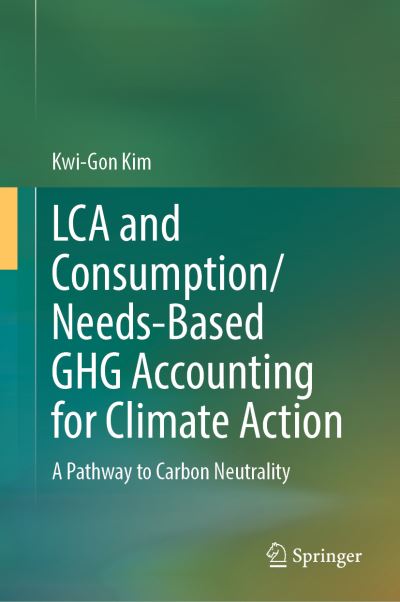
This book reveals causes of the GHG emission accounting practice failure over the last several decades, describes evolution of new tenets of the accounting and remaining tasks, and suggests a new comprehensive integrated accounting in the form of protocol.
The latest Intergovernmental Panel on Climate Change (IPCC) assessment report calls for net zero CO2 emissions by 2050 to limit warming to 1.5 degree C. As a result, many countries, cities, and industries are putting forward their greenhouse gas (GHG) emission reduction actions and commitments. But can the countries, cities, and industries meet these ambitious decarbonization goals without a reliable GHG inventory? This book tries to answer this question.
It has been argued that there is a need to include LCA and consumption/needs-based GHG emissions as a complimentary indicator to the current approach of production-based GHG accounting emissions. As a shifting of the focus of accounting system after the Paris Agreement, consumption/needs-based approach is newly focused on a more broader accounting approach for NDCs and LDCs with a vision of all of society approach. Traditional national inventory approach to GHG emission accounting has been severely criticized as being too production process-oriented, sector-based approach, less transparent, a lack of public participation, no considerations for human needs and human factors.
| ISBN: | 9783031754678 |
| Publication date: | 7th February 2025 |
| Author: | KwiGon Kim |
| Publisher: | Springer an imprint of Springer Nature Switzerland |
| Format: | Hardback |
| Pagination: | 356 pages |
| Genres: |
Environmental management Environmental monitoring Sociology Meteorology and climatology Geography Society and Social Sciences |
This book reveals causes of the GHG emission accounting practice failure over the last several decades, describes evolution of new tenets of the accounting and remaining tasks, and suggests a new comprehensive integrated accounting in the form of protocol.
The latest Intergovernmental Panel on Climate Change (IPCC) assessment report calls for net zero CO2 emissions by 2050 to limit warming to 1.5 degree C. As a result, many countries, cities, and industries are putting forward their greenhouse gas (GHG) emission reduction actions and commitments. But can the countries, cities, and industries meet these ambitious decarbonization goals without a reliable GHG inventory? This book tries to answer this question.
It has been argued that there is a need to include LCA and consumption/needs-based GHG emissions as a complimentary indicator to the current approach of production-based GHG accounting emissions. As a shifting of the focus of accounting system after the Paris Agreement, consumption/needs-based approach is newly focused on a more broader accounting approach for NDCs and LDCs with a vision of all of society approach. Traditional national inventory approach to GHG emission accounting has been severely criticized as being too production process-oriented, sector-based approach, less transparent, a lack of public participation, no considerations for human needs and human factors.
LCA and Consumption/needs-Based GHG Accounting for Climate Action features in the following genres: Environmental management, Environmental monitoring, Sociology, Meteorology and climatology, Geography, Society and Social Sciences
LCA and Consumption/needs-Based GHG Accounting for Climate Action is available in Hardback
LCA and Consumption/needs-Based GHG Accounting for Climate Action was written by KwiGon Kim and published by Springer an imprint of Springer Nature Switzerland
LCA and Consumption/needs-Based GHG Accounting for Climate Action has 356 pages
£134.99