

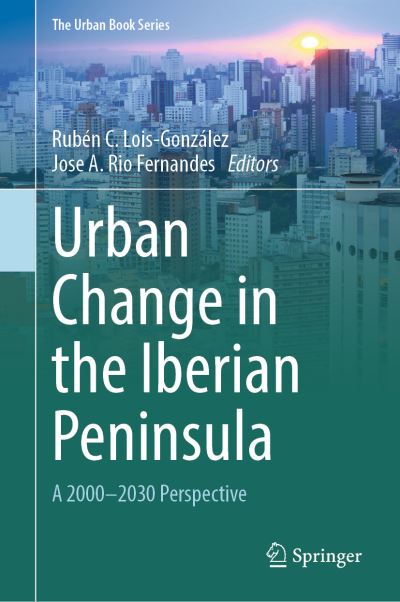
The book addresses the situation of the urban world in Spain and Portugal in the first quarter of the 21st century. Cities and metropolitan areas have become the key to understanding the organization of the territory and the economic system in the Iberian Peninsula. Iberian cities drive financial-based business, and they constitute the main centers of commerce and tourism, since urban and economic organization are presented as two directly related variables. This reality is defined by the primacy of three main cities (Madrid, Barcelona, and Lisbon), followed by six metropolitan areas with around one or two million inhabitants (Porto, Bilbao, Zaragoza, Valencia, Seville, and Malaga). As in the large capitals, problems of income inequality and access to housing, mobility, and government also affect the remaining regional urban systems.
This book examines these urban areas through six major themes, which are developed in more than 25 chapters. The themes are urbanization, inequality, finance and housing markets, consumers and new residents, mobility, and governance. Contributions from leading geographers and urban planners from the most important universities of the Iberian Peninsula comprise this overview of metropolitan areas of Spain and Portugal.
Chapter "Territorial Governance and Soft Planning in the Region of Lisbon" is available open access under a Creative Commons Attribution 4.0 International License via Springerlink.
| ISBN: | 9783031596780 |
| Publication date: | 16th July 2024 |
| Author: | R C Lois González, José A Rio Fernandes |
| Publisher: | Springer an imprint of Springer Nature Switzerland |
| Format: | Hardback |
| Pagination: | 419 pages |
| Series: | The Urban Book Series |
| Genres: |
Regional geography Sustainability Regional, state and other local government Human geography |
The book addresses the situation of the urban world in Spain and Portugal in the first quarter of the 21st century. Cities and metropolitan areas have become the key to understanding the organization of the territory and the economic system in the Iberian Peninsula. Iberian cities drive financial-based business, and they constitute the main centers of commerce and tourism, since urban and economic organization are presented as two directly related variables. This reality is defined by the primacy of three main cities (Madrid, Barcelona, and Lisbon), followed by six metropolitan areas with around one or two million inhabitants (Porto, Bilbao, Zaragoza, Valencia, Seville, and Malaga). As in the large capitals, problems of income inequality and access to housing, mobility, and government also affect the remaining regional urban systems.
This book examines these urban areas through six major themes, which are developed in more than 25 chapters. The themes are urbanization, inequality, finance and housing markets, consumers and new residents, mobility, and governance. Contributions from leading geographers and urban planners from the most important universities of the Iberian Peninsula comprise this overview of metropolitan areas of Spain and Portugal.
Chapter "Territorial Governance and Soft Planning in the Region of Lisbon" is available open access under a Creative Commons Attribution 4.0 International License via Springerlink.
Urban Change in the Iberian Peninsula features in the following genres: Regional geography, Sustainability, Regional, state and other local government, Human geography
Urban Change in the Iberian Peninsula is available in Hardback
Urban Change in the Iberian Peninsula was written by R C Lois González, José A Rio Fernandes and published by Springer an imprint of Springer Nature Switzerland
Urban Change in the Iberian Peninsula has 419 pages
Yes it is part of The Urban Book Series series
£134.99