

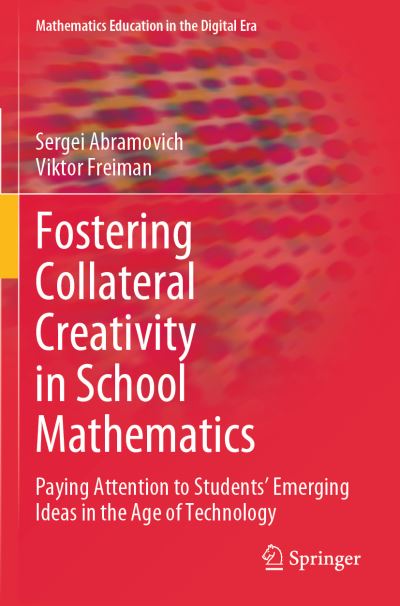
This book explores the topic of using technology, both physical and digital, to motivate creative mathematical thinking among students who are not considered 'mathematically advanced.' The book reflects the authors' experience of teaching mathematics to Canadian and American teacher candidates and supervising several field-based activities by the candidates. It consists of eight chapters and an Appendix which includes details of constructing computational learning environments.
Specifically, the book demonstrates how the appropriate use of technology in the teaching of mathematics can create conditions for the emergence of what may be called 'collateral creativity,' a notion similar to Dewey's notion of collateral learning. Just as collateral learning does not result from the immediate goal of the traditional curriculum, collateral creativity does not result from the immediate goal of traditional problem solving. Rather, mathematical creativity emerges as a collateral outcomeof thinking afforded by the use of technology. Furthermore, collateral creativity is an educative outcome of one's learning experience with pedagogy that motivates students to ask questions about computer-generated or tactile-derived information and assists them in finding answers to their own or the teacher's questions. This book intends to provide guidance to teachers for fostering collateral creativity in their classrooms.
| ISBN: | 9783031406416 |
| Publication date: | 5th October 2024 |
| Author: | Sergei Abramovich, Viktor Freiman |
| Publisher: | Springer an imprint of Springer International Publishing |
| Format: | Paperback |
| Pagination: | 130 pages |
| Series: | Mathematics Education in the Digital Era |
| Genres: |
Teaching of a specific subject Educational equipment and technology, computer-aided learning (CAL) Mathematics The Arts |
This book explores the topic of using technology, both physical and digital, to motivate creative mathematical thinking among students who are not considered 'mathematically advanced.' The book reflects the authors' experience of teaching mathematics to Canadian and American teacher candidates and supervising several field-based activities by the candidates. It consists of eight chapters and an Appendix which includes details of constructing computational learning environments.
Specifically, the book demonstrates how the appropriate use of technology in the teaching of mathematics can create conditions for the emergence of what may be called 'collateral creativity,' a notion similar to Dewey's notion of collateral learning. Just as collateral learning does not result from the immediate goal of the traditional curriculum, collateral creativity does not result from the immediate goal of traditional problem solving. Rather, mathematical creativity emerges as a collateral outcomeof thinking afforded by the use of technology. Furthermore, collateral creativity is an educative outcome of one's learning experience with pedagogy that motivates students to ask questions about computer-generated or tactile-derived information and assists them in finding answers to their own or the teacher's questions. This book intends to provide guidance to teachers for fostering collateral creativity in their classrooms.
Fostering Collateral Creativity in School Mathematics features in the following genres: Teaching of a specific subject, Educational equipment and technology, computer-aided learning (CAL), Mathematics, The Arts
Fostering Collateral Creativity in School Mathematics is available in Paperback, Hardback
Fostering Collateral Creativity in School Mathematics was written by Sergei Abramovich, Viktor Freiman and published by Springer an imprint of Springer International Publishing
Fostering Collateral Creativity in School Mathematics has 130 pages
Yes it is part of Mathematics Education in the Digital Era series
£116.99