

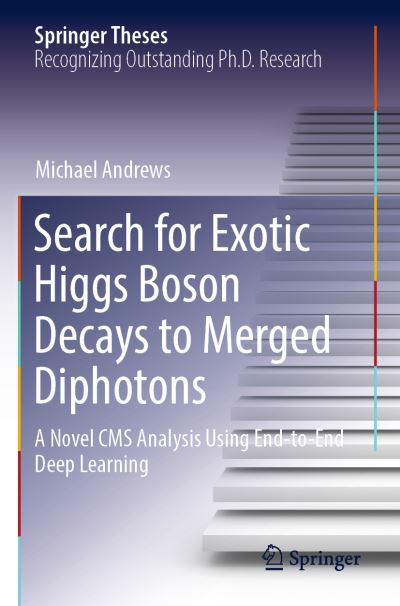
This book describes the first application at CMS of deep learning algorithms trained directly on low-level, "raw" detector data, or so-called end-to-end physics reconstruction. Growing interest in searches for exotic new physics in the CMS collaboration at the Large Hadron Collider at CERN has highlighted the need for a new generation of particle reconstruction algorithms. For many exotic physics searches, sensitivity is constrained not by the ability to extract information from particle-level data but by inefficiencies in the reconstruction of the particle-level quantities themselves. The technique achieves a breakthrough in the reconstruction of highly merged photon pairs that are completely unresolved in the CMS detector. This newfound ability is used to perform the first direct search for exotic Higgs boson decays to a pair of hypothetical light scalar particles H?aa, each subsequently decaying to a pair of highly merged photons a?yy, an analysis once thought impossible to perform. The book concludes with an outlook on potential new exotic searches made accessible by this new reconstruction paradigm.
| ISBN: | 9783031250934 |
| Publication date: | 3rd March 2024 |
| Author: | Michael Andrews |
| Publisher: | Springer an imprint of Springer Nature Switzerland |
| Format: | Paperback |
| Pagination: | 188 pages |
| Series: | Springer Theses |
| Genres: |
Particle and high-energy physics Artificial intelligence |
This book describes the first application at CMS of deep learning algorithms trained directly on low-level, "raw" detector data, or so-called end-to-end physics reconstruction. Growing interest in searches for exotic new physics in the CMS collaboration at the Large Hadron Collider at CERN has highlighted the need for a new generation of particle reconstruction algorithms. For many exotic physics searches, sensitivity is constrained not by the ability to extract information from particle-level data but by inefficiencies in the reconstruction of the particle-level quantities themselves. The technique achieves a breakthrough in the reconstruction of highly merged photon pairs that are completely unresolved in the CMS detector. This newfound ability is used to perform the first direct search for exotic Higgs boson decays to a pair of hypothetical light scalar particles H?aa, each subsequently decaying to a pair of highly merged photons a?yy, an analysis once thought impossible to perform. The book concludes with an outlook on potential new exotic searches made accessible by this new reconstruction paradigm.
Search for Exotic Higgs Boson Decays to Merged Diphotons features in the following genres: Particle and high-energy physics, Artificial intelligence
Search for Exotic Higgs Boson Decays to Merged Diphotons is available in Paperback, Hardback
Search for Exotic Higgs Boson Decays to Merged Diphotons was written by Michael Andrews and published by Springer an imprint of Springer Nature Switzerland
Search for Exotic Higgs Boson Decays to Merged Diphotons has 188 pages
Yes it is part of Springer Theses series
£125.99