

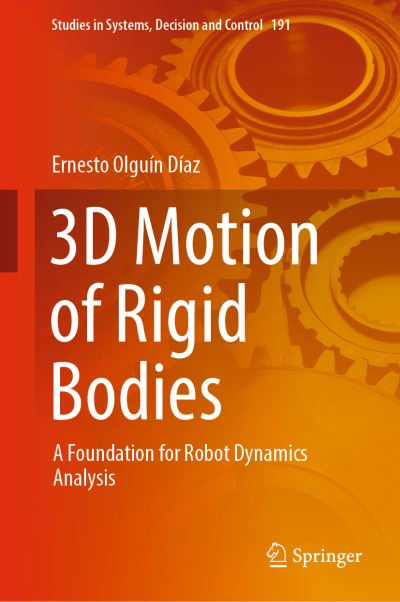
This book offers an excellent complementary text for an advanced course on the modelling and dynamic analysis of multi-body mechanical systems, and provides readers an in-depth understanding of the modelling and control of robots.
While the Lagrangian formulation is well suited to multi-body systems, its physical meaning becomes paradoxically complicated for single rigid bodies. Yet the most advanced numerical methods rely on the physics of these single rigid bodies, whose dynamic is then given among multiple formulations by the set of the Newton-Euler equations in any of their multiple expression forms. This book presents a range of simple tools to express in succinct form the dynamic equation for the motion of a single rigid body, either free motion (6-dimension), such as that of any free space navigation robot or constrained motion (less than 6-dimension), such as that of ground or surface vehicles. In the process, the book also explains the equivalences of (anddifferences between) the different formulations.| ISBN: | 9783030042745 |
| Publication date: | 23rd January 2019 |
| Author: | Ernesto Olguín Díaz |
| Publisher: | Springer an imprint of Springer International Publishing |
| Format: | Hardback |
| Pagination: | 474 pages |
| Series: | Studies in Systems, Decision and Control |
| Genres: |
Artificial intelligence Engineering: Mechanics of solids Automatic control engineering |
This book offers an excellent complementary text for an advanced course on the modelling and dynamic analysis of multi-body mechanical systems, and provides readers an in-depth understanding of the modelling and control of robots.
While the Lagrangian formulation is well suited to multi-body systems, its physical meaning becomes paradoxically complicated for single rigid bodies. Yet the most advanced numerical methods rely on the physics of these single rigid bodies, whose dynamic is then given among multiple formulations by the set of the Newton-Euler equations in any of their multiple expression forms. This book presents a range of simple tools to express in succinct form the dynamic equation for the motion of a single rigid body, either free motion (6-dimension), such as that of any free space navigation robot or constrained motion (less than 6-dimension), such as that of ground or surface vehicles. In the process, the book also explains the equivalences of (anddifferences between) the different formulations.3D Motion of Rigid Bodies features in the following genres: Artificial intelligence, Engineering: Mechanics of solids, Automatic control engineering
3D Motion of Rigid Bodies is available in Hardback
3D Motion of Rigid Bodies was written by Ernesto Olguín Díaz and published by Springer an imprint of Springer International Publishing
3D Motion of Rigid Bodies has 474 pages
Yes it is part of Studies in Systems, Decision and Control series