

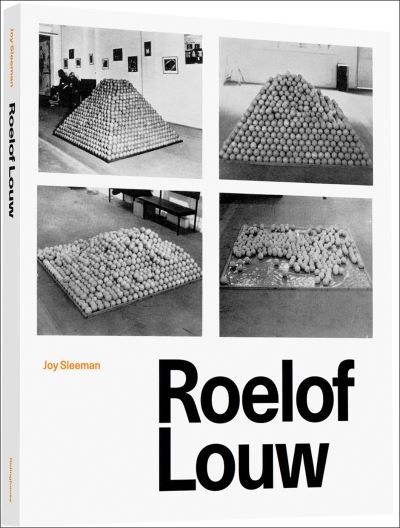
Roelof Louw (1936-2017) created sculpture from wooden slats, cast-iron wedges, sand-blasted and painted scaffolding poles, rope and neon. He made installations using industrial rubber bands, rolled-up lead sheets, or using tape recorders and the movements of viewers around a space. His work addresses itself to our bodies and minds, implicating them in its realisation and its sites, which might be streets, parks, woods or galleries.
In Soul City (Pyramid of Oranges) (1967), the work for which he is best known, the fit of an orange to a hand and the experience of eating the fruit are crucial aspects, as is the action of destroying the piece in the process. Prescient in anticipating the participatory and interactive art of the present, Louw's work remained resolutely defined as sculpture, at the artist's insistence. This was even so as sculpture became conceptual, 'dematerialised', or located in 'the expanded field', and while his art was itself a part of these shifts.
Born in South Africa, Louw moved to London in 1961. Practicing in London, New York and Cape Town, Louw participated in some of the most important episodes in sculpture history of the twentieth century. As well as being the first authoritative overview of Louw's oeuvre, this book presents a new perspective on a familiar and much written about era in art.
| ISBN: | 9781909932463 |
| Publication date: | 1st November 2018 |
| Author: | Joy Sleeman, Roelof Louw |
| Publisher: | Ridinghouse |
| Format: | Paperback |
| Pagination: | 191 pages |
| Series: | Ridinghouse |
| Genres: |
Individual artists, art monographs Sculpture |
Roelof Louw (1936-2017) created sculpture from wooden slats, cast-iron wedges, sand-blasted and painted scaffolding poles, rope and neon. He made installations using industrial rubber bands, rolled-up lead sheets, or using tape recorders and the movements of viewers around a space. His work addresses itself to our bodies and minds, implicating them in its realisation and its sites, which might be streets, parks, woods or galleries.
In Soul City (Pyramid of Oranges) (1967), the work for which he is best known, the fit of an orange to a hand and the experience of eating the fruit are crucial aspects, as is the action of destroying the piece in the process. Prescient in anticipating the participatory and interactive art of the present, Louw's work remained resolutely defined as sculpture, at the artist's insistence. This was even so as sculpture became conceptual, 'dematerialised', or located in 'the expanded field', and while his art was itself a part of these shifts.
Born in South Africa, Louw moved to London in 1961. Practicing in London, New York and Cape Town, Louw participated in some of the most important episodes in sculpture history of the twentieth century. As well as being the first authoritative overview of Louw's oeuvre, this book presents a new perspective on a familiar and much written about era in art.
Roelof Louw and British Sculpture Since the 1960S features in the following genres: Individual artists, art monographs, Sculpture
Roelof Louw and British Sculpture Since the 1960S is available in Paperback
Roelof Louw and British Sculpture Since the 1960S was written by Joy Sleeman, Roelof Louw and published by Ridinghouse
Roelof Louw and British Sculpture Since the 1960S has 191 pages
Yes it is part of Ridinghouse series
£18.00