

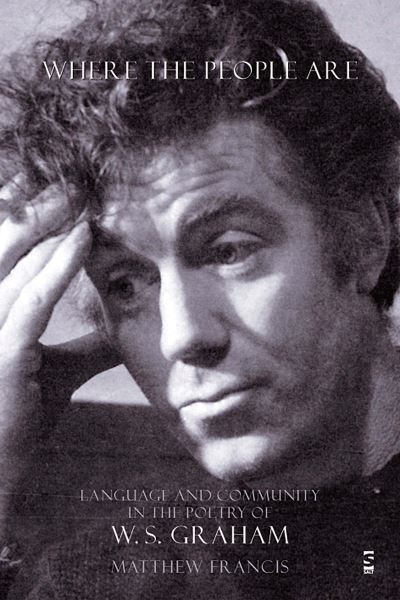
William Sydney Graham (1918-1986) is increasingly acknowledged as one of the most important British poets of the twentieth century. In playful but profound exercises in self-reflexivity, such as 'Implements in their Places' and 'What is the Language Using Us for?', he lays down a challenge to his readers which this book takes up. What exactly is he saying about language, and how are his concerns related to the apparently similar ones of postmodern theory? Matthew Francis offers a surprising answer: the theme of language in the poems is inextricable from that of community. Writing, for Graham, must always justify itself in terms of an idealized model of community based on his working-class Clydeside childhood. His work is haunted by guilt: in becoming a writer he felt he had betrayed his family and background. He attempts to assuage this by means of an ingenious metaphor that presents language itself as a community.
Francis traces the development of this metaphor from the experimentalism of the early poems through the complexities of Graham's most ambitious poem, 'The Nightfishing', to the subtlety and daring of the late work. Finally, he looks at some intriguing unpublished writings, and shows that their resistance to closure and dalliance with automatism are further attempts to solve this problem. Here as elsewhere, Graham's brilliant rhetoric and deep insight into language are products of a quest for a mythical linguistic community, 'where the people are'.
| ISBN: | 9781876857233 |
| Publication date: | 1st August 2004 |
| Author: | Matthew Francis |
| Publisher: | Salt an imprint of Salt Publishing Limited |
| Format: | Paperback |
| Pagination: | 201 pages |
| Genres: |
Literary studies: c 1900 to c 2000 |
William Sydney Graham (1918-1986) is increasingly acknowledged as one of the most important British poets of the twentieth century. In playful but profound exercises in self-reflexivity, such as 'Implements in their Places' and 'What is the Language Using Us for?', he lays down a challenge to his readers which this book takes up. What exactly is he saying about language, and how are his concerns related to the apparently similar ones of postmodern theory? Matthew Francis offers a surprising answer: the theme of language in the poems is inextricable from that of community. Writing, for Graham, must always justify itself in terms of an idealized model of community based on his working-class Clydeside childhood. His work is haunted by guilt: in becoming a writer he felt he had betrayed his family and background. He attempts to assuage this by means of an ingenious metaphor that presents language itself as a community.
Francis traces the development of this metaphor from the experimentalism of the early poems through the complexities of Graham's most ambitious poem, 'The Nightfishing', to the subtlety and daring of the late work. Finally, he looks at some intriguing unpublished writings, and shows that their resistance to closure and dalliance with automatism are further attempts to solve this problem. Here as elsewhere, Graham's brilliant rhetoric and deep insight into language are products of a quest for a mythical linguistic community, 'where the people are'.
Where the People Are features in the following genres: Literary studies: c 1900 to c 2000
Where the People Are is available in Paperback
Where the People Are was written by Matthew Francis and published by Salt an imprint of Salt Publishing Limited
Where the People Are has 201 pages
£22.49