

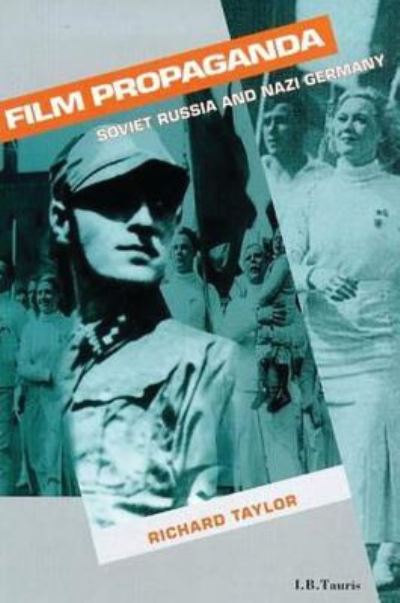
Lenin, Stalin, Trotsky, Hitler and Goebbels all regarded cinema as their most important weapon for mass political propaganda. This revised and expanded edition of "Film Propaganda" examines the ways in which cinema was used for political purposes by two of the most highly politicised societies in twentieth-century European history. "Film Propaganda" is still to date the only book in English to compare these two cinemas and examine both in depth. Richard Taylor demonstrates how cinema was brought under political control in each country and goes on to explore the themes and stereotypes projected by the feature films that were produced. In so doing, he highlights the means used by the authorities to condition and control the filmgoer as individual spectator and as member of a mass audience. This process is examined in greater depth in a series of detailed analyses of films selected for their particular political significance, including "October", "Alexander Nevsky", "Triumph of the Will", "The Wandering Jew" and, new to this edition, the 1949 Stalin cult film, "The Fall of Berlin".;Also new to this edition are appendices with details of films viewed by Hitler and Goebbels, which were captured by the Red Army from Berlin 's ruins in 1945 and were considered by Stalin for release during the film famine years after the war.
| ISBN: | 9781860641671 |
| Publication date: | 31st December 1998 |
| Author: | Richard Taylor |
| Publisher: | I. B. Tauris |
| Format: | Paperback |
| Pagination: | 266 pages |
| Series: | Kino : The Russian Cinema Series |
| Genres: |
Far-left political ideologies and movements Far-right political ideologies and movements Political control and freedoms |
Lenin, Stalin, Trotsky, Hitler and Goebbels all regarded cinema as their most important weapon for mass political propaganda. This revised and expanded edition of "Film Propaganda" examines the ways in which cinema was used for political purposes by two of the most highly politicised societies in twentieth-century European history. "Film Propaganda" is still to date the only book in English to compare these two cinemas and examine both in depth. Richard Taylor demonstrates how cinema was brought under political control in each country and goes on to explore the themes and stereotypes projected by the feature films that were produced. In so doing, he highlights the means used by the authorities to condition and control the filmgoer as individual spectator and as member of a mass audience. This process is examined in greater depth in a series of detailed analyses of films selected for their particular political significance, including "October", "Alexander Nevsky", "Triumph of the Will", "The Wandering Jew" and, new to this edition, the 1949 Stalin cult film, "The Fall of Berlin".;Also new to this edition are appendices with details of films viewed by Hitler and Goebbels, which were captured by the Red Army from Berlin 's ruins in 1945 and were considered by Stalin for release during the film famine years after the war.
Film Propaganda features in the following genres: Far-left political ideologies and movements, Far-right political ideologies and movements, Political control and freedoms
Film Propaganda is available in Paperback
Film Propaganda was written by Richard Taylor and published by I. B. Tauris
Film Propaganda has 266 pages
Yes it is part of Kino : The Russian Cinema Series series