

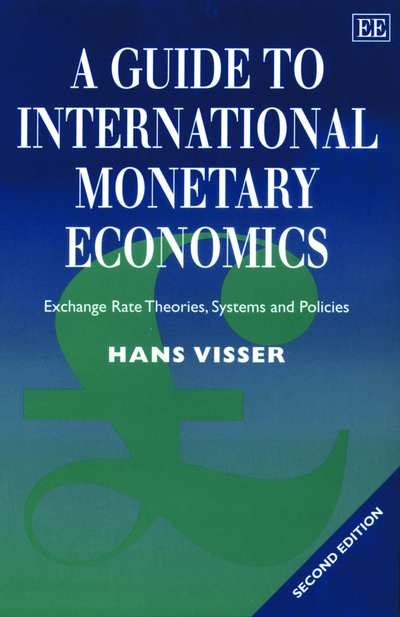
In this fully revised and updated second edition of a well-regarded and popular text, Hans Visser includes recent developments in the world economy such as the rise of currency boards and the changing role of the IMF in solving currency crises.
There is a bewildering array of models to explain the volatility of exchange rates since the collapse of the Bretton Woods system in the early 1970s. Hans Visser brings method to this 'model madness' by grouping the various theories according to the time period for which their explanation is relevant, and further subdividing them according to their assumptions as to price flexibility and international financial asset substitutability.
As well as showing how exchange rates are determined in different models and how these models relate to one another, the author discusses the obstacle's that may confront policymakers while running any particular system. Emphasis is placed on attempts to create exchange rate stability, running from payments restrictions to the radical solutions of adopting a currency board and the formation of a monetary union.
As in the first edition, the emphasis is on the economic reasoning behind the formula while introducing students to the mathematics which will enable them to pursue further reading. This book is aimed at advanced students of economics, finance and business as well as professional economists wishing to refresh their knowledge of exchange rate theories.
| ISBN: | 9781840646962 |
| Publication date: | 31st May 2001 |
| Author: | Hans Visser |
| Publisher: | Edward Elgar Publishing |
| Format: | Paperback |
| Pagination: | 240 pages |
| Genres: |
International economics Monetary economics |
In this fully revised and updated second edition of a well-regarded and popular text, Hans Visser includes recent developments in the world economy such as the rise of currency boards and the changing role of the IMF in solving currency crises.
There is a bewildering array of models to explain the volatility of exchange rates since the collapse of the Bretton Woods system in the early 1970s. Hans Visser brings method to this 'model madness' by grouping the various theories according to the time period for which their explanation is relevant, and further subdividing them according to their assumptions as to price flexibility and international financial asset substitutability.
As well as showing how exchange rates are determined in different models and how these models relate to one another, the author discusses the obstacle's that may confront policymakers while running any particular system. Emphasis is placed on attempts to create exchange rate stability, running from payments restrictions to the radical solutions of adopting a currency board and the formation of a monetary union.
As in the first edition, the emphasis is on the economic reasoning behind the formula while introducing students to the mathematics which will enable them to pursue further reading. This book is aimed at advanced students of economics, finance and business as well as professional economists wishing to refresh their knowledge of exchange rate theories.
A Guide to International Monetary Economics features in the following genres: International economics, Monetary economics
A Guide to International Monetary Economics is available in Paperback
A Guide to International Monetary Economics was written by Hans Visser and published by Edward Elgar Publishing
A Guide to International Monetary Economics has 240 pages