

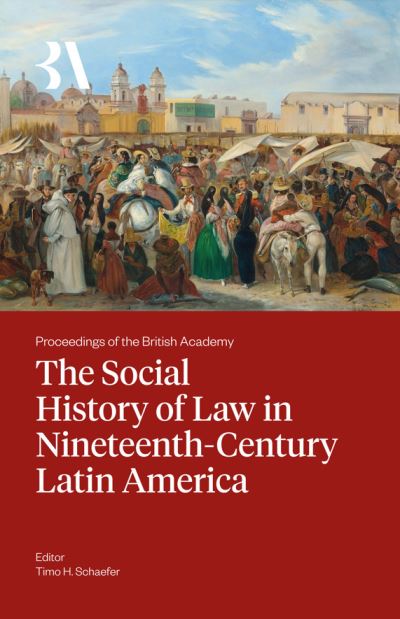
The Social History of Law in Nineteenth-Century Latin America examines how ordinary people responded to the transformation of Latin America's systems of justice following the end of the colonial period. In the decades following Latin American independence the region embarked on a veritable legal revolution. In this period, Latin American lawmakers eliminated the differences between social groups that had defined the colonial legal order. They abolished slavery. They designed procedural rules to guarantee the equal treatment of all litigants and dramatically improved the accessibility of the law, building courts and appointing justices of the peace in areas whose residents had previously had little contact with formal judicial institutions. Scholars have done much to illuminate the intellectual history of that legal revolution. But they have neglected to study the impact of legal change on society in nineteenth-century Latin America, treating republican law largely as touching the lives of popular sectors only as a disruptive, punitive imposition. This volume, by contrast, explores how ordinary people engaged with and used republican law. Its contributors consider how Latin America's post-colonial legal revolution remade not only the paper-worlds of men of letters but the world of ideas, interests, and ambitions of the region's non-elite majorities.
| ISBN: | 9781805966104 |
| Publication date: | 28th July 2026 |
| Author: | Timo H Schaefer |
| Publisher: | The British Academy an imprint of Liverpool University Press |
| Format: | Hardback |
| Pagination: | 267 pages |
| Series: | Proceedings of the British Academy |
| Genres: |
History of the Americas |
The Social History of Law in Nineteenth-Century Latin America examines how ordinary people responded to the transformation of Latin America's systems of justice following the end of the colonial period. In the decades following Latin American independence the region embarked on a veritable legal revolution. In this period, Latin American lawmakers eliminated the differences between social groups that had defined the colonial legal order. They abolished slavery. They designed procedural rules to guarantee the equal treatment of all litigants and dramatically improved the accessibility of the law, building courts and appointing justices of the peace in areas whose residents had previously had little contact with formal judicial institutions. Scholars have done much to illuminate the intellectual history of that legal revolution. But they have neglected to study the impact of legal change on society in nineteenth-century Latin America, treating republican law largely as touching the lives of popular sectors only as a disruptive, punitive imposition. This volume, by contrast, explores how ordinary people engaged with and used republican law. Its contributors consider how Latin America's post-colonial legal revolution remade not only the paper-worlds of men of letters but the world of ideas, interests, and ambitions of the region's non-elite majorities.
The Social History of Law in Nineteenth-Century Latin America features in the following genres: History of the Americas
The Social History of Law in Nineteenth-Century Latin America is available in Hardback
The Social History of Law in Nineteenth-Century Latin America was written by Timo H Schaefer and published by The British Academy an imprint of Liverpool University Press
The Social History of Law in Nineteenth-Century Latin America has 267 pages
Yes it is part of Proceedings of the British Academy series
£90.00