

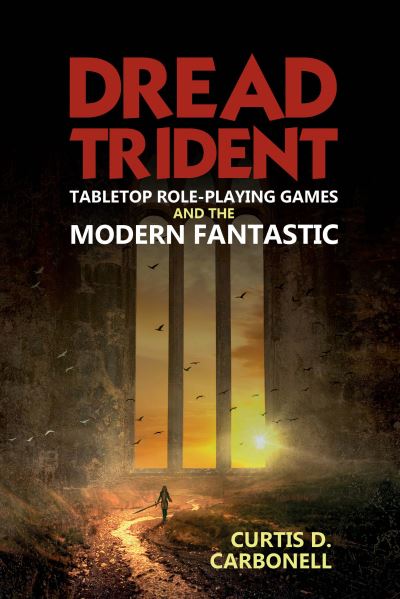
Dread Trident examines the rise of imaginary worlds in tabletop role-playing games (TRPGs), such as Dungeons and Dragons. With the combination of analog and digital mechanisms, from traditional books to the internet, new ways of engaging the fantastic have become increasingly realized in recent years, and this book seeks an understanding of this phenomenon within the discourses of trans- and posthumanism, as well as within a gameist mode.
The book explores a number of case studies of foundational TRPGs. Dungeons and Dragons provides an illustration of pulp-driven fantasy, particularly in the way it harmonizes its many campaign settings into a functional multiverse. It also acts as a supreme example of depth within its archive of official and unofficial published material, stretching back four decades. Warhammer 40k and the Worlds of Darkness present an interesting dialogue between Gothic and science-fantasy elements. The Mythos of HP Lovecraft also features prominently in the book as an example of a realized world that spans the literary and gameist modes.
Realized fantasy worlds are becoming ever more popular as a way of experiencing a touch of the magical within modern life. Reworking Northrop Frye's definition of irony, Dread Trident theorizes an ironic understanding of this process and in particular of its embodied forms.
| ISBN: | 9781802077056 |
| Publication date: | 1st September 2022 |
| Author: | Curtis D Carbonell |
| Publisher: | Liverpool University Press |
| Format: | Paperback |
| Pagination: | 256 pages |
| Series: | Liverpool Science Fiction Texts and Studies |
| Genres: |
Role-playing, war games and fantasy sports Literary studies: from c 2000 |
Dread Trident examines the rise of imaginary worlds in tabletop role-playing games (TRPGs), such as Dungeons and Dragons. With the combination of analog and digital mechanisms, from traditional books to the internet, new ways of engaging the fantastic have become increasingly realized in recent years, and this book seeks an understanding of this phenomenon within the discourses of trans- and posthumanism, as well as within a gameist mode.
Dread Trident features in the following genres: Role-playing, war games and fantasy sports, Literary studies: from c 2000
Paperback, Hardback. Not Available.
Dread Trident was written by Curtis D Carbonell and published by Liverpool University Press
Dread Trident has 256 pages
Yes it is part of Liverpool Science Fiction Texts and Studies series