

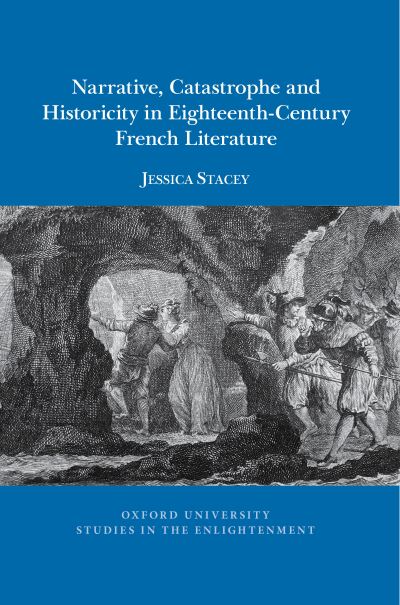
How do communities tell and retell stories of catastrophe to explain their own origins, imagine their future, and work for their survival? This book contends that such stories are central to how communities claim a position within history. It explores this question, so vital for our present moment, through narratives produced in eighteenth-century France: a tumultuous period when a new understanding of a properly 'modern' national history was being elaborated. Who gets to belong to the modern era? And who or what is relegated to a gothic, barbarous or medieval past? Is an enlightened future assured, or is a return to a Dark Age inevitable? Following barbarians, bastards, usurpers, prophets and Revolutionary martyrs through stories of catastrophes real and imagined, the book traces how narrative temporalities become historicities: visions of the laws which govern the past, present and future. Ultimately it argues that the complex temporality of catastrophe offers a privileged insight into how a modern French historical consciousness was formed out of the multiple pasts and possible futures that coexisted alongside the age of Enlightenment. Further, examining the tension between a desire to place the imagined community definitively beyond catastrophic times, and a fascination with catastrophe in its revelatory or regenerative aspect, it offers an important historical perspective on the presence of this same tension in the stories of catastrophe that we tell in our own multiple, tumultuous present.
| ISBN: | 9781800856004 |
| Publication date: | 14th February 2022 |
| Author: | Jessica Stacey, Voltaire Foundation |
| Publisher: | Voltaire Foundation an imprint of Liverpool University Press |
| Format: | Paperback |
| Pagination: | 384 pages |
| Series: | Oxford University Studies in the Enlightenment |
| Genres: |
European history |
How do communities tell and retell stories of catastrophe to explain their own origins, imagine their future, and work for their survival? This book contends that such stories are central to how communities claim a position within history. It explores this question, so vital for our present moment, through narratives produced in eighteenth-century France: a tumultuous period when a new understanding of a properly 'modern' national history was being elaborated. Who gets to belong to the modern era? And who or what is relegated to a gothic, barbarous or medieval past? Is an enlightened future assured, or is a return to a Dark Age inevitable? Following barbarians, bastards, usurpers, prophets and Revolutionary martyrs through stories of catastrophes real and imagined, the book traces how narrative temporalities become historicities: visions of the laws which govern the past, present and future. Ultimately it argues that the complex temporality of catastrophe offers a privileged insight into how a modern French historical consciousness was formed out of the multiple pasts and possible futures that coexisted alongside the age of Enlightenment. Further, examining the tension between a desire to place the imagined community definitively beyond catastrophic times, and a fascination with catastrophe in its revelatory or regenerative aspect, it offers an important historical perspective on the presence of this same tension in the stories of catastrophe that we tell in our own multiple, tumultuous present.
Narrative, Catastrophe and Historicity in Eighteenth-Century French Literature features in the following genres: European history
Narrative, Catastrophe and Historicity in Eighteenth-Century French Literature is available in Paperback
Narrative, Catastrophe and Historicity in Eighteenth-Century French Literature was written by Jessica Stacey, Voltaire Foundation and published by Voltaire Foundation an imprint of Liverpool University Press
Narrative, Catastrophe and Historicity in Eighteenth-Century French Literature has 384 pages
Yes it is part of Oxford University Studies in the Enlightenment series