

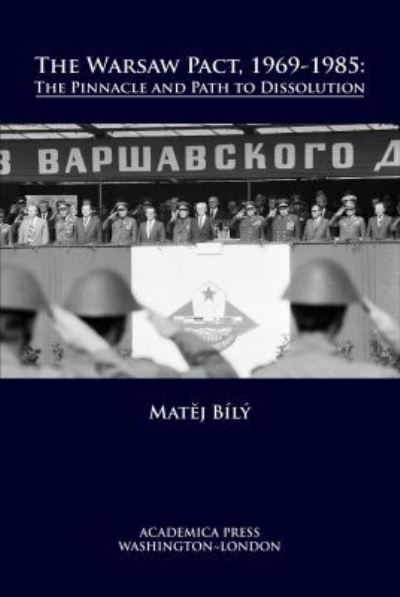
In The Warsaw Pact, 1969-1985, young Czech scholar Mat?j Bìlý analyzes the internal tensions of the Soviet-led Cold War alliance as its careened toward its end. Starting with the peak of the alliance's power under Soviet leader Leonid Brezhnev, the book follows its ossification to its increasing haplessness under Brezhnev's successors Yuri Andropov and Konstantin Chernenko. Rooted in detailed research in Czech, Polish, and German archives, this book presents much previously unknown information about the alliance's mechanisms as it served as one of the Kremlin's increasingly ineffective tools for managing the Eastern Bloc.
Bìlý's findings prove that the Warsaw Pact never became an initiator of political processes within the Soviet sphere of interest and only reactively addressed military issues. The alliance's framework did not allow it to become an incubator or agent of any independent development in the Soviet sphere of influence. To the contrary, events within the Warsaw Pact reflected the overall dismal situation in the Eastern Bloc and the changing policy of the Kremlin toward its East European satellites. Because of the alliance's lack of flexibility and cumbersome internal mechanisms, it was unable to react to the dynamic challenges of the 1980s and helplessly followed a path to its own end.
| ISBN: | 9781680531947 |
| Publication date: | 30th May 2020 |
| Author: | Matej BílÔy |
| Publisher: | Academica Press |
| Format: | Hardback |
| Pagination: | 594 pages |
| Series: | St. James's Studies in World Affairs |
| Genres: |
International relations Cold wars and proxy conflicts European history |
In The Warsaw Pact, 1969-1985, young Czech scholar Mat?j Bìlý analyzes the internal tensions of the Soviet-led Cold War alliance as its careened toward its end. Starting with the peak of the alliance's power under Soviet leader Leonid Brezhnev, the book follows its ossification to its increasing haplessness under Brezhnev's successors Yuri Andropov and Konstantin Chernenko. Rooted in detailed research in Czech, Polish, and German archives, this book presents much previously unknown information about the alliance's mechanisms as it served as one of the Kremlin's increasingly ineffective tools for managing the Eastern Bloc.
Bìlý's findings prove that the Warsaw Pact never became an initiator of political processes within the Soviet sphere of interest and only reactively addressed military issues. The alliance's framework did not allow it to become an incubator or agent of any independent development in the Soviet sphere of influence. To the contrary, events within the Warsaw Pact reflected the overall dismal situation in the Eastern Bloc and the changing policy of the Kremlin toward its East European satellites. Because of the alliance's lack of flexibility and cumbersome internal mechanisms, it was unable to react to the dynamic challenges of the 1980s and helplessly followed a path to its own end.
The Warsaw Pact, 1969-1985 features in the following genres: International relations, Cold wars and proxy conflicts, European history
The Warsaw Pact, 1969-1985 is available in Hardback, Paperback
The Warsaw Pact, 1969-1985 was written by Matej BílÔy and published by Academica Press
The Warsaw Pact, 1969-1985 has 594 pages
Yes it is part of St. James's Studies in World Affairs series