

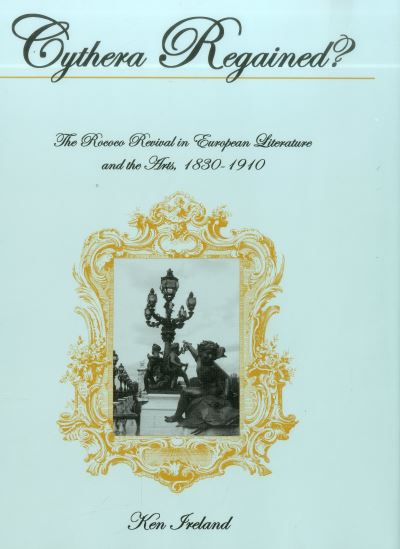
This is the first comprehensive study of the Rococo Revival in nineteenth-century European literature and the arts. Much has been written and published about the Gothic and Classical, Renaissance and Baroque revival styles, but little more than specialist articles or monographs have dealt with the revival of eighteenth-century Rococo. One reason for its relative critical neglect may be the fact that it is not concentrated in a single country or a single art, in a single period or a single creative artist, but rather dispersed across different arts and cultures, fluctuating in intensity and importance at different times between 1830 and 1910. The book examines developments in France and Germany, Austria and England, as well as contributions from American and Russia. Its two halves comprise, firstly, a thematic account of literary examples of the Rococo Revival organized into perceptual modes: theatrical, oriental, pastoral, and musical. the second half is chronological, tracing shifts in cultural ambience between 1830 and 1910 in manageable stages of twenty years each, dealing with different types of phenomena: critical perspectives, the decorative arts, painting, music, and literature. Initiating each of the perceptual modes, the French painter Jean-Antoine Watteau (1684-1721) projects an underlying gravity, a sense of transience and duality, and it is these features that mark him off from later Rococo artists, and affect the nineteenth-century's response to Rococo. As one of several historicist styles in an eclectic century, the Rococo Revival alternates between the poles of Aestheticism and Decadence. While its most characteristic mode is that of pastoral, the style manifests itself less in any large-scale architectural achievements, than in the decorative and so-called "minor" arts. Its critical image correspondingly shifts, as it is refracted in turn by Romanticism and Realism, Symbolism and Art Nouveau. The rise of Mozart, too, as aesthetic and musical icon, both influences the Rococo Revival, and is
| ISBN: | 9781611473155 |
| Publication date: | 1st March 2006 |
| Author: | Ken Ireland |
| Publisher: | Fairleigh Dickinson University Press an imprint of University Press Copublishing Division |
| Format: | Hardback |
| Pagination: | 240 pages |
| Genres: |
Literary reference works |
This is the first comprehensive study of the Rococo Revival in nineteenth-century European literature and the arts. Much has been written and published about the Gothic and Classical, Renaissance and Baroque revival styles, but little more than specialist articles or monographs have dealt with the revival of eighteenth-century Rococo. One reason for its relative critical neglect may be the fact that it is not concentrated in a single country or a single art, in a single period or a single creative artist, but rather dispersed across different arts and cultures, fluctuating in intensity and importance at different times between 1830 and 1910. The book examines developments in France and Germany, Austria and England, as well as contributions from American and Russia. Its two halves comprise, firstly, a thematic account of literary examples of the Rococo Revival organized into perceptual modes: theatrical, oriental, pastoral, and musical. the second half is chronological, tracing shifts in cultural ambience between 1830 and 1910 in manageable stages of twenty years each, dealing with different types of phenomena: critical perspectives, the decorative arts, painting, music, and literature. Initiating each of the perceptual modes, the French painter Jean-Antoine Watteau (1684-1721) projects an underlying gravity, a sense of transience and duality, and it is these features that mark him off from later Rococo artists, and affect the nineteenth-century's response to Rococo. As one of several historicist styles in an eclectic century, the Rococo Revival alternates between the poles of Aestheticism and Decadence. While its most characteristic mode is that of pastoral, the style manifests itself less in any large-scale architectural achievements, than in the decorative and so-called "minor" arts. Its critical image correspondingly shifts, as it is refracted in turn by Romanticism and Realism, Symbolism and Art Nouveau. The rise of Mozart, too, as aesthetic and musical icon, both influences the Rococo Revival, and is
Cythera Regained? features in the following genres: Literary reference works
Cythera Regained? is available in Hardback
Cythera Regained? was written by Ken Ireland and published by Fairleigh Dickinson University Press an imprint of University Press Copublishing Division
Cythera Regained? has 240 pages