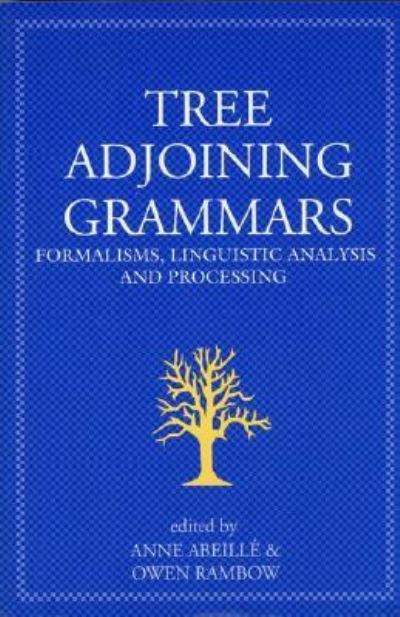
Past research conducted on natural language syntax has occasionally employed the well-known mathematical formalism Context-Free Grammar, defined by Noam Chomsky in 1957. But recent studies have indicated that this approach may not always be ideal in analyzing all types of natural languages. Researchers in theoretical linguistics, psycholinguistics, cognitive science, and in natural language processing have recently converged on a collective insight: formalizing the syntax of words is central to describing, understanding, and analyzing language. This insight has sparked considerable interest in Tree Adjoining Grammar (TAG). Unlike traditional approaches for analyzing natural language syntax, TAG is a lexically-oriented mathematical formalism that can precisely capture the syntactic properties of natural languages such as English, French, and Korean. Tree Adjoining Grammars is the first ever collection of works that discusses the use of the TAG framework in natural language research. The volume begins with an introductory chapter that provides an overview of TAG and key research projects that have utilized the TAG framework in the past. Contributors discuss the formalism itself, its use in analyzing linguistic phenomena, and its use in building natural language processing systems. A glossary and extensive bibliography is included, allowing the volume to be accessible to a broad audience. The selection of works in this volume were presented at the Third International Workshop in Tree Adjoining Grammars and Related Formalisms held in Paris in 1994.
Buy from our bookstore and 25% of the cover price will be given to a school of your choice to buy more books. *15% of eBooks.
Frequently asked questions
Past research conducted on natural language syntax has occasionally employed the well-known mathematical formalism Context-Free Grammar, defined by Noam Chomsky in 1957. But recent studies have indicated that this approach may not always be ideal in analyzing all types of natural languages. Researchers in theoretical linguistics, psycholinguistics, cognitive science, and in natural language processing have recently converged on a collective insight: formalizing the syntax of words is central to describing, understanding, and analyzing language. This insight has sparked considerable interest in Tree Adjoining Grammar (TAG). Unlike traditional approaches for analyzing natural language syntax, TAG is a lexically-oriented mathematical formalism that can precisely capture the syntactic properties of natural languages such as English, French, and Korean. Tree Adjoining Grammars is the first ever collection of works that discusses the use of the TAG framework in natural language research. The volume begins with an introductory chapter that provides an overview of TAG and key research projects that have utilized the TAG framework in the past. Contributors discuss the formalism itself, its use in analyzing linguistic phenomena, and its use in building natural language processing systems. A glossary and extensive bibliography is included, allowing the volume to be accessible to a broad audience. The selection of works in this volume were presented at the Third International Workshop in Tree Adjoining Grammars and Related Formalisms held in Paris in 1994.
Tree Adjoining Grammars features in the following genres: Grammar, syntax and morphology
Tree Adjoining Grammars is available in Paperback
Tree Adjoining Grammars was written by Anne Abeillé, Owen Rambow, International Workshop in Tree Adjoining Grammars and Related Formalisms and published by CSLI Publications an imprint of Center for the Study of Language and Inf
Join our community for the latest bookish news, reading recommendations, exclusive opening extracts, author events and competitions. It\'s all free. And enter a monthly draw to win a £50 Gift Card. See past winners here